
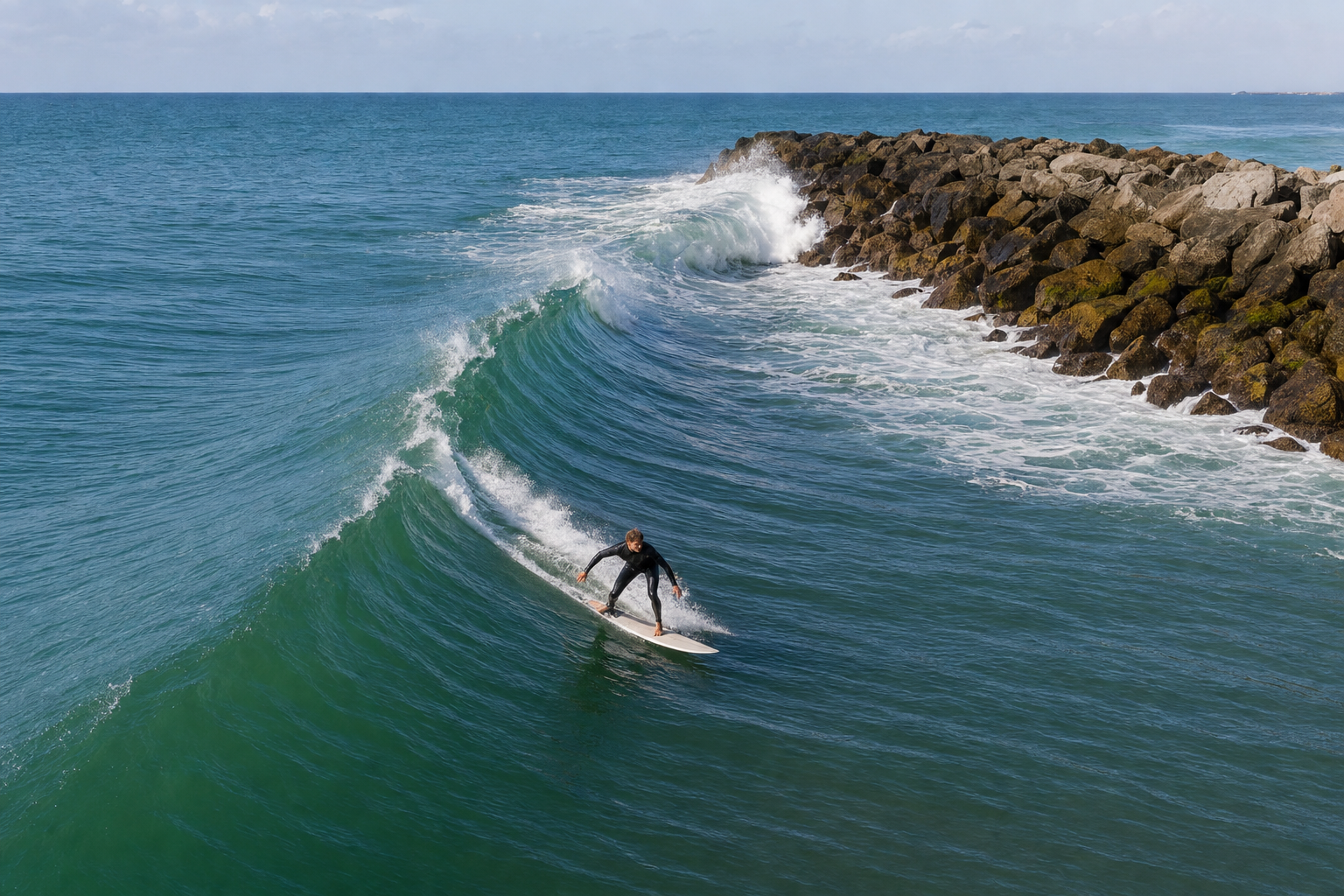
Wedge waves are some of the most exciting waves in surfing. Instead of arriving as a simple line of swell, a wedge forms when energy is focused into a compact, steep, fast-moving peak — shaped by reflection, refraction, sandbars, jetties, or intersecting swell lines. The result can be a perfect A-frame, a heavy hollow barrel, or a ramp for turns and airs that looks far bigger than the surrounding surf. If you’re heading into heavier conditions, a quality surfboard leash is worth having on before you even enter the water. Understanding how wedge waves form helps surfers choose better spots, read shifting peaks, and decide which waves are makeable before committing.
Unlike most breaking waves, a wedge doesn’t spread energy evenly along a breaking line — it redirects existing swell energy into a tighter zone. That concentration is why a wedge can look one or two size categories larger than the rest of the beach, even when it comes from the same swell. For surfers who want to go deeper into wave mechanics and technique, a resource like a surf technique book can be a useful complement to time in the water. The key idea behind every wedge wave is constructive interference: when two crests meet at the right moment, their heights combine and the wave jacks up sharply.
What Creates Wedge Waves?
Reflected waves from jetties, cliffs, and seawalls
The classic wedge is made by a wave reflecting off a hard structure. A swell line hits a jetty, cliff, groyne, or seawall, then bounces back into the incoming swell. When the reflected line crosses the next incoming line, the two wave faces meet and form a triangular peak.
This is the mechanism behind many famous jetty wedges. The angle matters enormously: if the swell comes in too straight, there may be little reflected peak. If it comes in too sideways, the wave may run along the structure without forming a surfable face. Sand movement around these structures also plays a role, since the wave still needs a suitable bottom where the peak can break.
Refraction over reefs, sandbars, and underwater canyons
Refraction happens when parts of a swell slow down as they enter shallower water. Because shallow sections slow first, the wave bends around reefs, sandbars, and canyon edges. When bent wave lines converge, the swell focuses into a peak.
This is why some beachbreaks produce wedging A-frames over certain sandbars, and why canyon-influenced spots can be significantly larger than nearby beaches. A good wedge often sits near the edge of a channel, reef corner, or bank where the wave bends and steepens quickly.
Intersecting swells and crossed-up peaks
Sometimes wedge waves come from two swell trains arriving from different directions. If a south swell and a west swell meet at a beachbreak, their peaks can cross and form A-frames. When the timing is clean, the result is a peaky, bowled-up wave. When the timing is off, it becomes lumpy and difficult to read.
Wedge Wave Shape, Power, Speed, and Hollowness
Wedge waves are known for their dramatic shape. Instead of a long, even wall, they often rise abruptly into a peak with a steep takeoff and a compact pocket. Some break both ways as A-frames, while others throw most of their energy in one direction.
The shape of a wedge wave
A typical wedge has a triangular or peaked appearance. One line of swell may approach from outside while another line runs across it from the side. Where they meet, the water stacks up and the wave often appears to jump out of the ocean.
Depending on the setup, a wedge wave may form as:
- An A-frame: a peak that breaks left and right from the same takeoff zone.
- A side-wedge: a wave that throws strongly in one direction because side energy pushes into the main peak.
- A slabby wedge: a thick, abrupt wave that breaks over a shallow reef or ledge.
- A shorebreak wedge: a steep peak that unloads close to the sand.
Power and height amplification
Wedge waves can be far more powerful than raw swell height alone suggests. Because energy is focused into a small takeoff area, the lip can be thicker and the face can stand taller than nearby waves. A head-high swell at a normal beach might produce overhead wedges if the angle, tide, and bottom align correctly.
The most powerful wedges usually combine three things: strong incoming swell, a focusing feature, and an abrupt depth change. That depth change forces the wave to shoal quickly, making the face steeper and the lip heavier.
Speed, steepness, and hollowness
Wedge waves are typically fast because the peak breaks from a concentrated bowl. The surfer usually has to generate speed immediately rather than ease into a long wall. Many wedges also break diagonally, so the best line isn’t always straight down the face.
Hollowness depends on the bottom. A gentle sandbar may create a playful wedge with a soft shoulder, while a shallow reef ledge can produce a square barrel with very little margin for error. A steep beachbreak can throw a punchy, hollow peak that barrels briefly before shutting down.
How Hard Are Wedge Waves to Surf?
Wedge waves range from approachable to extremely difficult. Small, clean beachbreak wedges can be great for intermediate surfers because they offer clear peaks and opportunities to practice takeoffs. Heavy reef or jetty wedges are usually advanced waves — the takeoff zone is small, the lip is thick, and the wave changes shape quickly.
The main challenge is positioning. A normal wave might give you a wide takeoff zone, but a wedge may only offer a few feet of perfect positioning. Too far outside and the wave rolls under you. Too far inside and it breaks on your head. Too wide and you miss the power. Too deep and the section outruns you before you can stand.
Wedge waves also demand quick decisions. You often need to choose your direction before paddling, angle your board early, and generate speed as soon as you stand. On heavier wedges, hesitation usually means missing the wave or getting caught behind the lip. At serious reef and slab wedges, wearing an impact vest adds a meaningful layer of protection if things go wrong.
Where Wedge Waves Form: Bottom Structure and Seabed Gradient
The best wedge waves form where swell energy is redirected and then forced to break quickly. The most common setups involve jetties, reef corners, river mouths, sandbars, and submarine canyon edges.
Jetties, groynes, piers, and harbor walls
Man-made structures are excellent wedge makers because they reflect wave energy. A swell hits the structure, bounces away, then collides with incoming swell. If the structure is near a breaking sandbar or shorebreak, the reflected energy can form a sharp peak.
These spots tend to be very angle-sensitive. A slight change in swell direction can turn a world-class wedge into an ordinary closeout. The sandbar or bank on the adjacent side still needs to be in the right shape for the peak to break properly.
Reefs, rock shelves, and point corners
Reefs create wedge waves when their shape bends swell lines into one another. A reef corner may cause one section of the wave to slow and wrap while another continues moving faster. The intersection forms a bowl that can barrel hard.
Slab waves are often wedge-like because the reef rises abruptly from deep water. The wave may look manageable outside, then it hits the ledge, doubles up, and throws a thick lip. These waves are less forgiving than sandbar wedges because the takeoff point is fixed and the breaking zone is very shallow. At spots like these, reef booties can protect your feet during wipeouts and hold-downs.
Sandbars, rip channels, and beachbreak wedges
Sandbar wedges are common at beachbreaks with shifting banks. The best banks often sit beside a channel — the shallow bar makes the wave break, while the deeper channel gives the shoulder room to peel. Rip currents help shape these bars by scouring deeper gutters through the sand.
When swell approaches at an angle, the wave may bend across the bar and wedge into a steep A-frame. These setups can change week to week, especially after storms rearrange the sand.
Ideal seabed gradient for wedge waves
The best seabed gradient depends on the type of wedge. A moderate slope produces cleaner, more forgiving peaks. A steep slope produces hollower, heavier waves. A very flat slope usually spreads energy too widely, making the wave crumbly or slow.
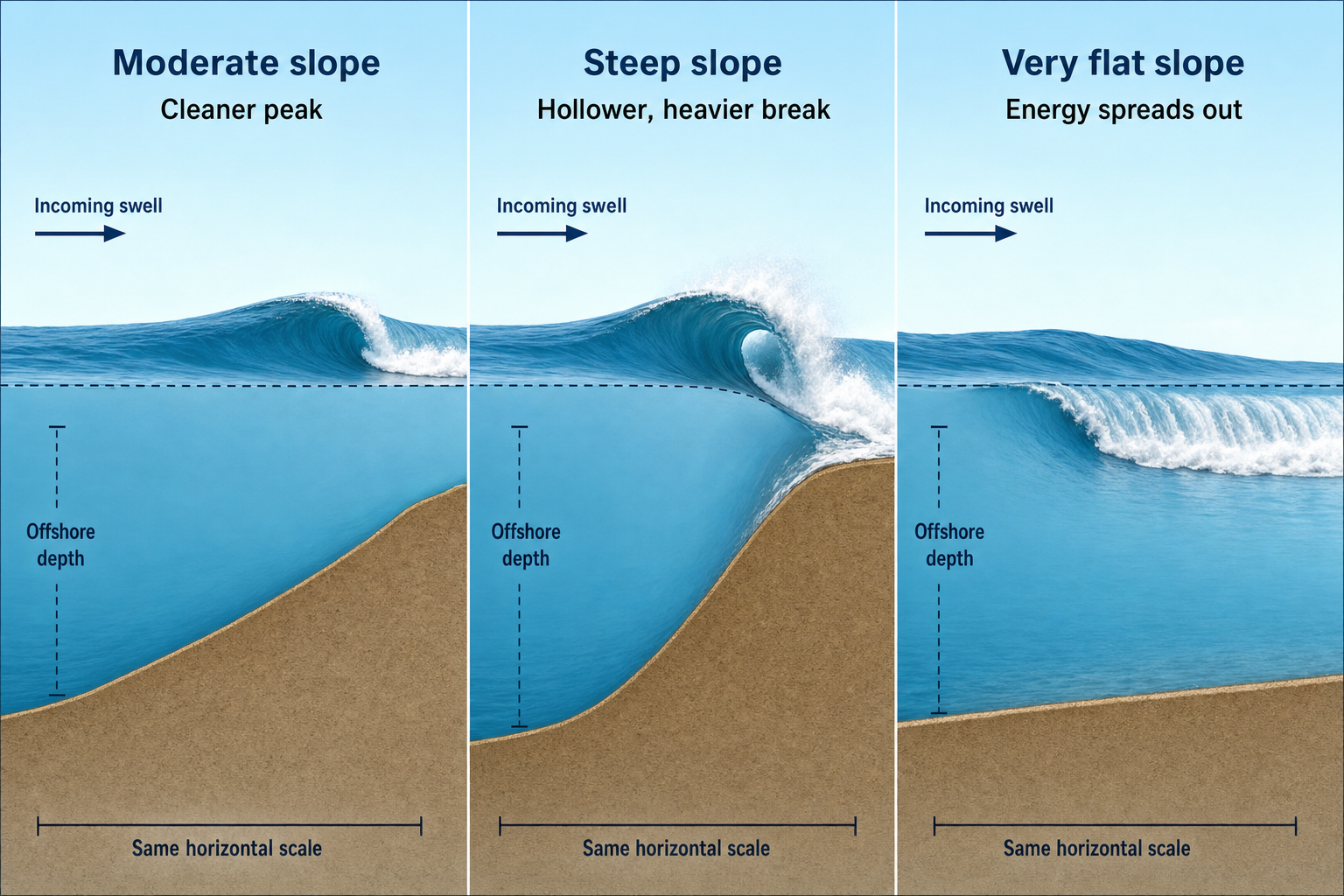
For a high-quality, surfable wedge, the bottom often has:
- A defined shoal where the wave can stand up.
- A deeper channel or shoulder that keeps the ride open.
- An angled contour that bends swell into a peak.
If the bottom is too abrupt, the wave may unload all at once. If it is too even, the wedge may never focus enough to become special.
Best Swell, Tide, and Wind for Wedge Waves
Every wedge spot has its own preferred conditions, but certain patterns are common across most setups. The best wedge waves usually need clean swell, a precise angle, and a tide that exposes enough bottom to steepen the wave without making it shut down.
Best swell direction and swell angle
The ideal swell direction is usually oblique rather than straight-on. The swell needs to approach at an angle that lets it interact with a reflector, reef, sandbar, or canyon edge. For many classic wedges, the key interaction happens when the incoming line and the secondary line meet at roughly 30 to 70 degrees.
If the crossing angle is too small, the waves may simply merge into a normal wall. If the angle is too large, the peak may explode into itself and become unmakeable. The best angle creates a steep takeoff with a shoulder that continues peeling down the line.
For jetty wedges, the swell must hit the structure and still break on the adjacent bank. For reef wedges, the swell must wrap across the reef from the right direction. For beachbreak A-frames, it needs to hit the sandbar in a way that creates a peak rather than a closeout.
Best wave period for wedge waves
Medium to long-period swell is usually best. A period of around 10 to 18 seconds is typical for quality wedges, though the ideal range varies by spot.
- Short-period swell: often creates smaller, punchier wedges with less overall power.
- Medium-period swell: tends to work well for beachbreak wedges and sandbar setups.
- Long-period swell: refracts more strongly and can produce powerful, focused peaks.
Very long-period swell can be spectacular at deepwater reefs and canyon-influenced spots. At some beachbreaks, however, it creates closeouts because the swell carries too much energy across the bank for any shoulder to open.
Best wave height
The best size depends on the break. Many wedge waves start working once there is enough swell for the secondary energy to become meaningful. For average beachbreaks, chest-high to a couple of feet overhead is often the sweet spot. Smaller surf may not wedge strongly, while larger surf can close out the entire bank.
Heavy reef wedges and jetty wedges may need more size to activate properly. Once they do, the faces can look far larger than the swell forecast suggests — which is why local knowledge matters so much at wedge spots.
Best tide
Mid tide is often the most consistent for wedge waves because it balances steepness and makeability. Low tide can make wedges hollower, but it can also make them too fast or too shallow to exit cleanly. High tide can soften the wave, though some shorebreak and wall-reflection wedges actually become stronger with more water pushing against the structure.
A simple way to think about it: the best tide is the one that lets the wave peak up sharply while still offering an exit. If the lip throws over the whole face at once, the tide may be too low. If the wave rolls in without standing up, it may be too high.
Wind and swell quality
Clean conditions matter particularly for wedge waves, since they already contain crossing energy. Offshore or light winds help hold the face open. Onshore wind can crumble the lip and make the peak difficult to read. Strong cross-shore wind may improve or ruin a wedge depending on direction relative to the barrel.
Swell direction spread is also a factor. A clean, organized swell creates more predictable interference patterns. A mixed or confused sea can still wedge, but tends to produce random peaks with bumps, steps, and abrupt shutdowns.
How to Surf Wedge Waves
Surfing wedge waves well comes down to reading the peak, taking off at the right angle, and using speed immediately. The wave may look inviting from the beach, but the takeoff zone can shift with every set.
Study the wedge before paddling out
Watch several sets and identify where the peak actually becomes rideable. Look for where the lines cross, where the lip first feathers, and where successful surfers take off. Notice whether the best rides come from the first wave of the set or from later waves after the water has rebounded.
Also pay attention to which direction offers the better shoulder. Some wedges look like A-frames but only one side is makeable. Others switch direction depending on the swell angle that day.
Position near the apex, not under the explosion
The goal is to sit close enough to the apex to catch the energy, but not so deep that the two lines collide on top of you. On a rideable wedge, the best takeoff spot is usually just beside the most violent part of the peak — close enough to use the steepness, but positioned to escape down the face rather than getting trapped behind the lip.
Because wedge peaks shift, keep adjusting. A move of one or two board lengths can make the difference between a clean entry and a missed wave.
Angle the takeoff early
Most wedge waves reward an angled takeoff. Paddle slightly toward the open shoulder rather than straight toward the beach. This helps you match the wave’s diagonal energy and prevents you from getting stuck at the bottom while the section runs away.
On a hollow wedge, stand quickly, stay compact, and set your rail as soon as possible. On a softer wedge, you may have a moment for a deeper bottom turn. On a fast side-wedge, a high line may be the only way to beat the first section before it closes.
Use the pocket, then decide quickly
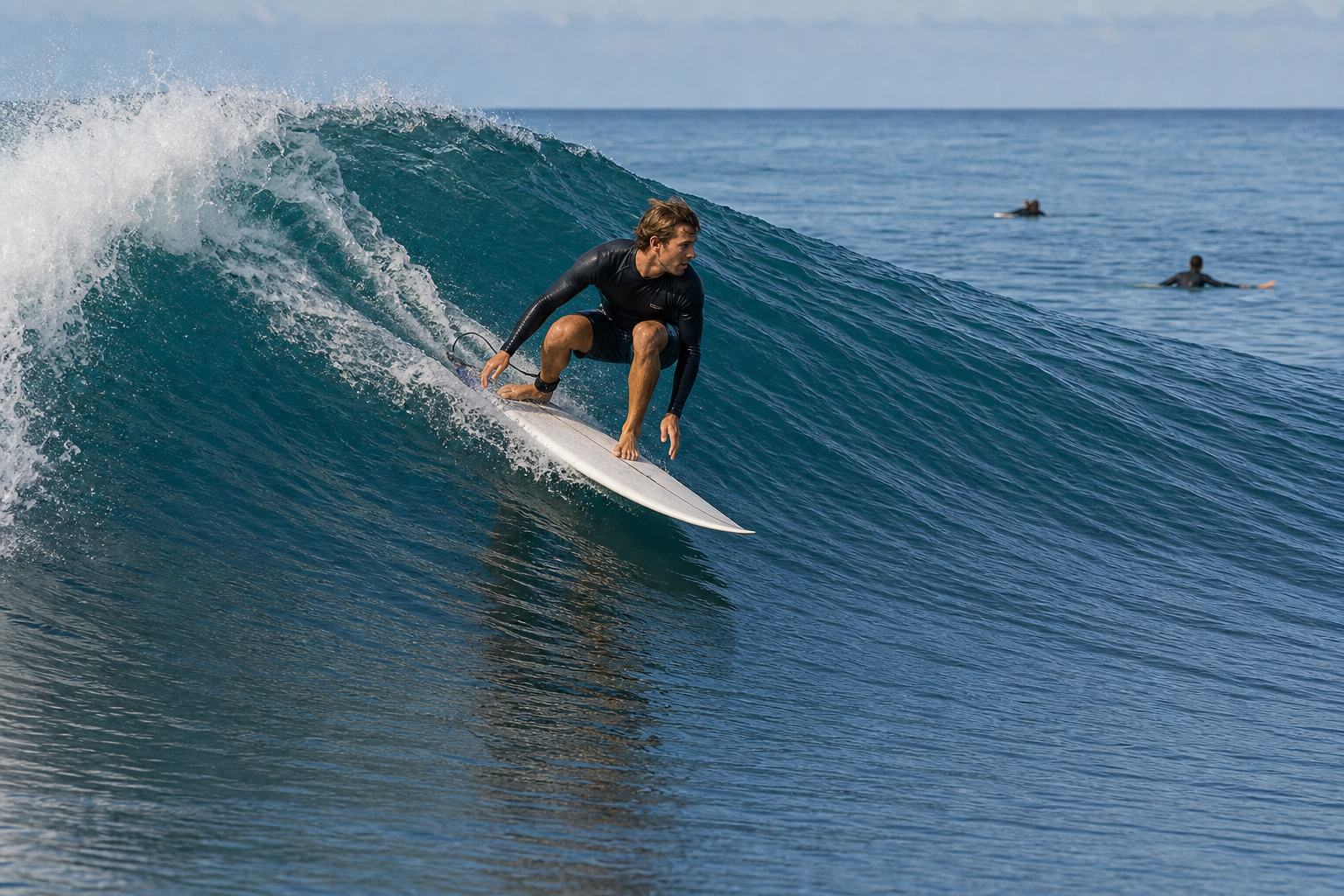
The pocket is the most powerful part of a wedge — it has the most speed, curve, and lift. Use that energy immediately. Depending on the wave, your first move might be a high trim, a compact bottom turn, or a stall for the barrel.
Don’t over-stall too early. Many wedge barrels look open for a moment, then clamp shut as the side energy catches up. Make the first section before trying to slow down for the tube.
Choose the right board and gear
For small to medium beachbreak wedges, a responsive shortboard or fish often works well. For powerful hollow wedges, a board with good paddle speed and a clean rail line is usually the better choice. At heavy slab-style wedges, control typically matters more than looseness.
Getting the right grip also makes a real difference on steep takeoffs. A well-placed surf traction pad gives you confident footing when the wave jacks up fast. Fin setup matters too — a three-fin thruster gives you the drive and control most surfers want in a wedge. A set of FCS-compatible fins or a set of Futures-compatible fins can be swapped depending on your board’s fin system and the conditions you’re expecting.
Don’t forget the basics. Fresh surf wax in the right temperature rating keeps you from slipping on a critical takeoff. After a heavy session in a wedge, dings are common — having a ding repair kit in your bag means you can patch up and get back out sooner. In cold water, a reliable wetsuit keeps you comfortable through long sessions, while a UPF rash guard works well for warmer conditions.
If you want to review your sessions and study your takeoffs, an action camera is a straightforward way to capture the footage. Pair it with a high-capacity microSD card so you don’t run out of storage mid-session. At critical reef breaks, a low-profile surf helmet is worth considering for wipeout protection on shallow takeoffs.
How to Recognize Rideable Versus Unmakeable Wedge Waves
The hardest part of surfing wedge waves is knowing which ones are worth going for. Some look spectacular but have no open face. Others look strange from the outside but offer a perfect line once you are in the pocket.
Signs of a rideable wedge wave
A rideable wedge usually has an open shoulder peeling away from the collision point. The lip throws down the line instead of detonating across the entire face at once. The peak may be steep, but the wave gives you a clear direction to exit.
Look for these signs:
- The shoulder tapers into deeper water or a channel.
- The lip feathers progressively from the peak outward.
- Previous waves in the set offered clean exits.
The best rideable wedges often look like they are about to close out, then the shoulder opens at the last moment. That is why watching patterns before paddling out is so important.
Signs of an unmakeable wedge wave
An unmakeable wedge usually has too much collision and not enough exit. The peak jumps, twists, and throws straight into the trough. If the whitewater outruns the shoulder immediately, the wave probably cannot be made.
Common warning signs include:
- The entire lip pitches at the same time with no shoulder opening.
- The crossing wave creates a vertical wall in front of the face.
- The peak breaks into backwash, boils, or rebound chop.
Unmakeable wedges become more common when the swell is too big for the bank, the period is too long, or the tide exposes too much bottom. A slight tide change can sometimes turn the same peak from a closeout into a quality barrel — which is why patience at wedge spots often pays off.
Famous Wedge Waves Around the World
Wedge waves exist all over the world, but each famous spot has its own mechanism. Some are jetty reflections, some are reef slabs, and others are sandbar A-frames shaped by swell refraction.
| Surf Spot | Location | Why It Wedges |
|---|---|---|
| The Wedge | Newport Beach, California | South swells reflect off the Newport Harbor jetty and collide with incoming waves, creating a powerful shorebreak wedge. |
| Sebastian Inlet First Peak | Florida | The jetty and sandbar setup create a wedging right-hander that can be far punchier than nearby beachbreaks. |
| Duranbah | New South Wales, Australia | Training walls, shifting sand, and angled swell create peaky wedges near the Tweed River mouth. |
| Blacks Beach | San Diego, California | Submarine canyon bathymetry focuses swell into powerful beachbreak peaks and A-frames. |
| Supertubos | Peniche, Portugal | Sandbars and swell refraction produce hollow, wedging beachbreak barrels. |
| La Gravière | Hossegor, France | Deep-water swell meets heavy sandbars, creating thick wedging peaks and fast barrels. |
| The Box | Western Australia | A shallow reef ledge creates a square, slabby wedge that breaks with extreme power. |
| Shipstern Bluff | Tasmania, Australia | Deep-water swell hits a complex reef ledge, producing heavy wedges and stepped faces. |
| Ours (Cape Fear) | Sydney, Australia | A shallow rock shelf near cliffs focuses swell into a thick, ledgy wedge. |
| Nazaré | Portugal | An underwater canyon focuses giant swell into dramatic peaks — more of a big-wave focusing setup than a classic wedge, but the same principle applies at a massive scale. |
These examples show that “wedge wave” isn’t one single type of break. It’s a family of waves created by focused, crossing, or redirected swell energy. The common thread is a peak that stands up more sharply and powerfully than the surrounding surf.
Wedge waves reward surfers who enjoy reading the ocean in detail. They are dynamic, angle-sensitive, and often unpredictable — but that’s a big part of their appeal. A small change in swell direction, period, tide, or sandbar shape can transform an average session into a day of steep peaks and hollow sections. Once you learn to recognize the difference between a rideable wedge and a closeout explosion, these waves become far less mysterious and much more approachable. Whether it’s a playful beachbreak A-frame or a heavy jetty wedge, the same principle applies: find the focused energy, take off with purpose, and use the speed before the wave changes its mind.
