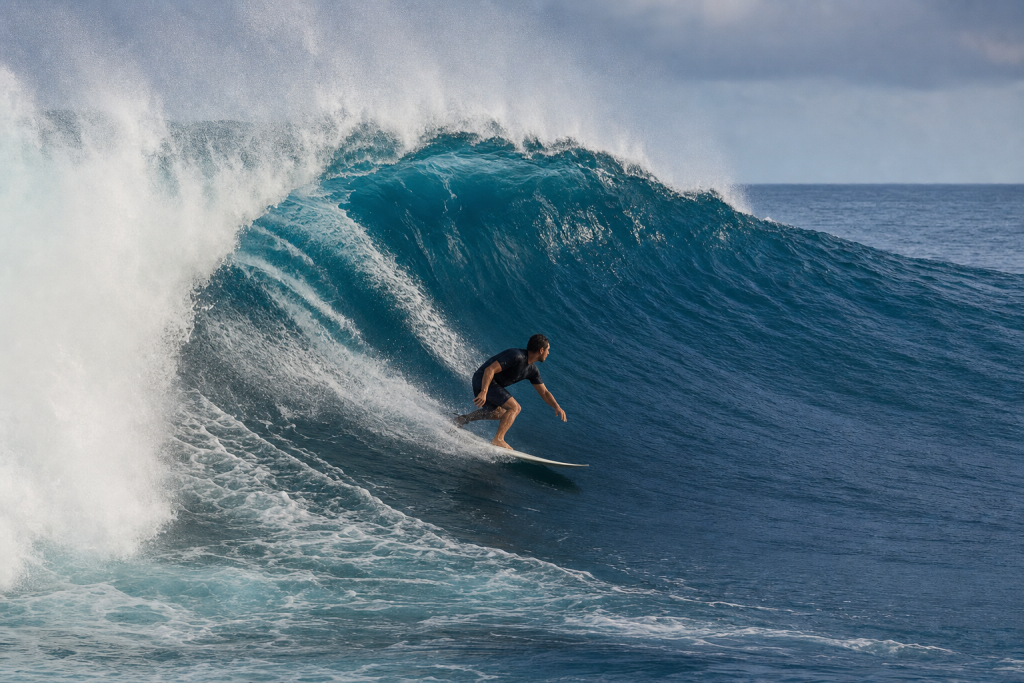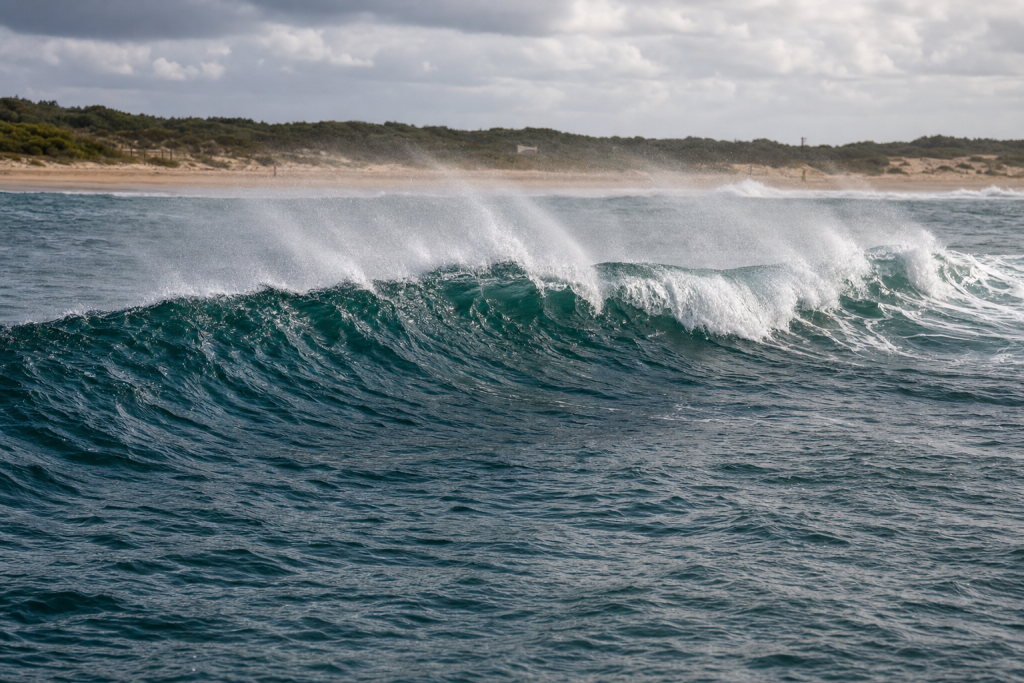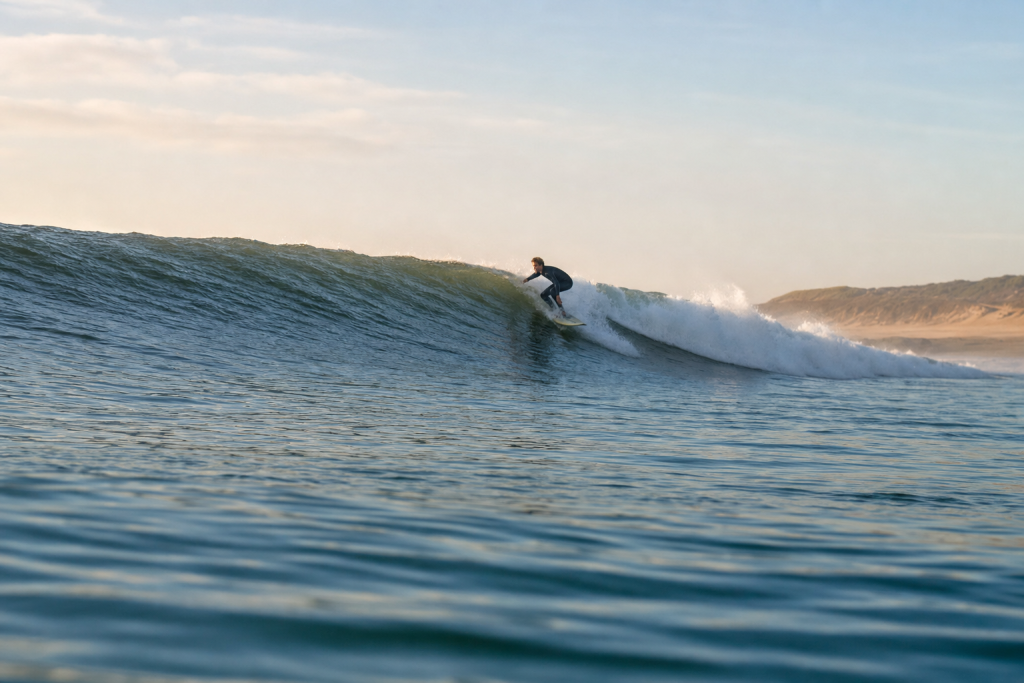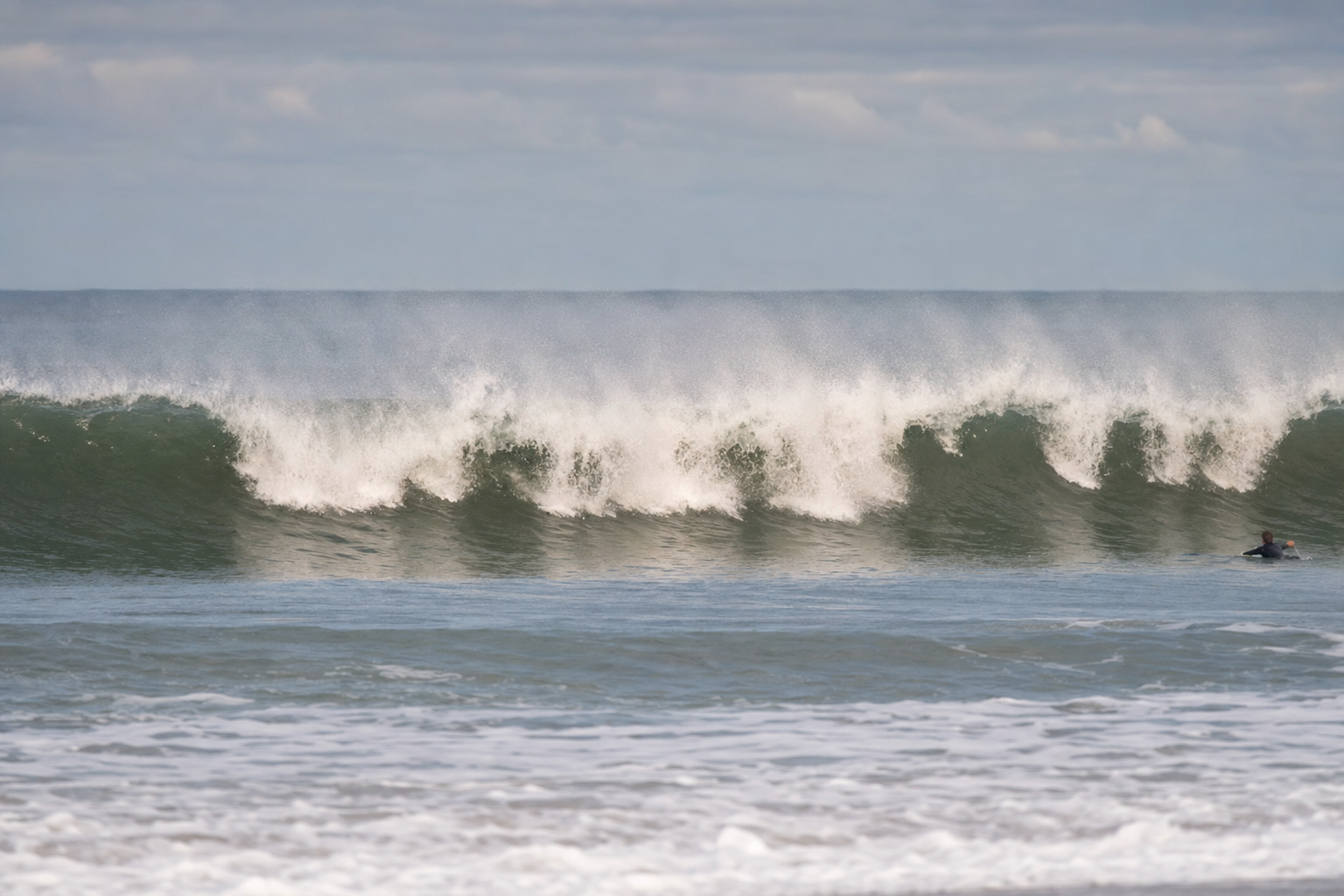
A closeout wave can look perfect for a split second: a clean wall stands up, the lip throws forward, and then the entire thing collapses at once. For surfers, that moment is the difference between a makeable ride and a wall of whitewater with nowhere to go. Understanding why waves close out helps you read surf forecasts better, choose the right spot, and recognize when a tempting wave is actually unrideable. If you’re heading out into heavier surf, having the right gear matters too — a reliable surfboard leash can save you a long swim when a closeout catches you off guard. A good layer of surf wax on your deck is equally important when you’re scrambling to recover after a wipeout.
What Is a Closeout Wave?
A closeout wave is a wave that breaks across most or all of its crest at the same time. Instead of peeling left or right with an open face, the lip folds over in a long line and shuts down the ride. In surfing terms, a closeout has no usable shoulder. The shoulder is the unbroken part of the wave that allows a surfer to travel laterally along the face. When the shoulder disappears, the wave becomes a straight drop, a brief barrel, or an immediate wipeout.
Closeouts are common at beach breaks, especially when swell hits a straight sandbar head-on. They can also happen on reefs, slabs, and shorebreaks when the wave breaks over a uniform section of bottom or when the swell is simply too big for the break to handle.
Why Waves Closeout: The Basic Mechanics
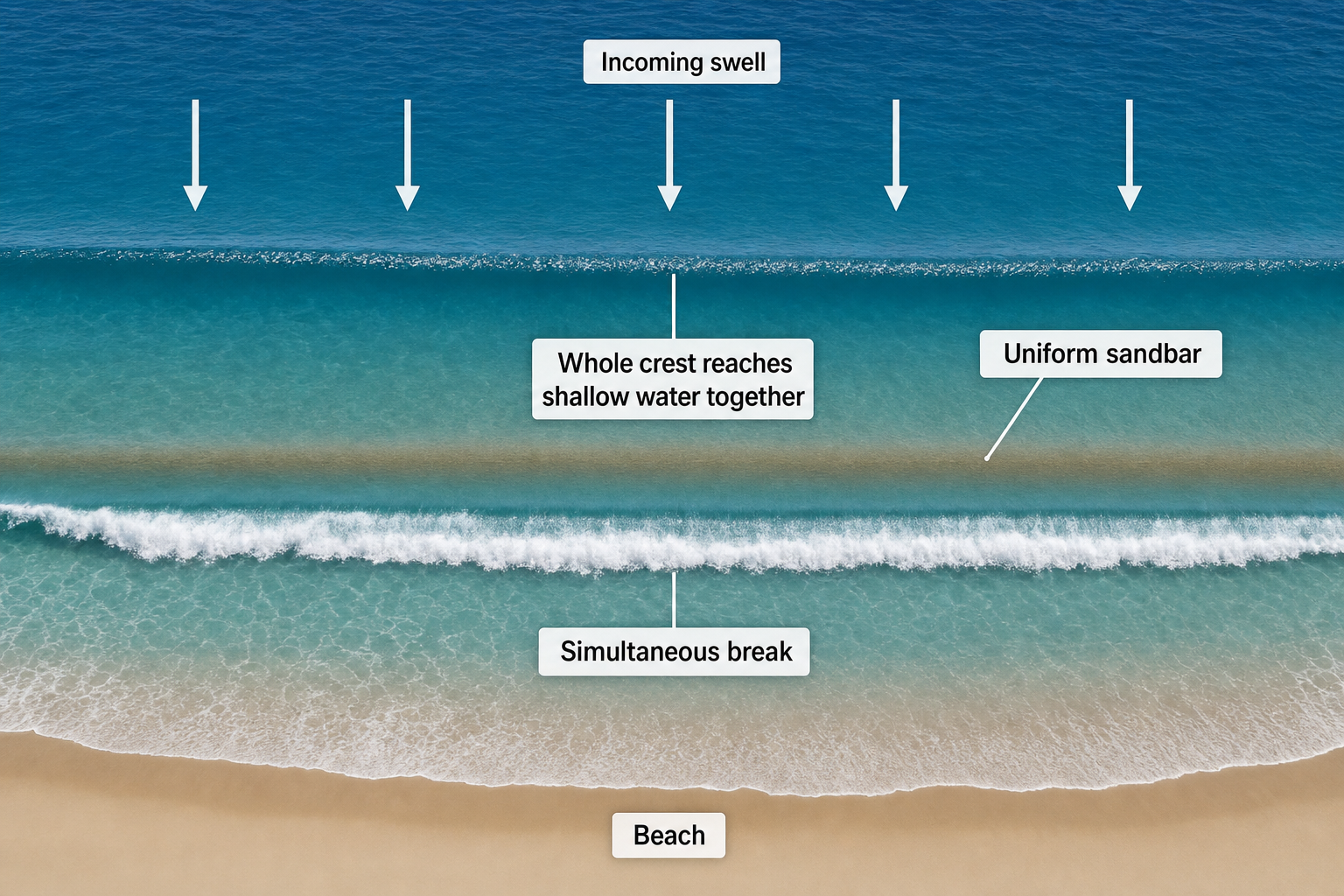
Waves close out when too much of the wave reaches breaking depth at the same time. To understand that, it helps to look at how waves change as they move from deep water into shallow water.
How Waves Begin to Break
In deep water, waves travel without strongly feeling the seabed. As they enter shallower water, the bottom slows the lower part of the wave. The top keeps moving forward, the face steepens, and the wave eventually breaks.
A useful rule of thumb is that waves typically break when the water depth is roughly 1.3 times the wave height — or put another way, the breaking wave height is often around 0.78 times the water depth. The exact figure varies with wave shape, seabed slope, and local currents. If one part of the wave reaches that critical depth before the rest, the wave can peel. If a long stretch reaches that depth all at once, it closes out.
Uniform Bottoms Create Closeout Waves
The main ingredient in a closeout is uniformity. If the seabed has a long, even contour running parallel to the beach, the whole wave line may stand up and break together. This is why straight sandbars so often produce closeouts.
Good surf breaks usually have variation in the bottom. A reef may have a takeoff ledge that leads into a deeper shoulder. A point break may wrap gradually around a headland. A quality beach break may have peaks, troughs, and rip channels that divide the swell into rideable sections. A closeout-prone bottom often has:
- A straight sandbar running parallel to shore
- A shallow ledge with little depth variation
- A steep inside bank that makes the wave dump
Swell Direction Can Make Waves Closeout
Swell direction is one of the biggest reasons a spot swings from fun to closed-out. When swell approaches nearly perpendicular to a straight beach, the wave crest lines up with the sandbar, and the whole line hits shallow water at the same time.
A little swell angle helps. If one end of the wave reaches the bar first, it may start breaking there and peel along the bank. Too little angle makes the wave shut down across the full section. Too much angle can cause the wave to race too fast or miss the best part of the bottom entirely.
At point breaks and reefs, the wrong swell direction creates the same problem. A reef that peels beautifully on a wrapping swell may close out completely when a straight swell hits the entire ledge at once.
Why Some Waves Peel While Others Closeout
The difference between a peeling wave and a closeout comes down to timing. A peeling wave breaks progressively. A closeout breaks simultaneously.
Peel Angle and Surfable Speed
Peel angle describes how quickly the breaking section travels along the wave. A generous peel angle creates a manageable wall. A very low peel angle creates a fast, racing section. When the peel angle effectively disappears, the wave closes out.
Surfers can only travel so fast across a face. If the breaking section outruns the surfer, the wave becomes unmakeable. This is why some waves are technically peeling but still feel like closeouts — the lip is moving too quickly down the line for anyone to stay ahead of it.
Bathymetry Creates the Wave’s Personality
Bathymetry is the shape of the seafloor. It is the hidden architecture that determines whether a wave peels, wedges, barrels, crumbles, or closes out. A peeling wave usually has a bottom that changes gradually along the wave’s path — one section is shallow enough to break, while the next is slightly deeper, creating a moving breaking point.
A closeout wave usually has a bottom that is uniformly shallow across a broad area. There is no staggered depth change to create a shoulder, so the wave detonates along the line instead of peeling down it.
The Shape and Surf Quality of Closeout Waves
Closeout waves vary considerably. Some are weak and crumbly. Others are powerful, hollow, and heavy. What they share is the absence of a makeable open face.
Closeout Wave Shape
A typical closeout wave has a long, straight wall. The lip may feather across the horizon almost evenly, then pitch forward in one continuous curtain. Common visual traits include:
- A ruler-straight crest with little taper from end to end
- Both ends breaking at nearly the same time
- A shoulder that disappears immediately after takeoff
Some closeouts form as A-frames, with the wave peaking in the middle and appearing to offer a left and a right. Both sides can still shut down quickly, which makes these waves deceptive — the takeoff looks surfable right up until the wave folds over.
Power, Speed, and Height of Closeout Waves
The power of a closeout depends mainly on wave height, swell period, and water depth. A waist-high closeout over a soft sandbar may be frustrating but not particularly dangerous. An overhead closeout over a shallow ledge is a different situation entirely. If you’re surfing heavier conditions, an impact vest can add a useful layer of protection, and a surf helmet is worth considering when the bottom is shallow and the lip is throwing hard.
Long-period swell carries more energy than short-period wind swell of the same height. It also produces longer lines, thicker lips, and heavier impacts. This is why a clean 16-second swell can turn an ordinary beach break into a series of punishing closeouts.
Closeouts also tend to become more common as surf size increases. A sandbar that produces fun chest-high peaks may shut down completely once waves reach overhead size. At that point, the wave may break farther outside, across too much of the bank at once, and lose the shaped peak that made it surfable.
Steepness and Hollowness in Closeout Waves
Closeouts can be steep or flat, but the most memorable ones are steep and hollow. A hollow closeout usually forms when a wave hits a shallow bank or ledge abruptly — the base slows, the lip keeps moving, and the wave pitches into a barrel with no exit. On reefs in particular, this kind of impact can damage a board fast. Keeping a surfboard ding repair kit in your bag after sessions like these is a good habit.
On gentler seabed slopes, closeouts may spill rather than pitch, crumbling along the line instead of throwing a clean lip. They are less dramatic but still poor for surfing because they offer no clean shoulder to work with. In general:
- Gentle slopes tend to create spilling closeouts
- Moderate slopes often create plunging closeouts
- Steep slopes can create dumping shorebreak closeouts
Bottom Structure and Seabed Gradient
Closeout waves are closely tied to the seabed. The same swell can produce excellent surf at one spot and complete closeouts a few hundred meters away simply because the bottom is shaped differently.
Straight Sandbars and Beach Break Closeouts
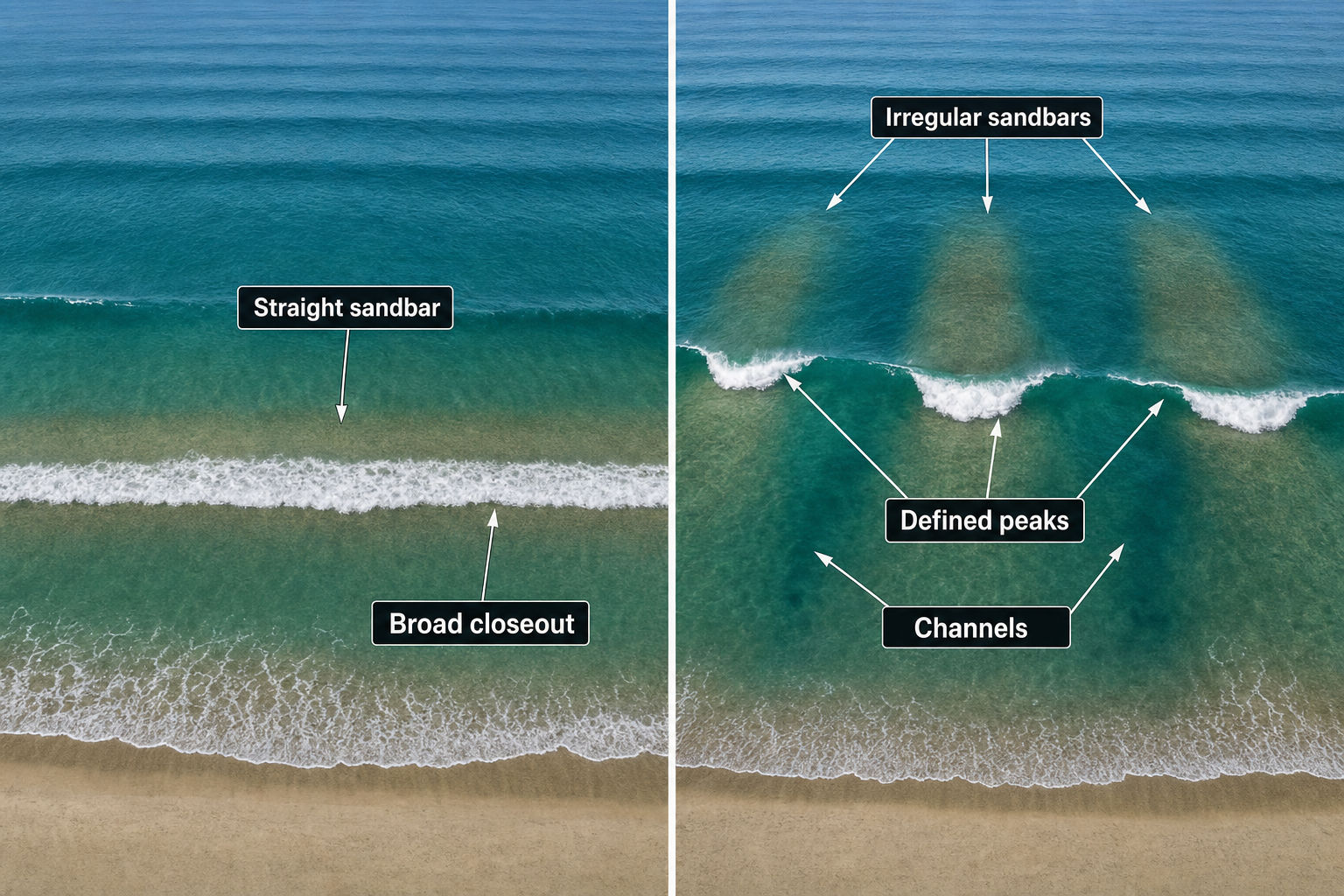
The classic closeout setup is a straight beach with a straight sandbar. If the bar is shallow and even, incoming waves break across the entire bank. This is common after storms redistribute sand into long parallel ridges.
Beach breaks are especially changeable because sand is always moving. A spot that peels well one month may close out the next. Good beach-break surf usually depends on irregular sandbars that create defined peaks and channels. Without those irregularities, the waves tend to shut down.
Shallow Reefs, Slabs, and Ledges
Reef closeouts happen when swell hits a shallow shelf evenly with no deeper shoulder or channel to create a peeling section. Slab waves are a special case — they often rise suddenly out of deep water and break over very shallow rock or reef. Some slabs produce makeable barrels because the ledge bends or tapers in just the right way. Others are pure closeouts because the lip throws across too much of the reef at the same time. When surfing rocky or reef breaks, a pair of reef booties protects your feet on the inevitable wipeouts.
Seabed Gradient and Breaking Style
Seabed gradient is the slope of the bottom as it rises toward shore, and it affects how quickly waves transform as they enter shallow water.
| Seabed Gradient | Likely Breaking Style | Closeout Tendency |
|---|---|---|
| Gentle slope | Spilling and soft | Can close out in long crumbly lines |
| Moderate slope | Plunging and steeper | Can create hollow closeouts on straight banks |
| Steep slope | Dumping or surging | Common in shorebreak closeouts |
The key is not slope alone. A steep but well-shaped reef can peel beautifully. A gentle but perfectly straight sandbar can close out all day. Closeouts happen when the breaking depth is reached too evenly along the crest, regardless of how the gradient is classified.
How Swell Period, Swell Angle, Tide, and Wind Affect Closeout Waves
No single forecast number guarantees closeouts. The final result comes from the interaction between swell, tide, wind, and bottom shape.
Swell Period and Closeout Waves
Swell period is the time between successive wave crests. Longer-period waves have longer wavelengths and begin feeling the bottom farther offshore. As an approximate guide, wavelength in meters is roughly 1.56 times the period squared in seconds. A 10-second swell has a wavelength of around 156 meters, while a 16-second swell has a wavelength of around 400 meters.
Long-period swell creates more organized, lined-up wave sets. That can be outstanding at points and reefs shaped to handle it. At straight beach breaks, those same long lines often mean powerful closeouts. Typical patterns break down roughly like this:
- Short period, 6 to 8 seconds: weaker and less organized, often peaky but messy
- Mid period, 9 to 12 seconds: common for beach breaks, with peaks and closeouts both possible
- Long period, 13 seconds and above: more lined-up and powerful, more likely to overwhelm poor banks
Period matters because it changes how the wave interacts with the seabed. A long-period swell may wrap, focus, and break in areas that shorter swell passes over entirely. If the bottom is too straight, that extra organization can work against surf quality rather than for it.
Swell Direction and Typical Swell Angle
Closeout waves are most common when swell approaches close to straight-on for the break. On a straight beach, that usually means swell arriving nearly perpendicular to shore. Even a slight angle can help, giving the wave a chance to break progressively rather than all at once. The ideal angle depends on beach orientation, sandbar shape, and how the swell refracts as it enters shallow water.
At reefs and points, the best swell angle is usually the one that wraps into the takeoff zone and runs along the bottom contour. If the swell hits too directly, the wave may break across the whole reef at once. If it comes from too far around the corner, it may become weak or sectiony.
Tide and Closeout Waves
Tide changes the depth over the bar or reef. Since waves break when they reach a certain depth relative to their height, the tide can completely alter whether a wave peels or closes out.
Low tide makes waves steeper and hollower because there is less water cushioning the bottom. On shallow sandbars, this can produce fast, dumping closeouts. Many beach breaks close out most severely at lower tides. High tide can soften waves if there is enough water over the bank, though on steep beaches it can also create heavy shorebreak closeouts when the wave holds up until the very inside.
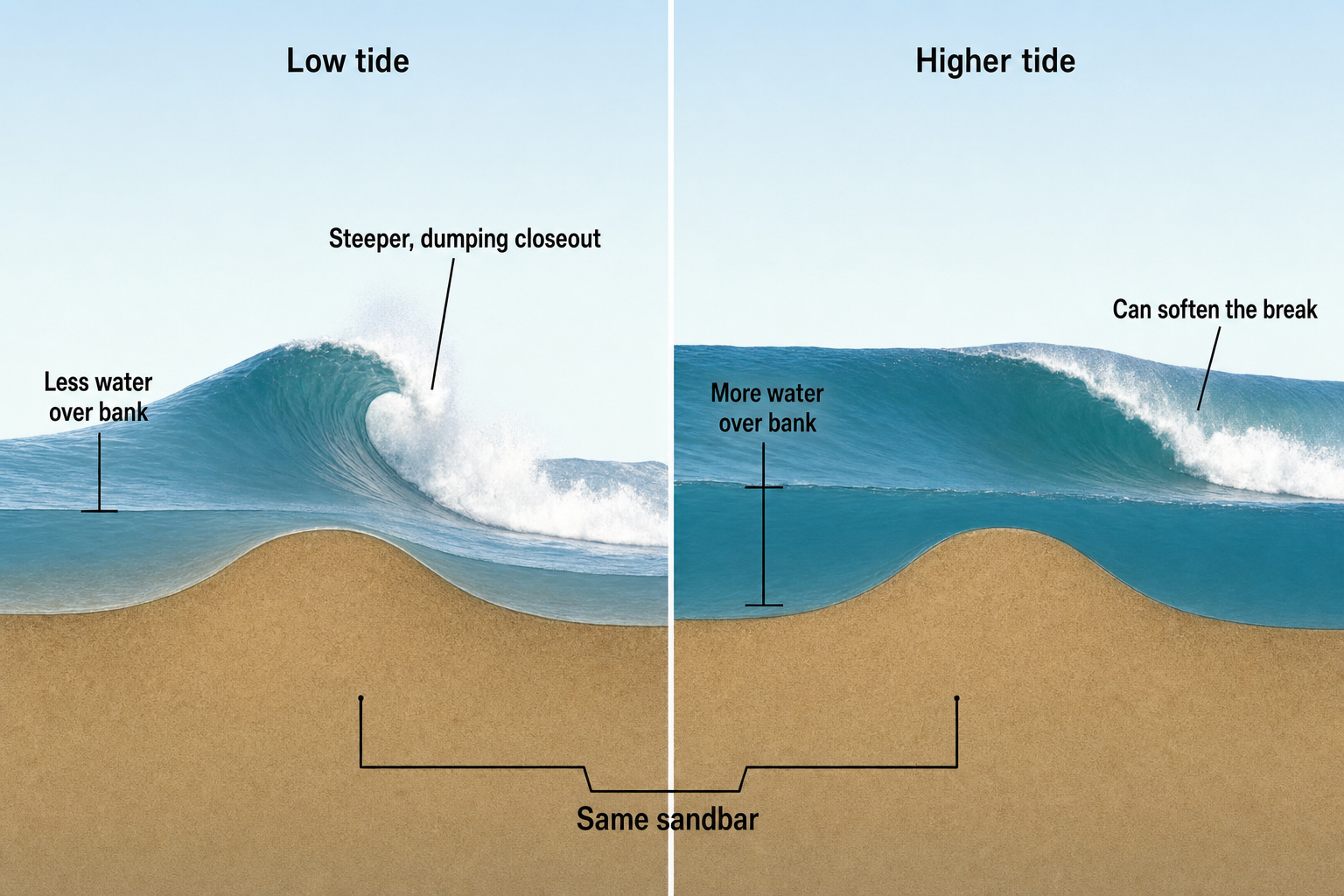
Mid tide is often the best window at beach breaks — enough water to prevent full dumping, but not so much that the wave becomes fat and weak. This is not universal, though. Some reef breaks need low tide to break properly, while others become too dangerous or too closed-out when the water drops.
Wind and Closeout Waves
Wind does not usually create the closeout pattern, but it changes how the wave breaks. Offshore wind holds the face open, delays the lip, and can create a hollow barrel even on a closeout wave. The result can be visually spectacular but still unmakeable. Onshore wind makes waves crumble earlier, which reduces the violence of a closeout but also lowers surf quality across the board. Cross-shore wind adds chop and irregular sections, occasionally opening a corner but usually making the wave harder to read.
How Hard Are Closeout Waves to Surf?
Closeout waves are generally harder to surf than peeling waves because the rideable window is short. There is less time to stand, set a line, and generate speed. There is also less room for error since the lip breaks directly across the escape route.
For beginners, small crumbly closeouts can be useful for practicing pop-ups in whitewater. Steep closeouts, however, are poor learning waves because they do not reward positioning or trimming. For intermediate surfers, closeouts in small doses can sharpen late takeoffs and quick direction changes — though surfing too many of them can encourage the bad habit of going straight rather than learning to read a shoulder. If you’re at the stage where you’re working on refining your technique, a resource like this surf technique book can help you understand wave reading more deeply.
Advanced surfers sometimes target closeout sections for quick barrels, airs, or committed end-section turns. Even then, they are looking for a closeout with a makeable corner somewhere — not a wave that shuts down across the entire beach with no exit.
How to Surf Closeout Waves
The best approach to surfing closeouts is to avoid the most closed-out part of the wave and look for corners, ends, and small imperfections in the line. A closeout with even a slight taper can still offer a short but worthwhile ride.
Pick the Corner, Not the Center
The middle of a closeout is usually the worst place to be, with both sides folding at once and no exit available. Position yourself near the edge of the breaking line where the wave begins to taper off. At beach breaks, corners often form near rip channels or uneven sections of the sandbar, where slightly deeper water delays the break and opens a temporary shoulder. Having fins that give you fast, reliable response through these tight sections makes a real difference. A set of FCS fins or Futures-compatible surfboard fins can help you hold your line and accelerate out of tighter spots.
Angle the Takeoff Early
On a closeout, going straight usually ends the ride after one or two seconds. Angle your board toward the shoulder before you stand up, so you enter the face with down-the-line speed rather than dropping to the flat and watching the lip outrun you. For steep closeouts, the takeoff may need to be late and committed — paddle hard, get to your feet quickly, and set your rail as soon as you are up. A low stance helps absorb the drop and hold speed through the initial section.
A good surf traction pad on your tail gives you a secure back foot position when you need to drive hard off a late drop, and paired with a quality wetsuit suited to your water temperature, you will be comfortable and in control through those short, intense rides.
Use the Right Line for the Wave
On a fast closeout section, a high line is often better than a deep bottom turn. Staying higher on the face keeps your speed up and positions you closer to the exit. A long bottom turn may look stylish, but on a closing wave it often wastes the only second you have. If the wave throws a short barrel, only commit to the stall if there is a genuine exit down the line. Many closeout barrels look open from behind the peak but pinch shut quickly. If the shoulder is not moving away from the whitewater, the barrel is probably not makeable.
Know When to Straighten Out
Some closeouts simply offer no exit. In those cases, the smart move is to straighten out before the lip lands directly on you. Good surfers read the wave and adjust before it shuts down rather than forcing a section that was never going to open up.
How to Recognize Rideable Versus Unmakeable Closeout Waves
Reading closeouts is a genuine skill. Many waves look perfectly makeable from the lineup because the takeoff is clean, but the real question is what happens two seconds later.
Signs a Closeout Wave Might Be Rideable
A rideable closeout usually has some kind of corner or delay — a part of the wave that breaks slightly later than the rest. Look for:
- One end of the wave feathering before the other
- The crest bending rather than forming a perfectly straight line
- A shoulder that stays green briefly after the peak breaks
Repetition is the best clue. If several waves in a row produce a short right near the same rip channel, that corner may be consistently surfable. If every set closes out in exactly the same place, the next one probably will too. If you want to capture those short but satisfying rides, mounting an action camera on your helmet or board can help you review your surfing afterward — just make sure you have a fast microSD card with enough storage for a full session.
Signs a Closeout Wave Is Unmakeable
An unmakeable closeout usually announces itself before it even fully breaks. The horizon line looks too straight, the lip feathers evenly across the full crest, and the shoulder never separates from the advancing whitewater. Watch for:
- The whole wave standing up at the same time across its full length
- The lip pitching in one continuous curtain rather than in sections
- Both left and right sides shutting down immediately after takeoff
One of the simplest tests is watching other surfers. If skilled surfers are repeatedly taking off and getting swallowed in the same spot, the wave is probably not makeable. If everyone is sitting on the ends of the peak rather than the middle, that tells you exactly where the only possible corners are.
Common Types of Closeout Waves
Beach Break Closeout Waves
These are the most common closeouts. They happen when swell hits a straight sandbar with little bottom variation. They may improve as the tide shifts or as sand gradually moves into a more irregular shape over days and weeks.
Shorebreak Closeout Waves
Shorebreak closeouts dump close to the sand, often on steep beaches or at high tide. They can be hollow and powerful even when small, and they typically offer very short rides because the wave breaks in extremely shallow water with no shoulder to follow.
Reef and Slab Closeout Waves
These closeouts break over rock, coral, or reef shelves, often caused by a swell direction that hits the ledge too squarely. Some offer dramatic barrels, but many are unmakeable because the exit disappears as the whole reef section breaks simultaneously.
Too-Big-for-the-Bank Closeouts
Some waves close out simply because the swell has outgrown the break. A normally fun sandbar may handle chest-high surf well and then shut down when the swell reaches overhead. The wave starts breaking farther outside, across a broader section of the bottom, and loses the shaped peak that made it work at smaller sizes. A rash guard like this UPF 50+ women’s rash guard is worth having for longer sessions spent picking through bigger, less consistent surf while you wait for a corner to appear.
Forecast Clues That Waves May Closeout
You can often predict closeouts before arriving at the beach by comparing the forecast to the shape of the spot. Closeouts are more likely when the forecast shows:
- Swell direction close to straight-on for the beach
- Long-period swell at a straight beach break
- Wave height above the spot’s comfortable range
They are less likely when the spot has defined peaks with deeper channels, a point or reef that bends the swell, or a swell angle that naturally creates a peeling shoulder.
The most reliable approach is to combine forecast knowledge with direct observation. Watch at least one full set before paddling out. Closeouts often appear in clear patterns at beach breaks, with each set breaking on the same shallow bank in the same way. If the first few sets show no rideable corners, the session may not improve until the tide changes or the swell angle shifts.
Why Closeout Waves Matter for Better Surfing
Closeout waves are not just bad waves — they are clues. They reveal how the swell is hitting the coast, how the tide is affecting the bottom, and whether the seabed is shaped in a way that supports surfing. Learning to identify them helps you stop wasting energy on unmakeable waves and start finding the corners that others miss. The key is learning to see progression. A surfable wave breaks in sequence. A closeout breaks all at once. Once you can see that difference clearly, you will understand why one wave peels cleanly down the sandbar while the next becomes a wall of whitewater, and that knowledge makes you a better wave reader, a smarter forecaster, and a more selective surfer over the long run.