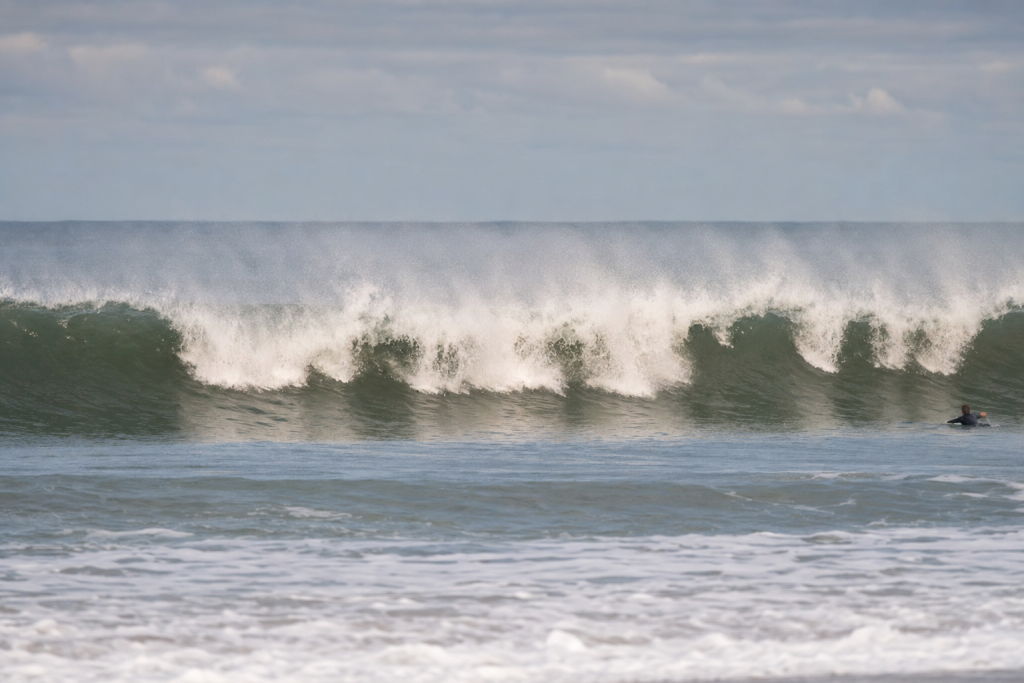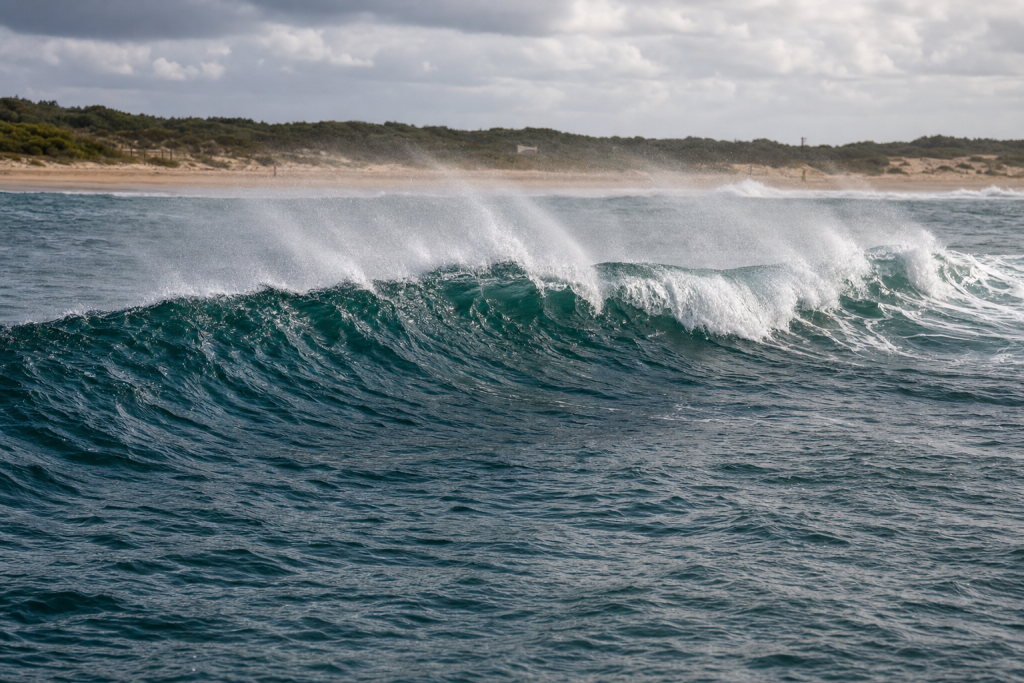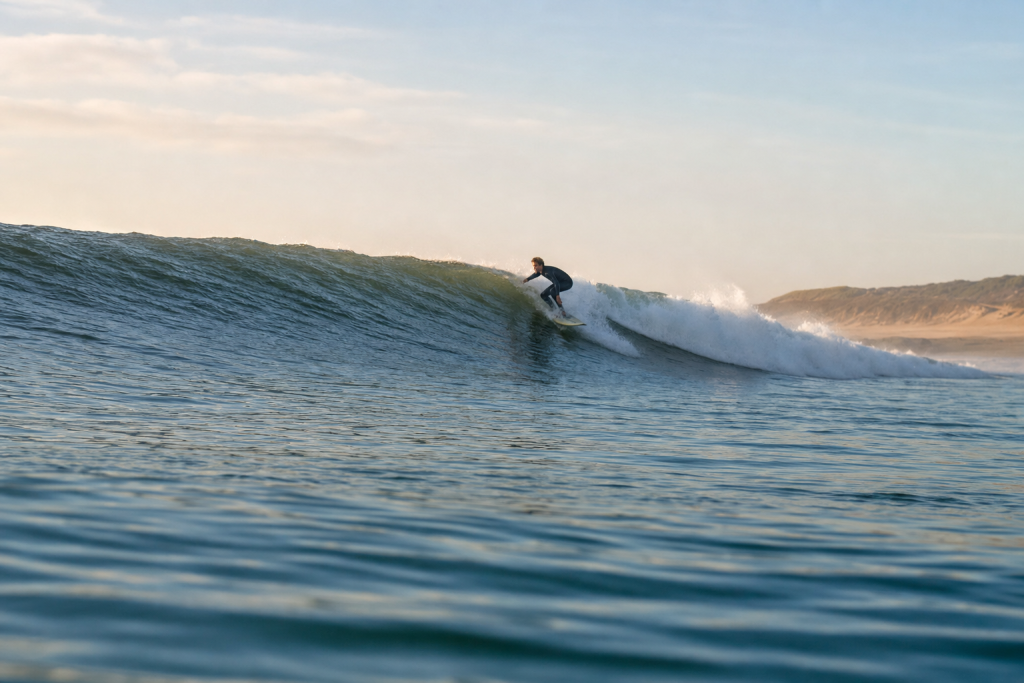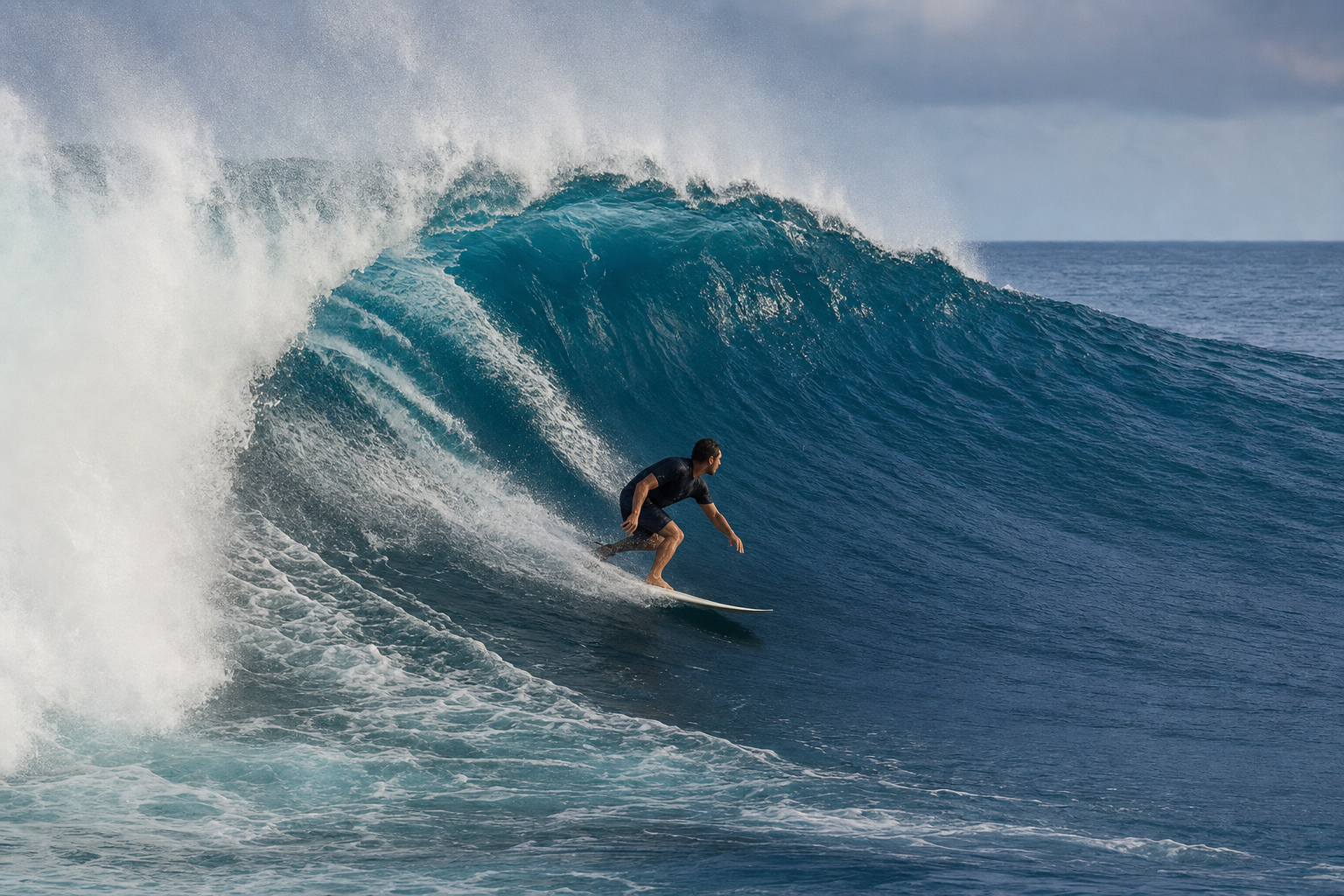
Some waves look inviting from the beach. Others look like they’re trying to fold the ocean in half. The difference isn’t just size. A wave becomes sketchy or dangerous when swell energy, bottom shape, tide, and wind combine to create a fast-breaking wall with serious consequences for mistakes. Some of the world’s best surf waves are also among the most dangerous because they are hollow, powerful, and very shallow. Learning what makes these waves dangerous helps surfers read the ocean more accurately, choose better windows, and understand why some waves are rideable while others are simply not. Having the right gear matters too — a quality surfboard leash is one piece of equipment you don’t want to compromise on when paddling out in heavier surf.
What Makes Dangerous Waves Different From Normal Surf?
A normal surfable wave gives the surfer time and space. It has a defined peak, a clean face, and a shoulder that peels down the line. A dangerous wave removes those margins. It may stand up suddenly, throw a thick lip into shallow water, or break so fast that even an expert surfer can’t outrun the section. Protection matters in these conditions — wearing an impact vest can make a real difference when wipeouts get heavy.
Dangerous waves are usually created by three things working together:
- High swell energy: large wave height, long period, or both.
- A powerful breaking shape: steep face, hollow barrel, or heavy lip.
- A consequential environment: shallow reef, strong current, or no easy exit.
Wave Power: Height Matters, but Period Matters More Than You Think
Wave height is the obvious danger sign, but period is what often makes a wave feel genuinely heavy. Period is the time between waves in a swell. A six-foot swell at 16 seconds carries far more energy than a six-foot swell at 9 seconds.
Wave energy increases roughly with the square of wave height. Double the height and the wave carries about four times the energy. Long-period swell also travels faster, reaches deeper into the water column, and bends more strongly around underwater features.
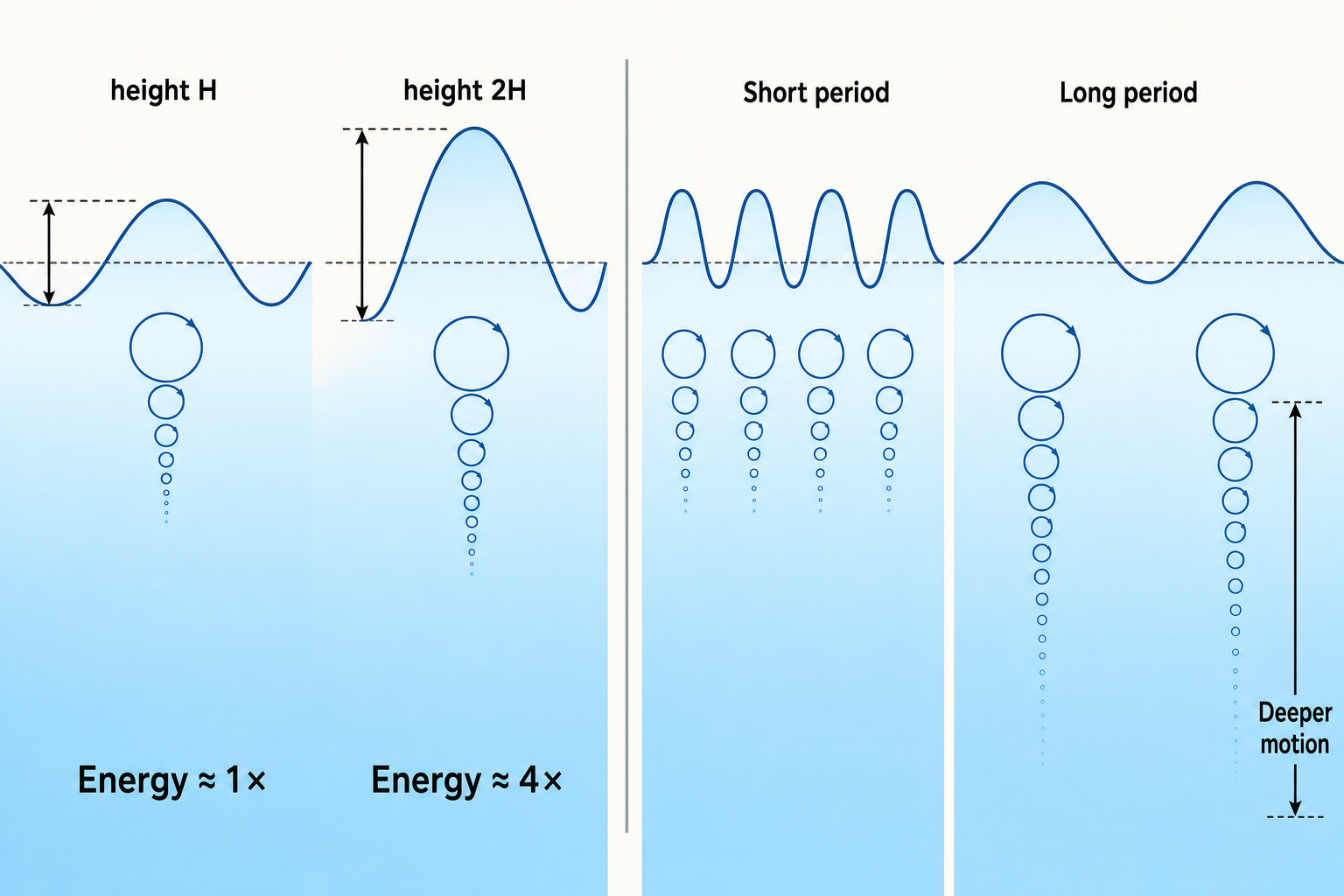
A useful deep-water rule is that wavelength in meters is approximately 1.56 times the period squared. A 16-second swell has a wavelength of roughly 400 meters, meaning it can start reacting to the seabed in water around 200 meters deep. This is why long-period groundswell can suddenly jack up on reefs, ledges, and canyon-fed beaches with very little warning.
Wave Shape: Steepness, Hollowness, and Lip Thickness
The most dangerous surf waves are rarely soft or crumbly. They are usually plunging waves — the top of the wave pitches forward and throws out into the trough. This creates a barrel, but it also creates serious impact.
Sketchy waves often share these shape features:
- A vertical or near-vertical face: the takeoff demands commitment and speed.
- A thick lip: more water falls from above, making wipeouts more violent.
- A hollow trough: the water beneath the surfer drains off the reef or sandbar.
- A fast-running shoulder: the wave may outrun even a skilled surfer.
- A sudden ledge: the wave transitions from deep water to breaking water very quickly.
Hollowness isn’t automatically bad. Many elite surfers chase hollow waves precisely because they offer the best barrels. The danger comes when the barrel is too square, too shallow, or too fast to exit cleanly.
The Main Types of Sketchy and Dangerous Waves
Dangerous Slab Waves
A slab is a thick, hollow wave that breaks abruptly over a shallow ledge. Unlike a classic peeling reef wave, a slab often rises from deep water with very little warning. The surface may look flat, then the swell hits the ledge and detonates.
Slabs are dangerous because the lip is heavy and the water beneath the surfer is often extremely shallow. Many slabs break over rock shelves, coral reefs, or uneven limestone. Some have boils on the face where the reef is close to the surface. Others have steps that form inside the barrel, making the ride even more unpredictable.
For surfing quality, slabs can be spectacular or terrible. A good slab has an entry point, a defined barrel, and an exit. A bad one throws wide, shuts down, and leaves no shoulder. The most famous slab waves are typically ridden by surfers who specialize in late drops and heavy barrels — people who have spent years dialing in their FCS fins setups and board choices for exactly these conditions.
Heavy Reef Barrels
Heavy reef waves are more organized than most slabs, but they can be just as dangerous. They break over coral, lava, or rock reefs with a predictable shape. The best ones peel beautifully. The worst ones clamp shut over dry reef.
These waves typically form when long-period swell approaches the reef at an angle. The reef focuses the swell, the wave stands up, and the lip throws into a hollow section. If the swell direction is too straight-on, the wave may close out across the reef. If the tide is too low, the barrel may look perfect but be nearly impossible to fall safely on.
Pipeline in Hawaii and Teahupo’o in Tahiti are classic examples. Both can look flawless, but both demand precise positioning. A surfer a few feet too deep may get trapped behind the lip, while one too wide may miss the barrel entirely or get caught inside by the next set.
Dangerous Shorebreak Waves
Shorebreak waves break directly onto the sand or very close to the beach. They can look playful when small, but they become genuinely dangerous when long-period swell hits a steep beach. The wave doesn’t have enough room to peel, so it pitches hard into shallow water.
Shorebreak is often unmakeable on a surfboard because the takeoff zone is also the impact zone. The wave may jack up, throw out, and explode in water that is only knee to waist deep. Bodyboarders and bodysurfers often handle shorebreak better than stand-up surfers because they have less board length and a much shorter fall distance.
The Wedge in Newport Beach is one of the most famous dangerous shorebreaks. Reflected swell bounces off the nearby jetty and intersects incoming swell, creating a peak that can double in size very quickly.
Big-Wave Reefs and Canyon-Focused Waves
Big-wave spots are dangerous in a different way. They’re not always as hollow as slabs, but they involve enormous water volume. The face may be 25, 40, or even 60 feet. At that size, wave speed and hold-down duration become the primary hazards.
Big-wave reefs often break over deep rock shelves or outer reefs. The wave may start feathering far outside, then draw off the reef and bowl through a defined takeoff zone. Canyon-focused waves, such as Nazaré in Portugal, are amplified by underwater canyons that funnel swell energy directly toward shore.
These waves are typically surfed on big-wave guns or tow boards. The surfer needs enough speed to match the wave and enough rail length to hold through the bottom turn. Fin choice becomes critical at this scale, and many big-wave surfers experiment with performance surfboard fins to find the right balance of drive and release.
Closeout Beachbreaks and Unpredictable Waves
A wave doesn’t need reef to be dangerous. Powerful beachbreaks can be extremely sketchy because sandbars shift, peaks move, and channels appear or disappear. Long-period swell hitting a straight sandbar can close out across a huge stretch of beach in an instant.
Puerto Escondido in Mexico is a classic example of a dangerous sand-bottom wave. It can produce enormous barrels, but it also delivers heavy closeouts. Because the bottom is sand, some surfers underestimate it — that’s a mistake. A powerful sand-bottom wave can break boards, hold surfers down, and generate intense rip currents.
How to Recognize Dangerous Waves Before Paddling Out
Visual Signs of Sketchy Waves
The best surfers spend a long time watching before they ever paddle out. Dangerous waves usually reveal themselves if you study several sets carefully.
Look for these warning signs:
- Sudden draw off the reef: water drains quickly from the takeoff zone.
- Boils on the face: uneven water indicates shallow rock or reef below.
- A thick, square lip: the wave is throwing more water than usual.
- No visible shoulder: the wave is likely a closeout.
- Feathering far outside: larger sets may be significantly bigger than the average.
- Backwash lines: reflected water can warp the face or create sudden double-ups.
- Whitewater exploding upward: the impact zone is shallow or extremely powerful.
A wave that breaks top-to-bottom across the entire line is generally not rideable. A wave with a peeling corner may be rideable, even if the main section looks terrifying from the beach.
Rhythm and Set Behavior in Dangerous Waves
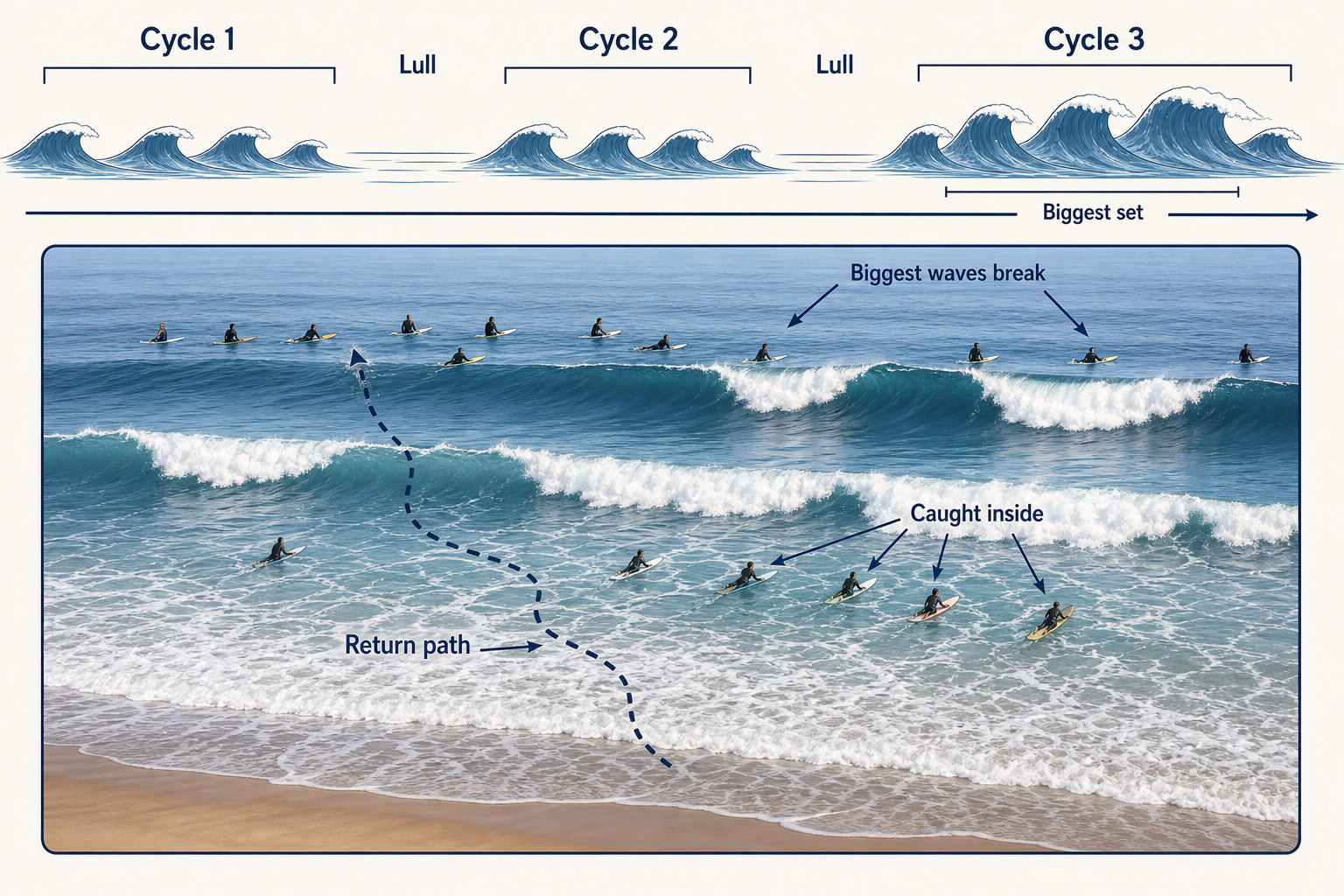
Sketchy surf often comes in pulses. Long-period swells can have long lulls, then arrive in sets that are far larger than the waves in between. If you only watch for five minutes, you might catch the friendly part of the cycle and miss what the real sets actually look like.
At reef and slab waves, the biggest set waves may break wider or deeper than the average waves. At beachbreaks, a large set may close out the whole lineup. At big-wave spots, the cleanup set is often the true hazard because it breaks well outside the normal takeoff zone.
A useful habit is to watch at least three full set cycles. Notice where the biggest waves break, where surfers get caught inside, and how long it takes them to return to the lineup. That information tells you more than any forecast number will.
Rideable Versus Unmakeable Dangerous Waves
What Makes a Dangerous Wave Rideable?
A dangerous wave can still be high quality if it has a clear path. The surfer needs a defined takeoff zone, a line through the critical section, and a possible exit.
Rideable dangerous waves often share these traits:
- An angled peel: the wave breaks progressively rather than all at once.
- A defined shoulder: open face exists ahead of the breaking lip.
- A makeable barrel line: the tube opens down the line rather than pinching shut immediately.
- A stable entry point: surfers can predict where to sit with confidence.
- A workable tide window: enough water covers the reef or sandbar.
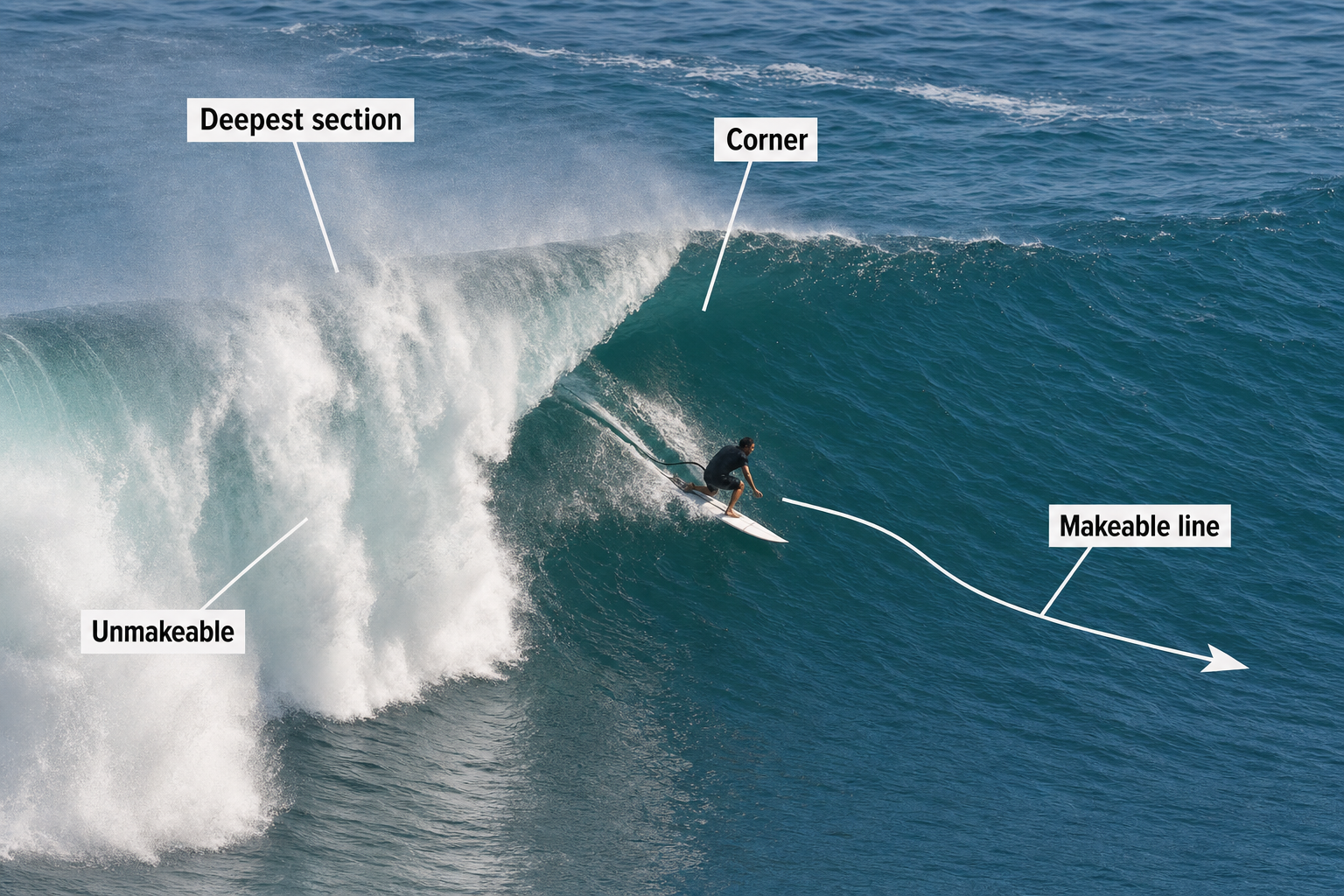
Advanced surfers often look for the “corner” of a heavy wave. The deepest part may be unmakeable, but the corner offers a line where the wave is still hollow and fast without being completely closed out.
What Makes a Dangerous Wave Unmakeable?
An unmakeable wave breaks faster than a surfer can travel, or offers no exit from the barrel. It may look spectacular in a photo, but it isn’t a functional surf wave.
Unmakeable waves tend to show these clues:
- The lip lands far out in the flats: the barrel is too square to outrun.
- The shoulder disappears instantly: the wave clamps completely shut.
- The whole line breaks at once: there is no peeling direction.
- The trough drains too aggressively: the takeoff effectively goes below sea level.
- The exit pinches against reef or rocks: there is simply nowhere to go.
One of the hardest judgments in heavy surf is deciding whether a wave is makeable from inside the barrel. Some waves look impossible from the beach but have a high line that works. Others look perfect until the last section doubles up and closes the door completely.
How Hard Are Dangerous Waves to Surf?
Why Dangerous Waves Require More Than Basic Surf Skill
Dangerous waves are difficult because they compress every decision. The surfer must paddle in, set the rail, read the section, and adjust speed almost simultaneously. There is little room for hesitation.
Key skills include:
- Late takeoff control: staying balanced as the board drops under the lip.
- Rail commitment: holding a line on a steep or bumpy face.
- Speed management: pumping, stalling, or high-lining at the right moment.
- Barrel judgment: knowing when to drive, when to stall, and when to exit.
- Lineup awareness: reading sets, currents, and shifting peaks in real time.
The same wave can be manageable for a specialist and nearly impossible for a skilled intermediate surfer. A clean six-foot reef barrel may be more difficult than a twelve-foot rolling point wave because the margin for error is so much smaller. If you want to deepen your understanding of wave mechanics and technique, a book like this surf technique guide covers a lot of the foundational concepts in real depth.
Equipment for Sketchy Waves
Board choice depends on the type of dangerous wave. A small slab may require a strong, responsive step-up with enough rocker to handle a steep drop. A big-wave reef may need a longer gun that paddles fast and holds a rail at high speed. A heavy beachbreak may call for a board that balances paddle power with quick turning.
Common equipment choices include:
- Step-up boards: useful for overhead reefs and powerful beachbreaks.
- Big-wave guns: designed for speed, paddle power, and hold at scale.
- Tow boards: used when paddle entry is too difficult or too slow.
- Thicker glassing: helps boards survive heavy lips and turbulence.
- Reliable leashes: important in large surf, though no leash is fail-proof.
Good grip on your board also becomes more critical in powerful surf. A solid surf traction pad gives you consistent foot placement on the tail, which matters a lot when the drop gets steep and fast. Fresh surf wax on the deck is equally important — don’t overlook either one before a serious session.
How to Surf Dangerous Waves More Effectively
Positioning for Heavy Waves
Positioning is everything in dangerous surf. Sit too deep and the wave may detonate directly on you. Sit too wide and you may miss it or get caught by the next one. The best surfers use landmarks, boil patterns, and the behavior of other surfers to triangulate the takeoff zone.
On reef waves, the takeoff spot is often fixed. On beachbreaks, it may shift constantly. On slabs, the correct position can be extremely precise because the wave only becomes makeable at one specific part of the ledge.
Watch where successful rides begin. Then watch where failed rides begin. The difference is often only a board length or two.
The Takeoff on Dangerous Waves
The takeoff is usually the most critical moment. In hollow surf, paddling too slowly leaves the surfer hung in the lip. Angling too much may cause the rail to skip or the board to slide out. Going straight may lead to a heavy bottom impact or a section that closes out before you can react.
A strong takeoff in heavy surf usually involves:
- Early commitment: start paddling before the wave is already pitching.
- Controlled angle: set a line without sliding sideways on the drop.
- Low stance: absorb chop, steps, and sudden acceleration through your legs.
- Eyes down the line: focus on the exit rather than the lip behind you.
On some slabs, the surfer must take off late because the wave simply doesn’t offer early entry. On big waves, the opposite is usually true — entry needs to happen early enough to match the wave’s speed before it stands up fully.
Making the Section on Fast Dangerous Waves
Once riding, the surfer’s main job is to match the speed of the wave. If the wave is hollow, a high line can be faster than a deep bottom turn. If the barrel is too open, stalling may be necessary to let it catch up. If the section starts to pinch, driving forward toward the shoulder is usually the right call.
In heavy surf, efficiency matters more than style. The right line is the one that carries you through the most critical part of the wave while keeping the board connected to the face.
Conditions That Create Sketchy and Dangerous Waves
Bottom Structure and Seabed Gradient
The seabed determines how a wave breaks. A gentle slope usually produces spilling waves with softer lips. A steep or abrupt change in depth creates plunging waves. Dangerous waves typically break where deep water meets shallow reef or sand in a very short distance.
| Bottom type | How it creates dangerous waves | Common wave result |
|---|---|---|
| Shallow reef ledge | Swell hits abrupt depth change | Slab, barrel, heavy lip |
| Coral reef pass | Swell bends and focuses along reef | Fast peeling barrel |
| Steep sand beach | Wave breaks close to shore | Shorebreak, closeout |
| Outer rock reef | Large swell shoals in deep water | Big-wave peak |
| Submarine canyon | Canyon focuses and amplifies swell | Huge peaks, shifting takeoffs |
A commonly cited breaking rule is that waves tend to break when wave height reaches approximately 78 percent of water depth. Real surf spots are far more complex, but the principle is useful. When the bottom rises sharply, the wave is forced to break hard and fast.
Swell Direction and Dangerous Wave Angles
Swell angle determines whether a wave peels or closes out. A swell that hits a reef or sandbar straight on may break all at once. A swell that crosses the bottom feature at an angle is far more likely to produce a peeling wall.
For many reef and point waves, a swell angle of roughly 20 to 45 degrees across the breaking line creates the best shape. Too much angle can make the wave race too fast or miss the reef altogether. Too little angle causes the wave to square up and shut down quickly.
Slabs are different. Some need swell approaching almost directly from deep water so the ledge throws the wave outward. Others need a secondary wedge or side angle to create a makeable corner in the first place.
Typical Wave Periods for Dangerous Surf
Dangerous waves can occur across many period ranges, but the heaviest surf is most often linked to long-period groundswell.
| Wave type | Typical period | Effect |
|---|---|---|
| Chaotic wind swell | 7 to 10 seconds | Messy peaks, short lulls |
| Powerful beachbreak | 10 to 14 seconds | Fast barrels, strong rips |
| Heavy reef barrel | 12 to 18 seconds | Hollow shape, stronger draw |
| Slab wave | 12 to 20 seconds | Thick lip, abrupt detonation |
| Big-wave reef | 16 to 22+ seconds | High speed, huge water volume |
Longer period isn’t always better for surf quality. At some spots, very long-period swell closes out the reef or makes the wave break too far outside. At others, long period is exactly what turns a normal wave into a world-class barrel.
Typical Wave Heights for Sketchy Waves
Danger doesn’t begin at a fixed height. A head-high slab over shallow reef can be more dangerous than a triple-overhead wave breaking in deep water. That said, certain height ranges are commonly associated with increased risk.
- Chest-high to overhead: dangerous in shorebreak, slabs, or very shallow reef.
- Overhead to double overhead: serious at hollow reefs and powerful beachbreaks.
- Double overhead to 20-foot faces: expert-only at most heavy-water spots.
- 20-foot faces and larger: big-wave territory requiring specialized equipment.
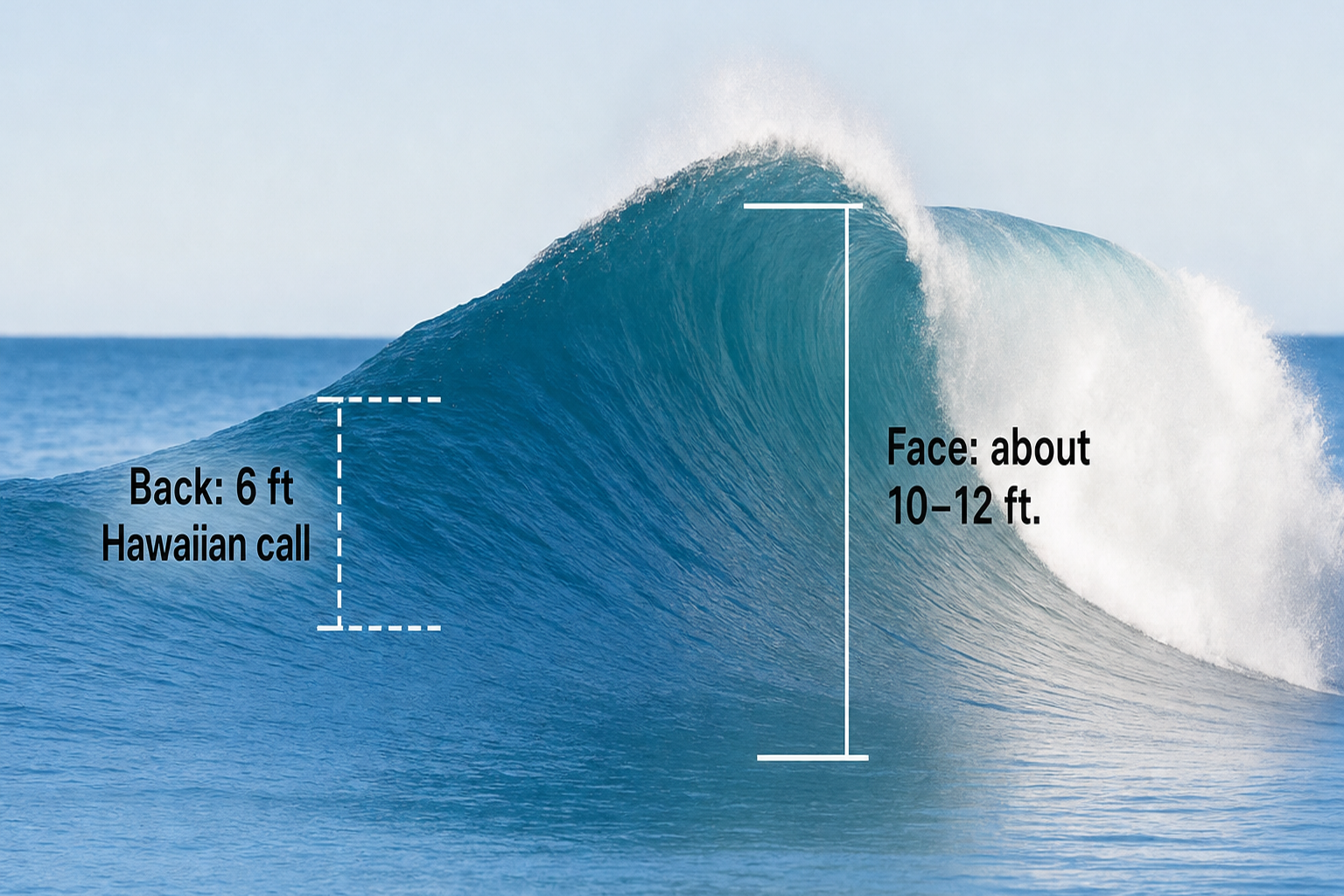
Surf height is also described differently depending on where you are. Hawaii traditionally uses a scale that refers to the back of the wave rather than the face. A “six-foot” Hawaiian wave may have a face closer to 10 or 12 feet by most other standards.
Tides and Dangerous Waves
Tide can completely change a wave’s personality. A reef that is perfect at mid tide may be dry and unrideable at low. A shorebreak that is manageable at low tide can become brutal at high tide when waves detonate directly on the sand with nowhere for the energy to go.
Common tide patterns include:
- Low tide: hollower waves, shallower water, more exposed reef.
- Mid tide: often the best balance of shape and water depth at reef breaks.
- High tide: fuller waves at some reefs, heavier shorebreak at steep beaches.
- Outgoing tide: stronger rips near channels, passes, and river mouths.
- Incoming tide: extra water coverage over reef, but sometimes more backwash.
There’s no universal “safe” tide for heavy surf. Each dangerous wave has its own specific tide window, and that window can shift with swell size and direction.
Wind, Backwash, and Surface Texture
Wind controls how clean or chaotic a dangerous wave becomes. Light offshore wind holds the lip up and opens barrels. Strong offshore wind can actually make takeoffs harder by blowing spray back up the face and stalling the surfer’s momentum. Onshore wind reduces barrel quality and adds chop that makes the face less predictable.
Backwash is another sketchy factor. When water rebounds off cliffs, seawalls, or steep beaches, it can run back into incoming waves and create warbles, double-ups, and sudden steps in the face. Some famous dangerous waves rely on exactly this wedge effect, but it makes timing significantly harder to get right.
Famous Dangerous Waves Around the World
Teahupo’o, Tahiti
Teahupo’o is one of the most famous heavy reef waves on earth. Long-period south and southwest swells hit a shallow reef shelf, creating a wave that looks like the ocean is folding over itself. The lip is extremely thick, and the reef sits just below the surface at low tide. It’s often described as a below-sea-level wave because the trough drains so dramatically. Surfing here without proper reef protection isn’t something to take lightly. Reef booties are a standard piece of kit at venues like this, and so is a surf helmet for surfers pushing deeper into the barrel.
Pipeline and Backdoor, Hawaii
Pipeline breaks over a series of reef ledges on Oahu’s North Shore. It can produce perfect barrels, but the takeoff is steep and the reef is shallow. Different swell directions activate different parts of the reef. West and northwest swells create Pipe or Backdoor barrels, while larger sets can shift the takeoff zone farther outside. A cold-water session here in winter makes a quality full wetsuit worth considering even in Hawaii’s relatively warm conditions.
Mavericks, California
Mavericks is a cold-water big-wave reef near Half Moon Bay. Large west and northwest swells hit an outer reef and produce massive peaks with serious power. The wave has a long drop, a powerful bowl section, and a punishing inside zone. Cold water and thick rubber are non-negotiable here. A well-fitted long-sleeve rash guard worn under your wetsuit adds warmth and cuts down on suit rash during long sessions.
Jaws, Maui
Jaws, also called Pe’ahi, is one of the world’s most recognized big-wave spots. It breaks on large north swells and produces enormous, fast-moving walls with clean faces. The wave is suited to elite paddle surfers or tow teams when it reaches its full potential. Boards at Jaws take a beating, and carrying a solid surfboard ding repair kit means a minor impact doesn’t end your trip early.
Shipstern Bluff, Tasmania
Shipstern Bluff is a cold, remote slab known for its steps. The wave forms ledges inside the face as it breaks over uneven reef, making the drop and barrel unpredictable in a way that most other waves simply aren’t. The setting adds further intensity, with cliffs and raw Southern Ocean swell. This is one spot where wearing an impact vest isn’t optional — it’s smart.
The Right and Cyclops, Western Australia
The Right and Cyclops are among the most intimidating slab waves in Western Australia. Both break over shallow reef with thick, square barrels. They are often associated with tow surfing because the takeoff can be extremely late and the lip is enormous. These spots also have strong, fast-moving currents that make swimming in after a wipeout a serious issue.
Nazaré, Portugal
Nazaré is famous for some of the largest surfed waves ever recorded. The Nazaré Canyon focuses Atlantic swell toward Praia do Norte, creating huge peaks that shift across the lineup. It’s not a classic reef barrel — the danger here comes from size, speed, turbulence, and the wave’s constantly shifting takeoff zones. If you’re lucky enough to film a session at a spot like this, a reliable waterproof action camera paired with a high-capacity microSD card means you won’t run out of storage mid-session.
Puerto Escondido, Mexico
Puerto Escondido is a sand-bottom beachbreak with reef-like power. South and southwest swells produce heavy barrels, but the same swell can also deliver massive closeouts. The paddle-out, currents, and impact zone make it one of the world’s most respected and feared beachbreaks. Because the bottom is sand, some surfers underestimate it. That’s always a mistake.
Cloudbreak, Fiji
Cloudbreak is a long left reef pass that can range from playful to extremely heavy depending on swell size and direction. On large southwest swells, it becomes a powerful barrel with long sections and serious reef consequences if things go wrong. Its quality is world-class, but its size and speed can be unforgiving.
Reading Dangerous Waves Comes Down to Pattern Recognition
Sketchy waves aren’t random. They are the visible result of swell energy meeting bottom shape under a particular combination of tide and wind. The more carefully you study those ingredients, the easier it becomes to understand why a wave is hollow, why it’s closing out, or why the next set might break much farther outside than the last one.
The key is to judge more than size. Look at period, angle, seabed, tide, and the way the lip throws. A dangerous wave can be a perfect barrel if it peels with a clear exit. It can also be an unmakeable trap if it shuts down over shallow water with no room to escape. For surfers, that distinction is everything. The best heavy waves reward precise reading, complete commitment, and genuine respect for the ocean’s power.