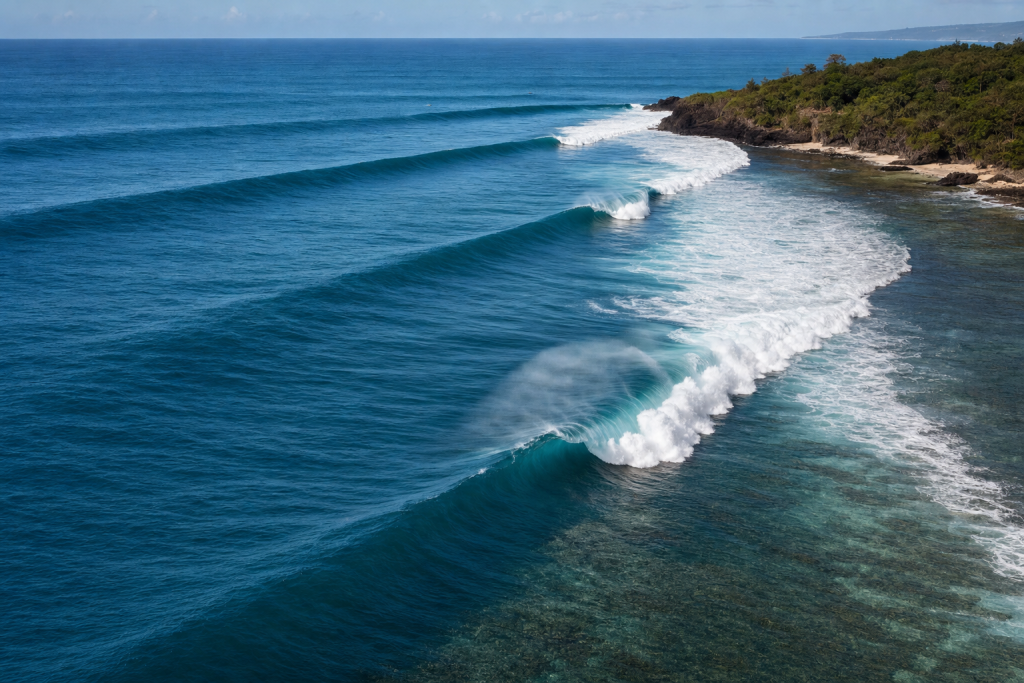
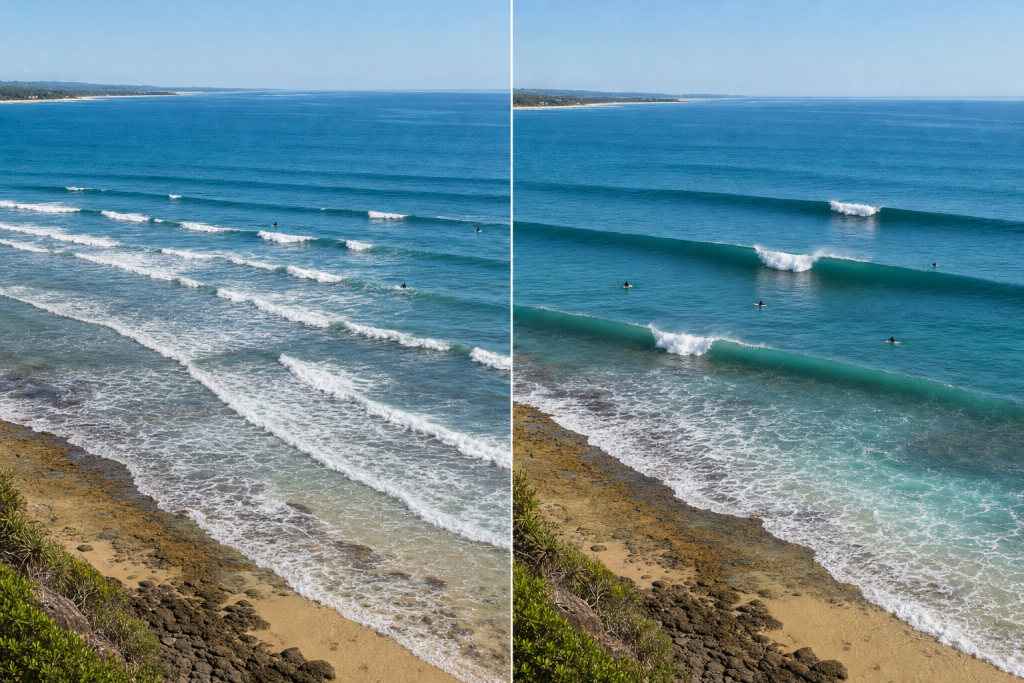
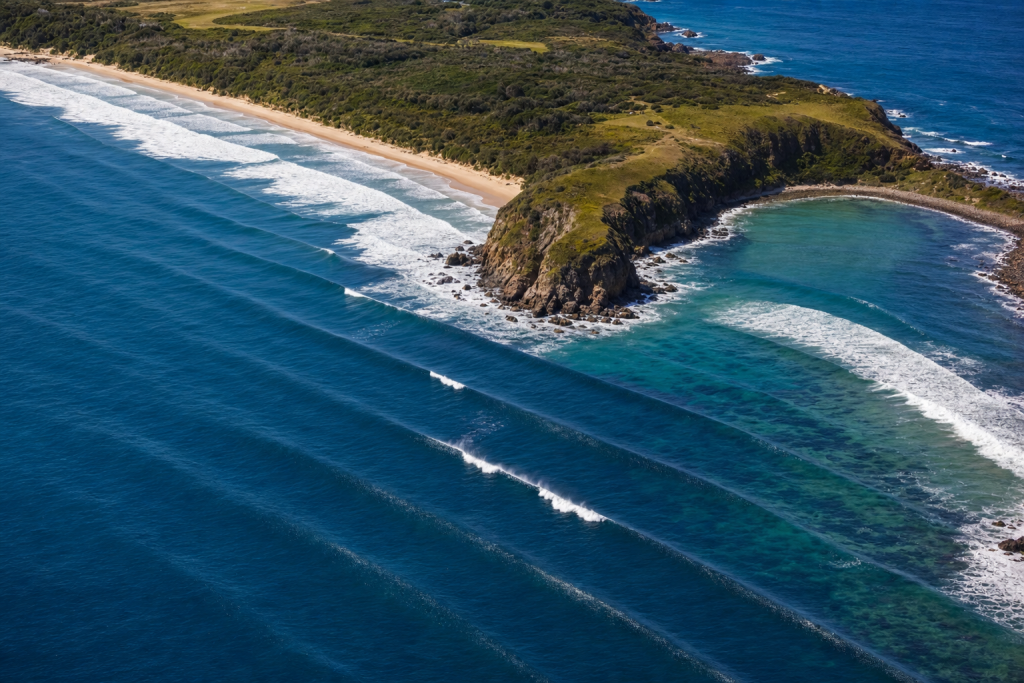
Every surfable wave begins with wind blowing over water, but not every swell arrives at the beach in the same form. Some swells are short-period, choppy, and produced close to the coast. Others travel thousands of miles as long, organized lines that bend into reefs and points with surprising power. Understanding the difference between wind swells and ground swells is one of the most useful skills in surf forecasting because it helps you predict wave quality, consistency, and which breaks will come alive. If you want to go deeper on the science behind it all, this surf forecasting guide breaks down how swells are generated and how to read them for your local break.
Types of Swells That Generate Surfing Waves
In surf forecasting, a swell is a train of waves moving through the ocean. Swells are usually described by three main characteristics:
- Swell height: the average size of the swell in deep water.
- Swell period: the time in seconds between passing wave crests.
- Swell direction: the compass direction the swell is traveling from.
The main types of swells surfers talk about are wind swell and ground swell. You may also hear terms like local swell, long-period swell, and hurricane swell. These are not always separate scientific categories, but they are useful ways to describe how a swell was generated and what it may feel like in the water. For a broader look at ocean wave science, this book on ocean wave science covers the forces that drive everything from everyday swells to rogue waves.
Wind Swell
A wind swell is produced by wind blowing over the ocean relatively close to the surf spot. It usually has a shorter period, less organization, and less deep-water energy than a ground swell. Wind swells are common in places exposed to nearby storms, coastal low-pressure systems, or strong local winds.
Typical wind swell periods are often in the range of 5 to 10 seconds, although the exact cutoff varies by region. A 9-second swell might feel decent in one location and weak in another, depending on bottom shape and exposure.
Ground Swell
A ground swell is a longer-period swell that has usually traveled a great distance from the storm that created it. As it moves away from the storm, the wave train becomes more organized. The faster, longer-period waves outrun the shorter-period ones, producing cleaner lines and more powerful surf when the swell eventually reaches shallow water.
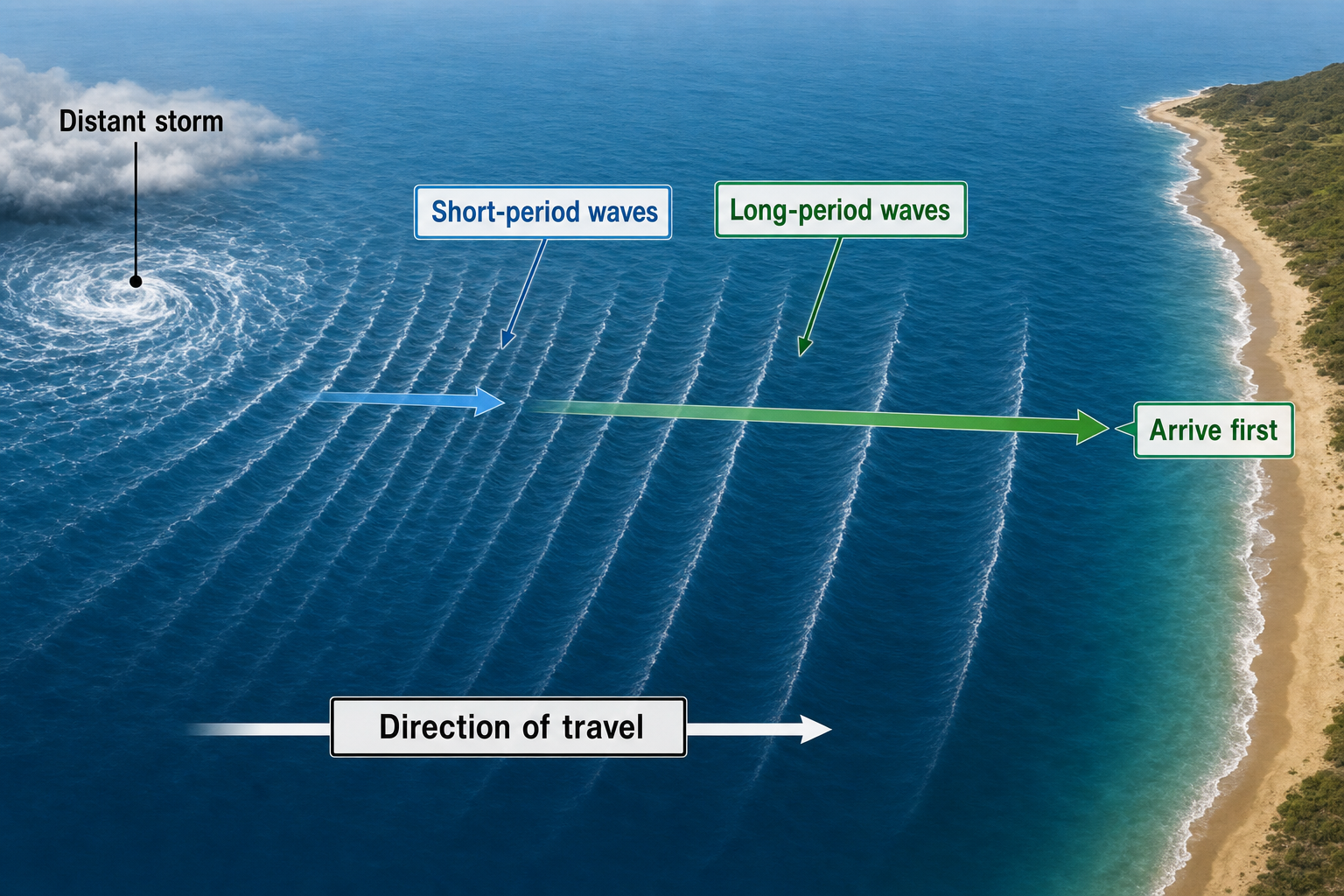
Ground swell periods are commonly 10 seconds or longer, with major ocean swells often reaching 14 to 20 seconds or more. These swells can produce waves much larger than the deep-water swell height suggests, especially at reefs, points, and submarine canyons that concentrate wave energy.
Combo Swell
A combo swell happens when two or more swell trains arrive at the same time. For example, a beach might receive a short-period wind swell from a nearby storm alongside a long-period ground swell from a distant system. Combo swells can create peaks at beach breaks because different wave directions intersect and wedge together.
Combo swell can be excellent, but it can also be unpredictable. One swell may produce the main wave energy while the other adds texture, peaks, or crossed-up conditions.
Hurricane Swell and Cyclone Swell
Hurricane swell, also called cyclone swell in some regions, is generated by tropical storms. It can behave like wind swell or ground swell depending on how far away the storm is, how powerful it becomes, and how long it tracks over open water.
A distant, slow-moving hurricane can produce powerful long-period swell with clean lines. A nearby tropical storm can produce raw, stormy, short-period surf. This is why hurricane surf can range from groomed, world-class waves to messy, short-lived conditions.
How Wind Swell Is Generated
Wind swell forms when wind transfers energy into the ocean surface. At first, small ripples form. If the wind keeps blowing, those ripples grow into waves. The size and quality of the resulting swell depend on three core ingredients:
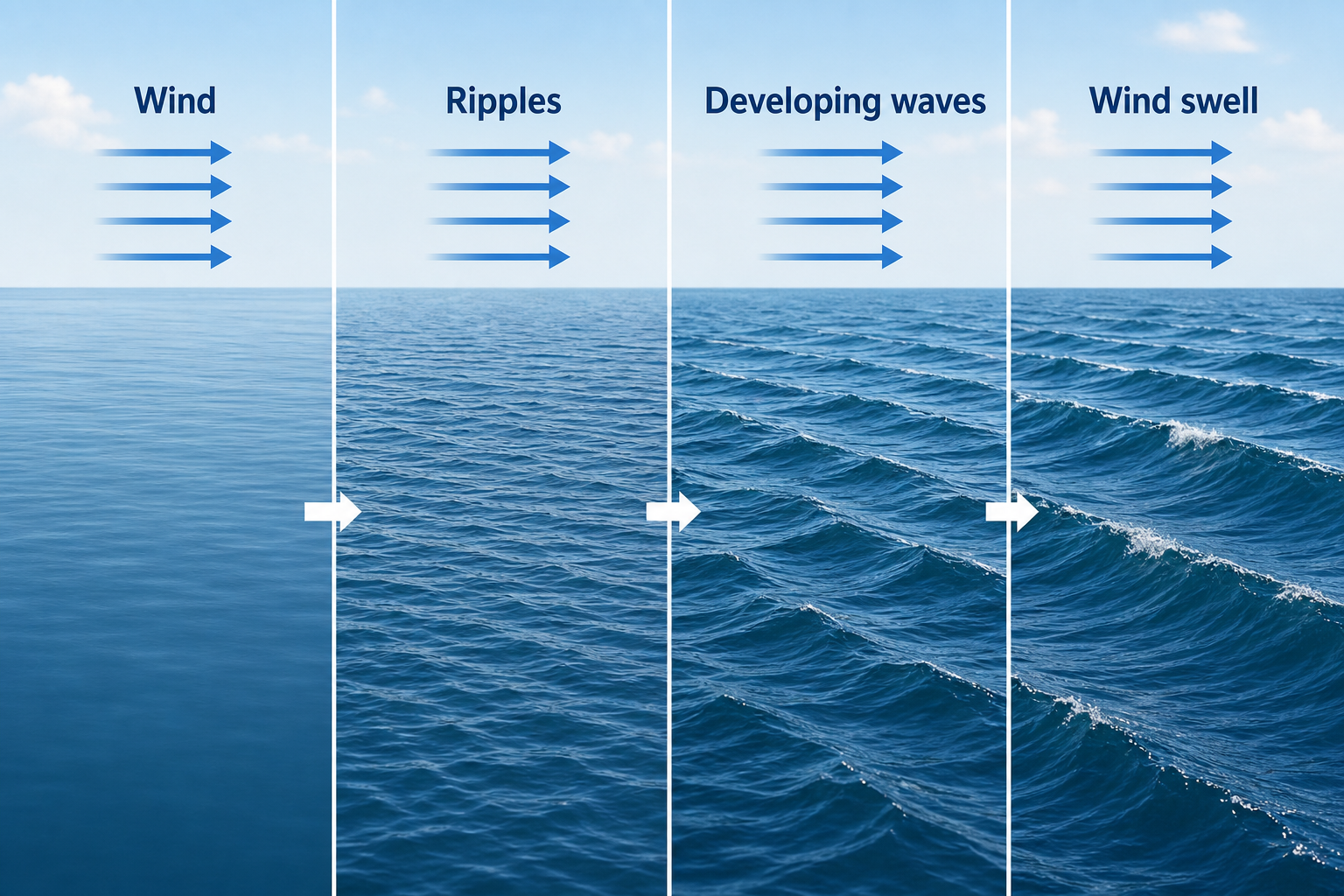
- Wind speed: stronger wind puts more energy into the water.
- Wind duration: wind must blow long enough for waves to build.
- Fetch: the distance over water that wind blows in one direction.
Wind swell is usually generated over a limited fetch close to the coast. Because the waves do not have much time or distance to sort themselves out, the resulting swell is often mixed, uneven, and closely spaced. If you like tracking local wind conditions at the beach, a handheld anemometer can give you a quick read on speed and direction before you paddle out.
Short-Period Wind Swell and Local Conditions
Short-period wind swell is closely tied to local weather. If the wind is blowing hard onshore, the surf may build quickly but become bumpy and disorganized. If the wind switches offshore after the swell has filled in, conditions can improve fast — sometimes for only a few hours.
This makes wind swell tricky to forecast. It can rise and fade within a single day. A morning session might be fun and peaky while the afternoon turns weak or blown out. Keeping an eye on barometric pressure trends can help, and a portable weather station is handy for monitoring conditions at home or at the beach.
Why Wind Swell Feels Less Powerful
Wind swell generally has shorter wavelengths, which means the energy is concentrated closer to the ocean surface. As the swell approaches shallow water, it has less deep energy to interact with the seabed. The waves may break abruptly, but they often lack the push of a longer-period swell.
This is why a 4-foot wind swell at 7 seconds may feel much weaker than a 4-foot ground swell at 15 seconds. The height number alone does not tell the whole story — swell period is often the key to understanding power.
How Ground Swell Is Generated
Ground swell is also created by wind, but the source is usually a large storm far from the surf spot. These storms may form in the North Pacific, South Pacific, North Atlantic, or Southern Ocean. When a storm has strong wind, a broad fetch, and enough duration, it can produce long-period waves that travel across entire ocean basins.
As the swell moves away from the storm, it undergoes a process called dispersion. Longer-period waves travel faster than shorter-period waves, so they spread out and arrive first. By the time a ground swell reaches a distant coastline, it often appears as clean, evenly spaced lines.
Long-Period Ground Swell and Wave Energy
Long-period ground swell contains energy that extends deeper below the ocean surface. A useful deep-water estimate is that wavelength in meters is roughly 1.56 multiplied by the swell period squared. That means a 15-second swell has far more spacing and deeper energy than an 8-second swell of the same height.
When this deeper energy feels the seafloor, the wave slows, steepens, and refracts. At certain reefs and points, the energy can focus into hollow, powerful surf. At other coastlines, the same swell may close out or pass by with little effect, depending on direction and bottom shape.
Why Ground Swell Can Arrive Before Local Weather Changes
Because ground swell travels away from its generating storm, it can arrive under sunny skies and light local winds. This is one of the great pleasures of surfing: waves from a storm thousands of miles away can reach a coastline with no obvious sign of bad weather nearby.
Forecasters track these swells using storm charts, buoy data, satellite measurements, and swell models. A long-period forerunner may show on offshore buoys well before the main energy arrives at the beach. A pair of compact binoculars can also help you study incoming sets from the shore before committing to a paddle out.
Wind Swell vs Ground Swell: The Key Differences
| Feature | Wind Swell | Ground Swell |
|---|---|---|
| Source | Nearby or local wind systems | Distant storms over open ocean |
| Typical period | About 5 to 10 seconds | About 10 to 20+ seconds |
| Organization | Often uneven and mixed | More lined up and consistent |
| Power | Usually weaker for the same height | Usually stronger for the same height |
| Set pattern | Shorter lulls and fewer defined sets | Clearer sets and longer lulls |
| Best suited to | Beach breaks and local peaks | Reefs, points, and powerful beach breaks |
The simplest way to think about it: wind swell is younger and closer to its source, while ground swell is older and more traveled. Ground swell has had time to organize. Wind swell is still raw.
What Wind Swell Is Like to Surf
Surfing wind swell can be fun, especially at beach breaks that thrive on short-period energy. The waves often break in shifting peaks rather than long, predictable lines. This creates plenty of opportunities, but it can also make positioning harder.
Wind Swell Wave Shape
Wind swell waves tend to be steeper over a shorter distance. They may jack up quickly, crumble early, or break in sections. On a good sandbar, this can produce punchy ramps and short barrels. On a poor sandbar, the surf may be weak, bumpy, and hard to read.
Because the period is short, waves arrive close together. This can make paddling out more tiring, but it also means fewer long waits between rides.
Best Surfboards for Wind Swell
Wind swell often favors boards that generate speed easily. Grovelers, fish designs, and fuller shortboards can help surfers make the most of weaker sections. In punchier wind swell, a standard shortboard may work well if the waves have enough face and steepness. Whatever board you ride, having the right fin setup makes a real difference — a set of soft-top surfboard fins can be a practical option, especially for smaller or softer conditions.
When Wind Swell Can Be Excellent
Wind swell is not automatically bad. In regions without consistent long-period swell windows, it may provide most of the surfable days. Wind swell tends to shine when the fetch is strong and aimed directly at the coast, the wind turns offshore as the swell peaks, or the beach has sandbars that shape short-period waves well. Some of the most enjoyable everyday surf comes from modest wind swell paired with clean local winds.
What Ground Swell Is Like to Surf
Ground swell usually feels more powerful, organized, and predictable. The waves often arrive in distinct sets with longer lulls between them. At quality surf spots, ground swell can produce long walls, clean lines, and more open faces for committed turns.
Ground Swell Wave Shape
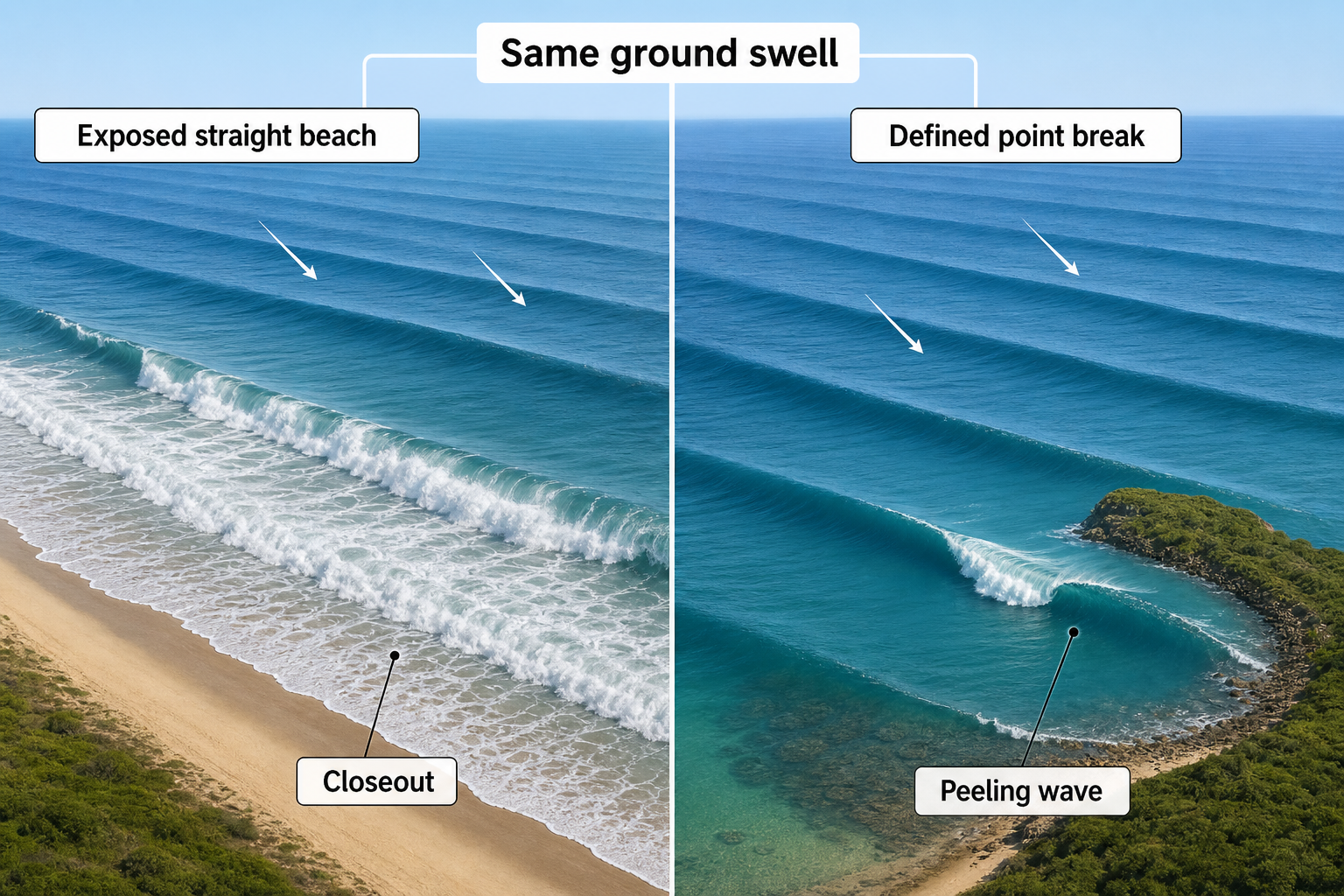
Ground swell tends to wrap into coastlines and interact strongly with underwater features. At a point break, it may peel for hundreds of yards. At a reef, it may stand up suddenly and throw a hollow barrel. At a beach break, it can create strong peaks but may also close out if the swell is too straight or too large.
This is one reason swell direction matters so much. A powerful ground swell from the wrong angle may miss a spot, overload it, or produce unmakeable lines. The same swell hitting a better-aligned break may be exceptional.
Ground Swell and Set Waves
Ground swell often arrives in sets because the wave energy is grouped together. A surf spot might be calm for several minutes and then suddenly receive a run of larger waves. This set pattern is part of what makes ground swell exciting and challenging to navigate.
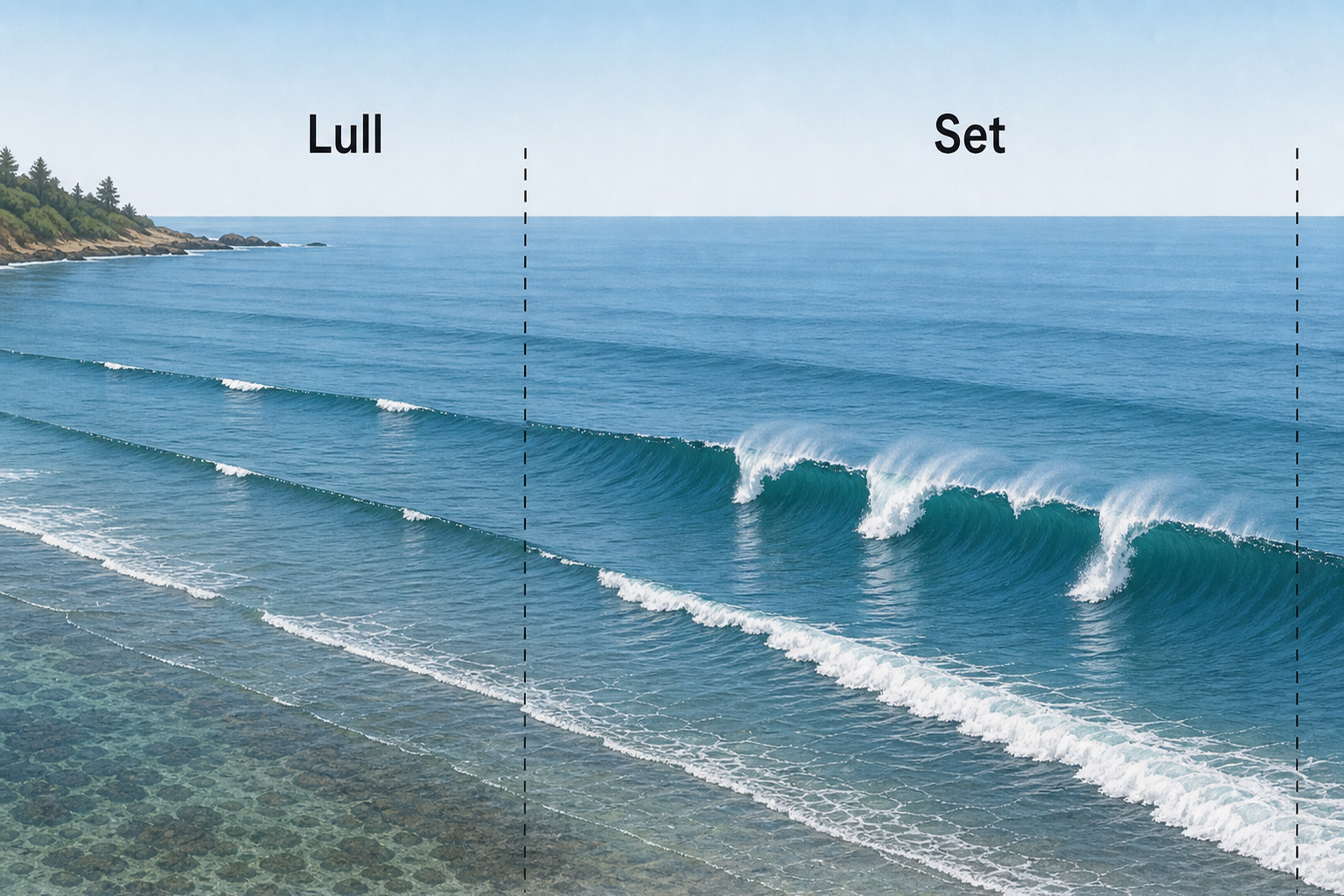
Longer-period swells also refract more strongly. They bend around headlands, focus over reefs, and can reach sheltered spots that short-period swells simply cannot access. This is why a long-period swell may light up breaks that seem too protected on ordinary days.
Best Surfboards for Ground Swell
On good ground swell, surfers often reach for boards with more hold and control. A performance shortboard, step-up, or pin-tail design may be useful depending on wave size and power. The goal is not just catching waves but managing speed, rail engagement, and steep drops. In smaller long-period surf, a normal shortboard or mid-length may be ideal — the extra push from the swell can make even waist-high waves feel lively.
Which Type of Swell Is Better for Surfing?
Ground swell is generally better for high-quality surf because it is more organized, more powerful, and more capable of producing long, clean waves. Most world-class reefs and points depend on ground swell for their best days.
However, the “better” swell always depends on the surf spot. Some beaches close out on long-period swell but produce excellent peaks on shorter-period wind swell. Other breaks need long-period energy to wrap in or break at all.
When Ground Swell Is Better
Ground swell is usually better when the spot has a defined bottom feature like a reef, point, or outer sandbar. These setups use long-period energy efficiently. Ground swell is also preferred when surfers want longer rides, more power, and cleaner set waves.
When Wind Swell Is Better
Wind swell can be better at short, peaky beach breaks where too much period causes closeouts. A 6-foot, 16-second swell may turn a straight beach into a wall of whitewater, while a 3-foot, 8-second wind swell may create fun A-frame peaks. Wind swell is also valuable simply because it is frequent — in many regions, it fills the gaps between major ground swells and keeps local surfers in the water.
How Swell Period Changes the Surf
Swell period is one of the most important numbers in a surf forecast. Two swells with the same height can produce completely different surf if their periods differ.
Short-Period Swell
Short-period swell has waves packed close together. It is more affected by local wind and usually has less deep-water energy. It can produce fun surf, but the waves often lack the strength to wrap into sheltered spots or break with much length.
Mid-Period Swell
Mid-period swell, often around 10 to 13 seconds, can be a sweet spot for many beach breaks. It has more organization than raw wind swell but may not be so long-period that it closes out exposed beaches. Many everyday “good” sessions fall into this range.
Long-Period Swell
Long-period swell carries more energy and interacts more strongly with the seabed. It can create powerful surf even when the swell height looks modest, and it bends more effectively into protected breaks. At some spots, long-period swell turns an average forecast into a standout day.
How Swell Direction Affects Wind Swell and Ground Swell
Swell direction determines which coastlines receive energy and which surf spots are exposed. A beach facing directly into the swell will usually receive more size, while a point or reef may need a very specific angle to break properly. Understanding swell direction is much easier when you can interpret navigational charts — a nautical chart reference guide or a coastal navigation chart can help you visualize coastline angles and offshore features.
Wind swell is often more localized, so direction can shift quickly with the weather system. Ground swell usually has a more stable direction, especially after traveling a long distance. Still, even a small directional change can make a major difference at advanced surf breaks.
Swell Windows
Every surf spot has a swell window — the range of directions that can actually reach it. Islands, headlands, and continental shelves can block or filter swell energy. A famous break may be world-class on one swell angle and nearly flat on another. A reliable compass is worth keeping in your kit for confirming swell angles when you are scouting a new break.
Refraction and Focusing
As swell approaches shallow water, it bends toward areas where waves slow down. This bending is called refraction. Long-period ground swell refracts more strongly than short-period wind swell, which is why it can wrap around corners and focus into powerful peaks. Submarine canyons can amplify this effect dramatically — Nazaré in Portugal is the most famous example, where deep-ocean energy is focused by the Nazaré Canyon and surrounding seafloor topography into some of the largest waves ever surfed.
Famous Surf Spots Where Wind Swell Is Common
Some well-known surf regions rely heavily on local storms, seasonal winds, or nearby weather systems. These places can receive ground swell too, but wind swell is a frequent part of the surf pattern.
New Jersey, United States
New Jersey is known for powerful beach-break surf, especially during autumn and winter. Much of its regular surf comes from nearby low-pressure systems, nor’easters, and shorter-period Atlantic wind swells. When the wind turns offshore, the sandbars can produce fast, hollow waves.
Outer Banks, North Carolina, United States
The Outer Banks receives a mix of hurricane swell, nor’easter swell, and local wind swell. Because the coastline is highly exposed, it picks up energy from many directions. Short-period wind swell can create punchy beach-break peaks, while stronger storms can push the surf into serious territory.
Florida, United States
Florida’s Atlantic coast often depends on trade-wind swell, local wind swell, and tropical systems. Spots like Sebastian Inlet can be great fun on shorter-period swell when wind, tide, and sand all line up.
Hossegor, France
Hossegor is best known for powerful Bay of Biscay surf and can receive serious ground swell, but wind-driven Atlantic systems are also common. The area’s shifting sandbars can turn raw storm energy into heavy, hollow beach-break waves when conditions clean up.
Bondi Beach, Australia
Bondi and other Sydney beaches often receive short to mid-period swell from Tasman Sea weather systems. Local winds and nearby lows provide frequent surf, with quality depending heavily on wind direction and sandbar formation.
North Sea Surf Spots, United Kingdom
Breaks along the east coast of England and Scotland often rely on North Sea wind swell. Fetch is limited compared to open-ocean coasts, so swell periods are commonly shorter. When storms align well and local winds cooperate, the surf can be surprisingly good.
Famous Surf Spots Where Ground Swell Is Common
The world’s most iconic waves are usually associated with consistent long-period ground swell. These breaks are positioned to receive energy from distant storm belts and are shaped by reefs, points, or special coastal bathymetry.
Pipeline, Hawaii
Pipeline on Oahu’s North Shore is one of the clearest examples of a ground-swell reef break. It receives long-period North Pacific swell generated by powerful winter storms. The shallow reef transforms that energy into steep, hollow barrels close to shore.
Teahupoʻo, Tahiti
Teahupoʻo is powered mainly by long-period South Pacific ground swell. The wave breaks over a very shallow reef and is famous for its thick, surging appearance. The combination of deep-ocean energy and abrupt reef bathymetry makes it one of the most intense waves in surfing.
Uluwatu, Indonesia
Uluwatu receives consistent Indian Ocean ground swell, especially during the dry season. Southern Ocean storms send long-period energy toward Bali, where reef passes and trade winds often create clean, powerful surf.
Jeffreys Bay, South Africa
Jeffreys Bay — often called J-Bay — is a world-class right-hand point break that comes alive on Southern Ocean ground swell. The best swells wrap down the point in long, fast walls that connect through multiple sections.
Mavericks, California
Mavericks depends on large, long-period North Pacific ground swell. The deep-water energy hits an offshore reef and produces some of the heaviest cold-water waves in the world. Swell period and direction are crucial to making the wave break properly.
Nazaré, Portugal
Nazaré is famous for giant North Atlantic ground swell magnified by the Nazaré Canyon. Not every swell produces record-breaking heights, but the right long-period energy and direction can create extraordinary wave faces.
Cloudbreak, Fiji
Cloudbreak receives long-period South Pacific ground swell and breaks over a reef pass. It can range from playful, open walls to extremely powerful barrels depending on swell size, period, and direction.
How to Read a Surf Forecast for Wind Swell and Ground Swell
A surf forecast becomes much more useful when you look beyond wave height. The key is to compare swell period, direction, and local wind together. If you want to start tracking your sessions alongside forecast data, a dedicated surf journal is a great way to build pattern recognition over time. For jotting notes at the beach in any conditions, a weatherproof pocket notebook holds up against spray and moisture.
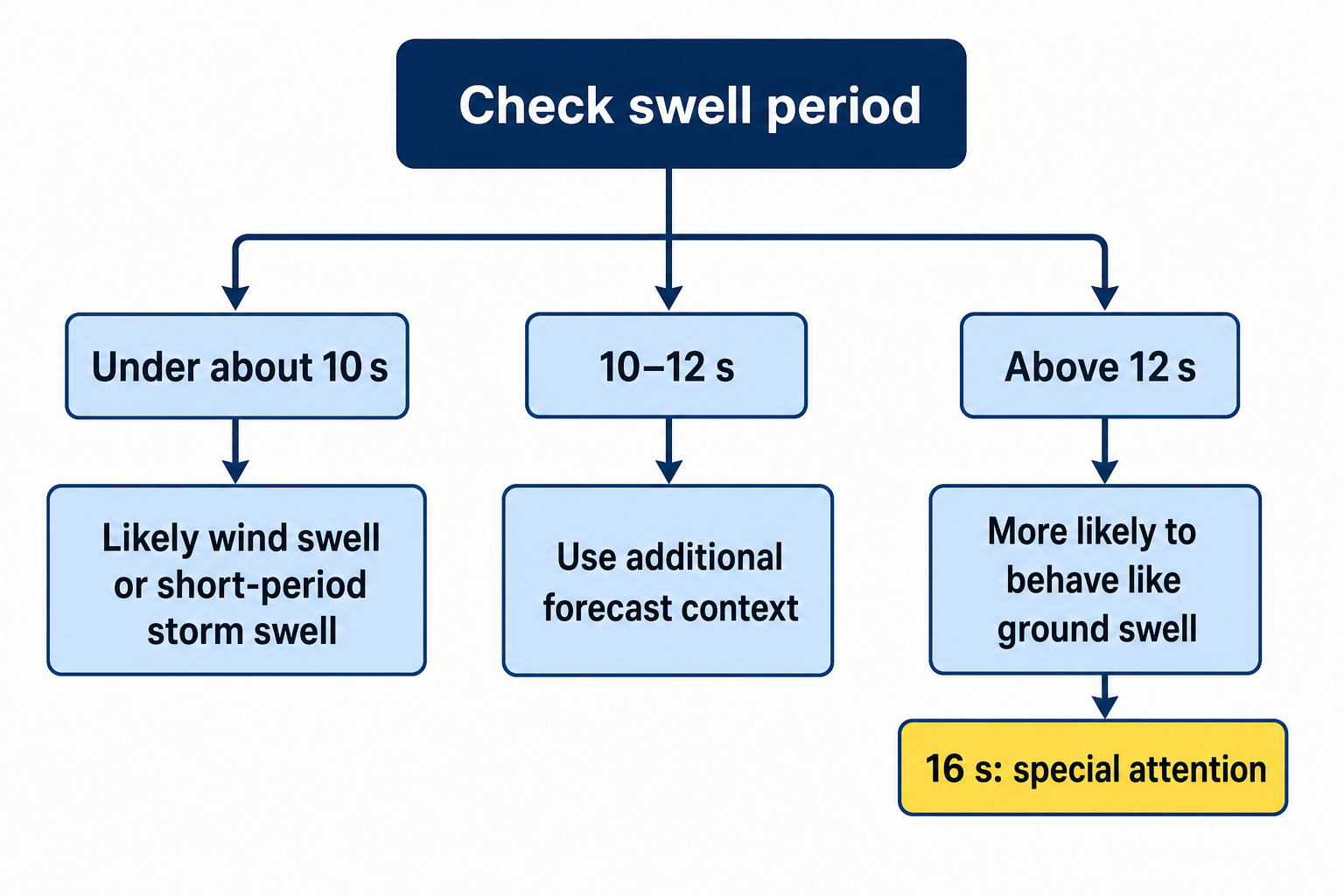
Step 1: Check the Swell Period
If the period is under about 10 seconds, you are probably looking at wind swell or short-period storm swell. If it is above 12 seconds, it is more likely to behave like ground swell. A 16-second swell deserves special attention because it may produce more power than the height reading suggests.
Step 2: Compare Swell Direction With the Spot
Ask whether the break is exposed to that swell angle. An east-facing beach may not receive much from a south swell, and a point break may need the swell to arrive from a narrow window. Local knowledge matters here because every coastline filters swell differently.
Step 3: Look at Local Wind
Swell creates the raw wave energy, but local wind shapes the surface. Offshore or light wind generally improves wave faces. Onshore wind can make even a strong ground swell messy. Wind swell forecasts are especially sensitive to local wind because the swell source may be nearby.
Step 4: Consider the Tide and Seafloor
Tide and bottom shape decide how incoming swell breaks. Some reefs need a particular tide. Some beach breaks depend on sandbars that shift after storms. A long-period ground swell might be excellent at one tide and too heavy or closed out at another. A simple tide clock mounted at home is a useful reference for planning sessions around tidal movement.
Common Misunderstandings About Wind Swell and Ground Swell
“Ground Swell Means the Waves Come From Under the Ground”
The term ground swell does not mean the wave originates on the seafloor. It still comes from wind. The name refers to the way long-period swell extends deeper into the water column and interacts more strongly with the seabed as it shoals into shallow water.
“Bigger Swell Height Always Means Bigger Surf”
Swell height matters, but period and direction can matter just as much. A 3-foot swell at 17 seconds may produce bigger breaking waves than a 5-foot swell at 7 seconds, especially at a spot that focuses long-period energy efficiently.
“Wind Swell Is Always Bad”
Wind swell can be messy, but it can also be excellent. Many beach breaks are at their best on short to mid-period swell. If the sandbars are good and the wind turns favorable, wind swell can deliver fast, fun, and very surfable waves.
“Ground Swell Is Always Better”
Ground swell often produces higher-quality waves, but it can overpower exposed beaches. Long-period energy may close out straight coastlines or make a spot too sectiony to surf well. The best swell is always the one that suits the break.
Putting Wind Swell and Ground Swell Together
Wind swell and ground swell are best understood as different stages of the same process: wind energy moving through the ocean. Wind swell is close to its source, usually shorter-period, and often raw. Ground swell has traveled farther, become more organized, and typically carries more power for its height. If you are filming sessions to study wave behavior or just want to capture the experience, an action camera paired with a high-capacity microSD card means you will never run out of storage at the wrong moment. And if you are heading into the water to check conditions with your phone, a waterproof phone pouch keeps your device protected near the shore.
For surfers, the practical lesson is straightforward: do not judge a forecast by height alone. Look at the period, direction, local wind, tide, and the type of break you plan to surf. Ground swell is often the source of the world’s best waves, but wind swell keeps many coasts alive between major storms. Once you understand how each swell behaves, a surf forecast becomes less like a guess and more like a reliable map to the best waves available.