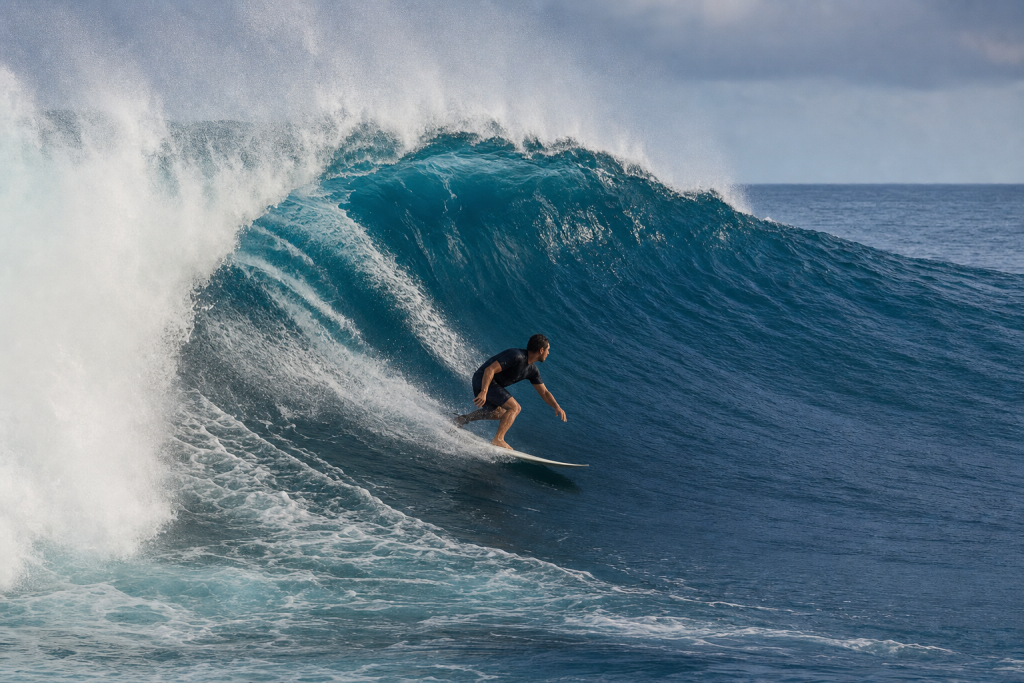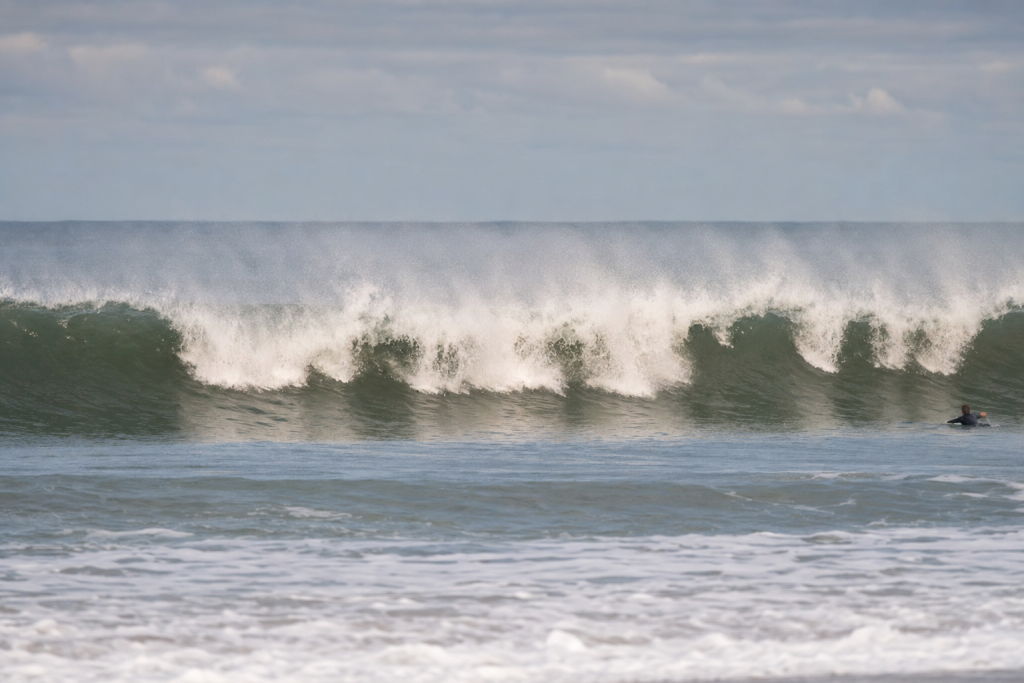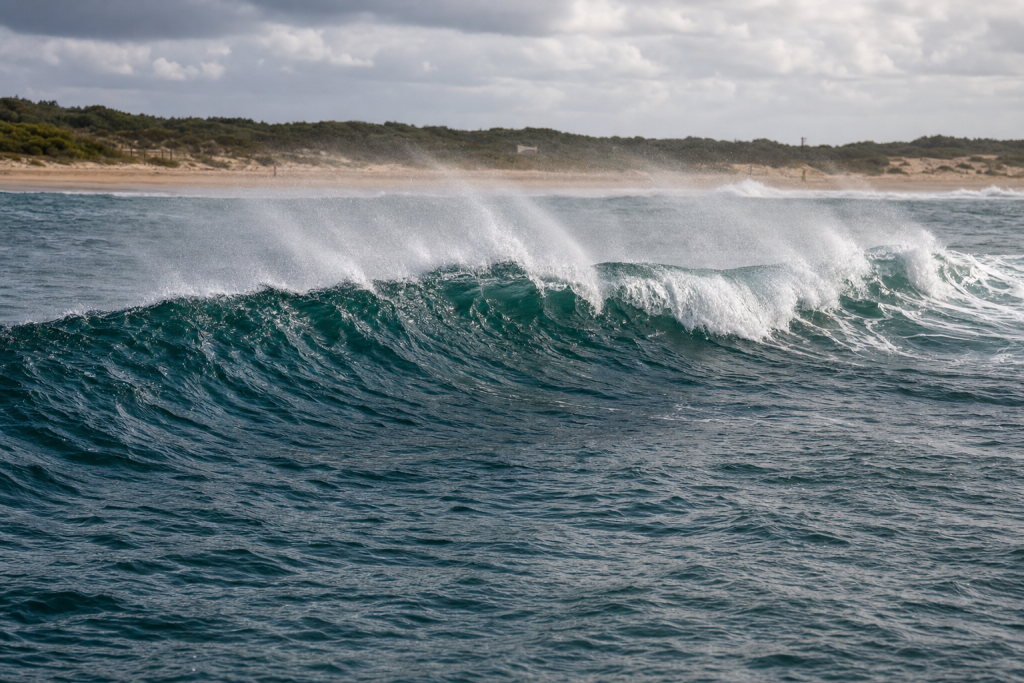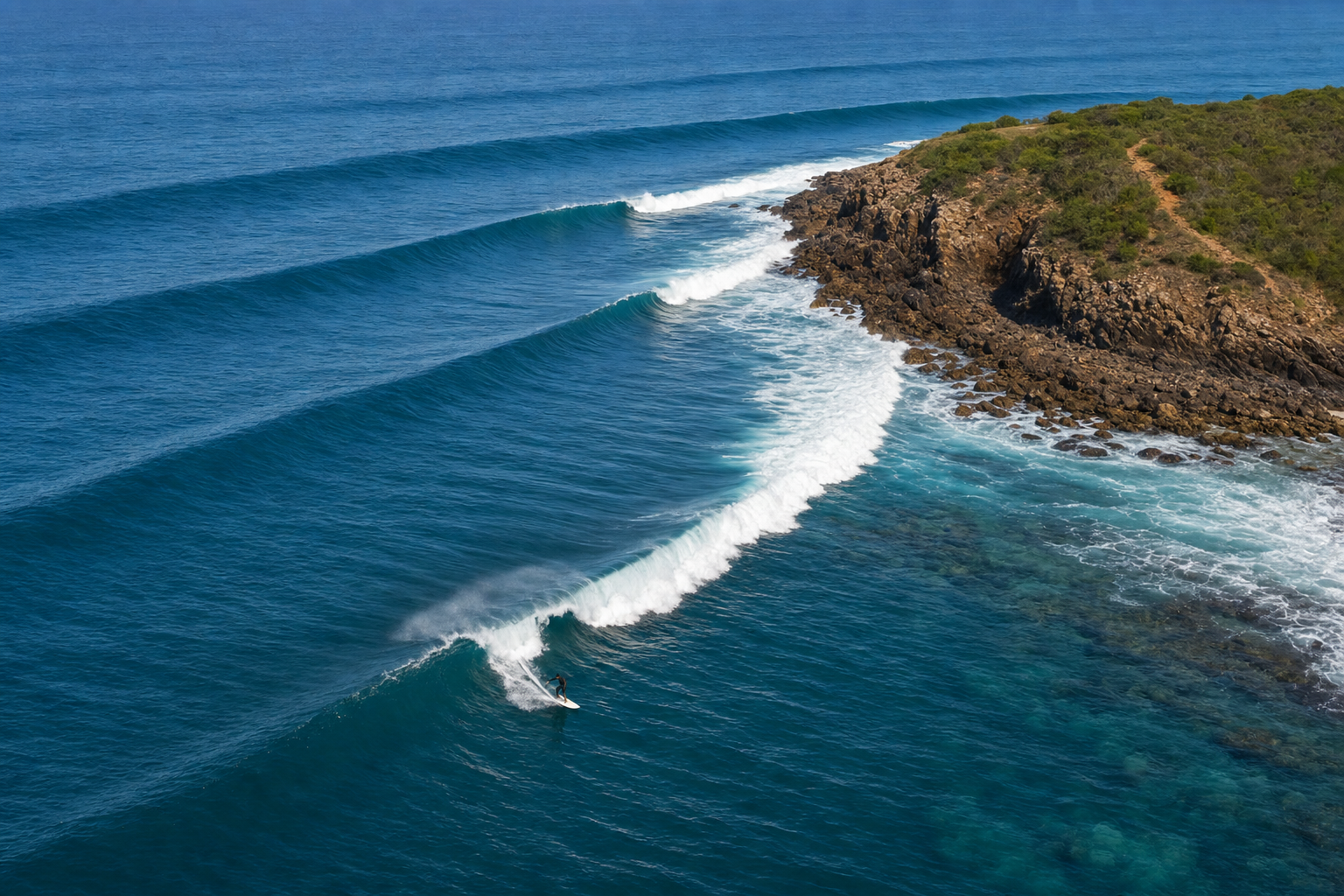
Wrapping waves are among surfing’s most treasured finds. They transform raw swell into long, organized walls that peel around a point, reef, or headland rather than dumping all at once. The wave bends into the coastline and releases its energy section by section, which is exactly why many legendary pointbreaks feel almost machine-made: the takeoff shows up in the same spot every time, the face opens down the line, and the ride can stretch far beyond what a straight beachbreak could ever offer. If you want to find and surf these waves more consistently, it helps to understand what actually creates them. A good surf technique book can also deepen your understanding of wave reading and positioning.
What Wrapping Waves Are and How They Form
A wrapping wave, sometimes called a wrap-around wave, forms when incoming swell bends as it approaches land. The wave may curve around a headland, refract over an underwater shelf, or spread into the lee of an island. The important result for surfers is straightforward: the swell arrives at the break from an angle that encourages the wave to peel rather than close out. If you are going to spend time hunting these waves, it is worth having your gear dialed in before you paddle out. A quality surfboard leash is something you do not want to compromise on, especially at unfamiliar reef or point breaks.
Wave Refraction Is the Main Engine Behind Wrapping Waves
Most wrapping waves are shaped by refraction. As a swell line moves from deep water into shallower water, the part of the wave over the shallower bottom slows down first while the deeper part keeps moving faster. That speed difference bends the wave crest, typically turning it toward the shallowest contour.
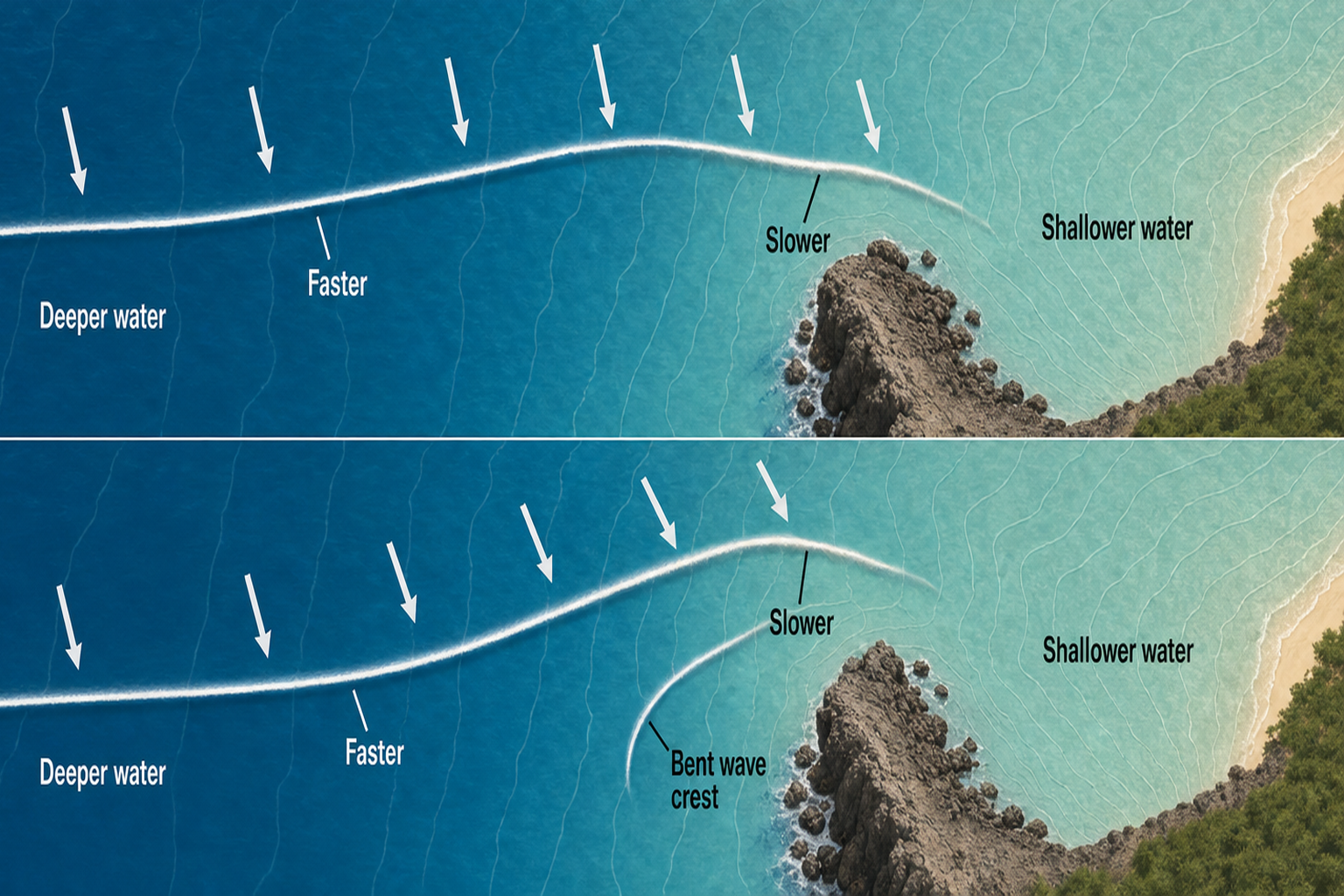
A headland or pointbreak exaggerates this effect. The outer tip of the point slows and catches the swell first. The rest of the swell line bends around the contour, creating a wave that begins to break at the outside peak and then peels progressively down the point.
There is also some diffraction at work, which is the spreading of wave energy into a sheltered area after swell passes an obstruction. Surfers often use “wrap” to describe the combined result of refraction and diffraction, even though refraction does most of the shaping at classic surf breaks.
Why Wrapping Waves Become Peeling Waves
A wave peels when one part of the crest breaks before the rest. Wrapping helps because the wave does not hit the seabed or shoreline squarely. It meets the bottom at an angle, so one section stands up and breaks while the unbroken shoulder keeps running down the line.
This relates directly to peel angle, which describes how fast the breaking section travels along the wave face. A smaller peel angle makes the wave faster and harder to make. A wider peel angle gives the surfer more time to trim, turn, and recover.
- Under about 30 degrees: very fast, often makeable only for skilled surfers on fast equipment.
- About 30 to 45 degrees: fast and high-performance, with possible barrel sections.
- About 45 to 65 degrees: more approachable, usually good for flowing turns and long rides.
- Over about 65 degrees: often slower and softer, though still fun on the right board.
The Shape and Surf Quality of Wrapping Waves
Wrapping waves range from gentle and playful to fast and hollow. Their character depends on how much swell energy reaches the break, how sharply the swell bends, and what kind of bottom it breaks over.
Shape and Height
The classic wrapping wave has a curved, tapered shape. From the beach or a cliff above, the swell lines often look like they are arcing into the bay rather than marching straight toward shore. The outside section is typically bigger and more defined, while the inside sections become smaller as the wave spends its energy.
Because wrapping usually involves some energy loss through refraction, these waves are often smaller than the exposed swell height. A point tucked behind a headland might show chest-high surf while a nearby exposed beach is double-overhead and disorganized. That size reduction is not necessarily a drawback. The wrap can filter messy swell into cleaner, more organized surf.
Power and Speed
Wrapping waves can be deceptively powerful. Even when smaller than the open-ocean swell, they may be highly organized and focused onto a reef or point. Long-period swell can concentrate energy into the takeoff zone, making the first section punchy and fast.
Speed typically changes along the wave. The outside peak may be steep and quick, the middle may offer a long trimming wall, and the inside may either accelerate over shallow bottom or fade into a softer shoulder. The best wrapping waves have speed variations that create variety without becoming impossible to connect.
Steepness and Hollowness
Not all wrapping waves are hollow. A wave that wraps over a gently sloping sand or cobblestone point will often break as a softer, spilling wave with a long shoulder but little tube shape.
A wrapping wave becomes hollow when the swell bends onto a more abrupt ledge or reef shelf. If the wave transitions suddenly from deeper water to a shallow bottom, the lip pitches forward and a barrel can form, especially when the swell period is long and the tide gives the wave room to stand up before it releases.
- Gentle gradient: longer rides, softer lips, easier trimming.
- Moderate gradient: steeper walls, better turns, more speed.
- Sharp gradient: hollower sections, faster takeoffs, more critical timing.
How Easy or Hard Wrapping Waves Are to Surf
Wrapping waves are often easier to read than random beachbreak peaks because they break in a more predictable pattern. The takeoff zone is usually consistent, and the shoulder tends to open in the same direction on similar swells.
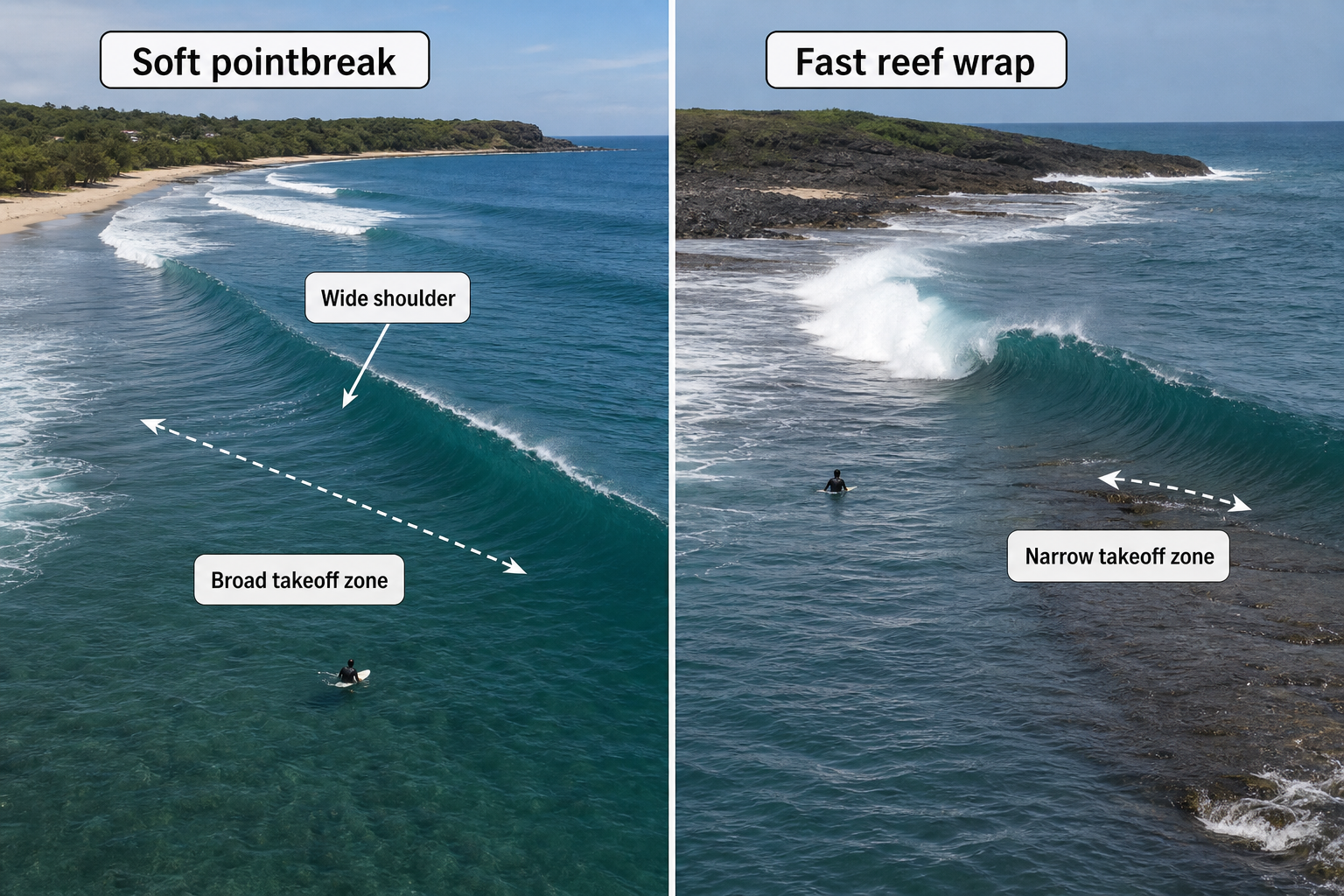
That does not mean every wrapping wave is easy. A soft pointbreak with a wide shoulder can suit beginners and longboarders well. A fast reef wrap with a narrow takeoff zone may demand late drops, instant speed, and precise line selection. The key difference is not whether the wave wraps, but how fast and steep that wrap becomes.
Best Conditions for Wrapping Waves
Good wrapping waves need the right combination of swell angle, swell period, seabed shape, and tide. A small change in any one of those variables can turn a perfect peeling wave into a fat shoulder or an unmakeable section.
Ideal Bottom Structure
The best bottom for wrapping waves usually features a point, reef, or sandbar that curves with the coastline. The swell needs a physical feature that both initiates the break and guides the wave down the line.
Classic wrapping-wave bottoms include:
- Cobblestone points: smooth, consistent, and excellent for long peeling walls.
- Reef points: more defined, often faster, and more likely to produce hollow sections.
- Sand points: highly changeable, but capable of excellent wrap when the sand forms a clean bank.
A good setup often has an outside ledge or shallow zone that creates the takeoff, followed by a gradually tapering inside shelf. If the bottom is too flat, the wave may be weak and slow. If the bottom rises too abruptly across a broad area, the wave may break in one long, unsurfable close-out line.
Seabed Gradient and Wave Quality
Seabed gradient controls how quickly a rolling swell transforms into breaking surf. Wrapping waves generally need a gradual but organized change in depth, with contours that guide the swell in a clean arc rather than random bumps.
A long, gently sloping point creates a forgiving wave that may peel for hundreds of meters. A sharper reef shelf produces a shorter but more intense wave with barrel sections. Many of the world’s best wrapping waves combine both: a steep outside takeoff followed by a more even inside wall.
Best Swell Direction
The ideal swell direction is spot-specific, but the principle is consistent: the swell should approach from an angle that clips the outside of the point and then bends down the line. If the swell hits too directly, the wave may close out. If it comes from too far around the corner, not enough energy reaches the break.
A useful visual is watching how the swell lines enter the bay or run along the point. Good wrapping swell often looks like it is arriving slightly wide of the break and then curving into place. The wave should run along the contour rather than march straight toward the beach behind the point.
For many pointbreaks, a slightly oblique swell angle can actually be better than the most direct angle because it creates a longer peel line. This is often why a nearby exposed beach looks bigger and messier while the point is smaller but far more surfable.
Best Swell Period
Swell period has a major effect on how well a wave wraps. Longer-period waves have longer wavelengths, so they feel the seafloor in deeper water and begin bending earlier. A rough estimate is that wavelength in meters equals about 1.56 times the period squared. A 10-second swell has a wavelength of roughly 156 meters, while a 16-second swell stretches to about 399 meters.
Because of this, long-period swells wrap farther around headlands and into sheltered points. They also carry more energy, which can make a wave more powerful even after bending deep into a bay.
| Swell Period | Typical Effect on Wrapping Waves |
|---|---|
| 8 to 10 seconds | Less wrap, weaker lines, more local texture. |
| 11 to 14 seconds | Good balance of wrap, size, and manageability. |
| 15 to 17 seconds | Strong wrap, more power, longer lines. |
| 18 seconds and above | Deep refraction, powerful sets, possible sectioning. |
For most wrapping waves, the sweet spot is around 12 to 16 seconds. That is long enough to bend into the point cleanly without always producing oversized or outrunning sets. Some famous long pointbreaks, however, need very long-period groundswell to connect their best sections.
Best Wave Height
The ideal wave height depends on exposure and bottom shape. In general, wrapping waves need enough swell to survive the bend around the point. Too small and the wave may arrive as a weak, fat line. Too big and it may break wide, wash through, or create sections that outrun any surfer.
- Waist to head high: ideal for mellow points and longboards.
- Head high to overhead: often the best range for performance surfing.
- Overhead to double overhead: best for powerful reefs and major pointbreaks.
Some tucked-away wrapping waves only come alive when the exposed coast is much larger. Others work perfectly at modest size because the bottom is so well aligned.
Best Tide
Tide controls how much water sits over the reef, rocks, sand, or cobbles, which directly affects steepness, speed, and makeability.
A mid tide is usually the most reliable starting point, giving the wave enough water to run while still allowing the bottom to shape the swell. A lower tide can make the wave steeper and hollower. A higher tide often softens things, especially on gently sloping points.
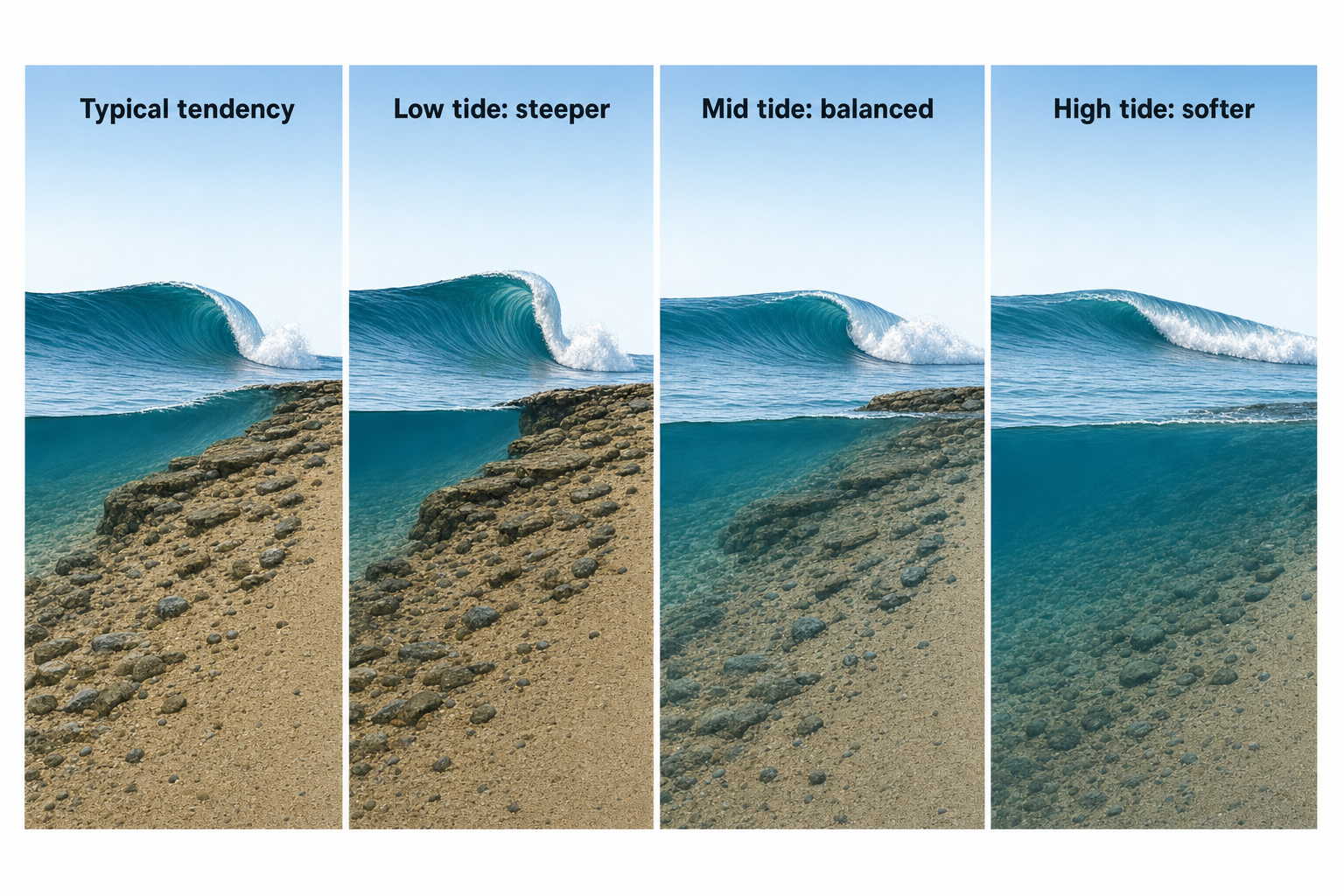
Tide effects are highly local, though. Some wrapping waves need high tide to reach an inside section. Others only show their best shape when the outer ledge is shallow enough to trigger the peel. The best way to understand a specific spot is to compare the same swell across several different tide stages.
Wind and Local Conditions
Wind can make or break a wrapping wave. Many classic wrap-around breaks sit in the lee of a headland, so the same landform that bends the swell can also block onshore wind. This is why points are often clean when nearby beaches are choppy.
The best wind is offshore or side-offshore relative to the breaking wave. Light wind is often enough. Strong offshore wind can hold up the lip and make entry harder, while onshore wind crumbles the face before the wave has time to peel properly.
Other local factors matter too. Sand movement can improve or destroy a sand-bottom point over the course of a season. River flow can build banks near rivermouth setups. Reflected waves from cliffs can add surface texture, particularly when the tide pushes water close to rock walls.
How to Recognize Rideable Wrapping Waves
Recognizing a good wrapping wave comes down to watching how energy releases down the line. A rideable wave does not just look clean. It has a shoulder that opens at a pace a surfer can realistically match.
Signs of a Good Wrapping Wave
Watch several sets from the shore before paddling out and look for these clues:
- The wave feathers from one end first. A clear starting point means the wave has an organized peel.
- The shoulder stays open. The unbroken face should run ahead of the whitewater.
- The swell lines bend smoothly. A clean arc usually means the swell is wrapping over even contours.
- Surfers connect sections. If riders make it from the peak into the inside, the peel speed is manageable.
- Set waves repeat the same pattern. Consistency shows the bottom and swell angle are working together.
Signs of an Unmakeable Wrapping Wave
A wrapping wave can look beautiful from the cliff but still be too fast or too sectiony to actually surf. Always watch several sets, not just one wave.
- The whole line breaks at once. Usually means the swell is too direct or the bottom is not creating enough angle.
- The first section outruns every surfer. The peel angle may be too narrow.
- The shoulder goes flat after takeoff. The swell may be wrapping too far and losing energy before reaching the inside.
- The inside doubles up and closes out. A second ledge or sandbar may be interrupting the peel.
- The face has crossing bumps. Reflected swell or mixed swell directions can break the clean line.
A simple test is to track the whitewater against a fixed object on land. If the breaking section races down the point faster than any surfer can reasonably trim, the wave is probably too quick. If the shoulder stays green but never steepens, it may be too soft to generate a proper ride.
How to Surf Wrapping Waves
Surfing wrapping waves well is about reading the line early and matching the wave’s pace. Because these waves often run for a long distance, small decisions at the takeoff can shape the entire ride. Making sure your board is properly waxed for grip is an easy detail that matters more than it sounds on fast, long walls. Surf wax suited to your local water temperature will keep your feet from slipping when the wave accelerates through a critical section.
Positioning for Wrapping Waves
Start by identifying the true takeoff zone. On a point or reef, it is usually where the first section stands up over the outside contour. Sit too deep and the lip may run past you before you can enter. Sit too wide and the wave may shoulder away before you get on it.
Use land markers to hold your position. A rock, tree, or cliff edge can help you stay aligned with the peak. Wrapping waves often have a takeoff zone that shifts with set size, so pay attention to whether bigger waves break farther outside or wider along the point.
Taking Off on Wrapping Waves
Angle your paddle and takeoff slightly down the line from the start. A straight drop works on slower points, but faster wrapping waves reward early direction. As soon as you stand, look toward the first open section rather than straight down into the trough.
On a mellow wrap, a smooth angled takeoff and a high trim line may be enough. On a steeper, faster wrap, you may need a committed bottom turn to project around the first section. The goal is to enter the wave with speed already built in, not to recover after the lip has started running.
Finding Speed on Wrapping Waves
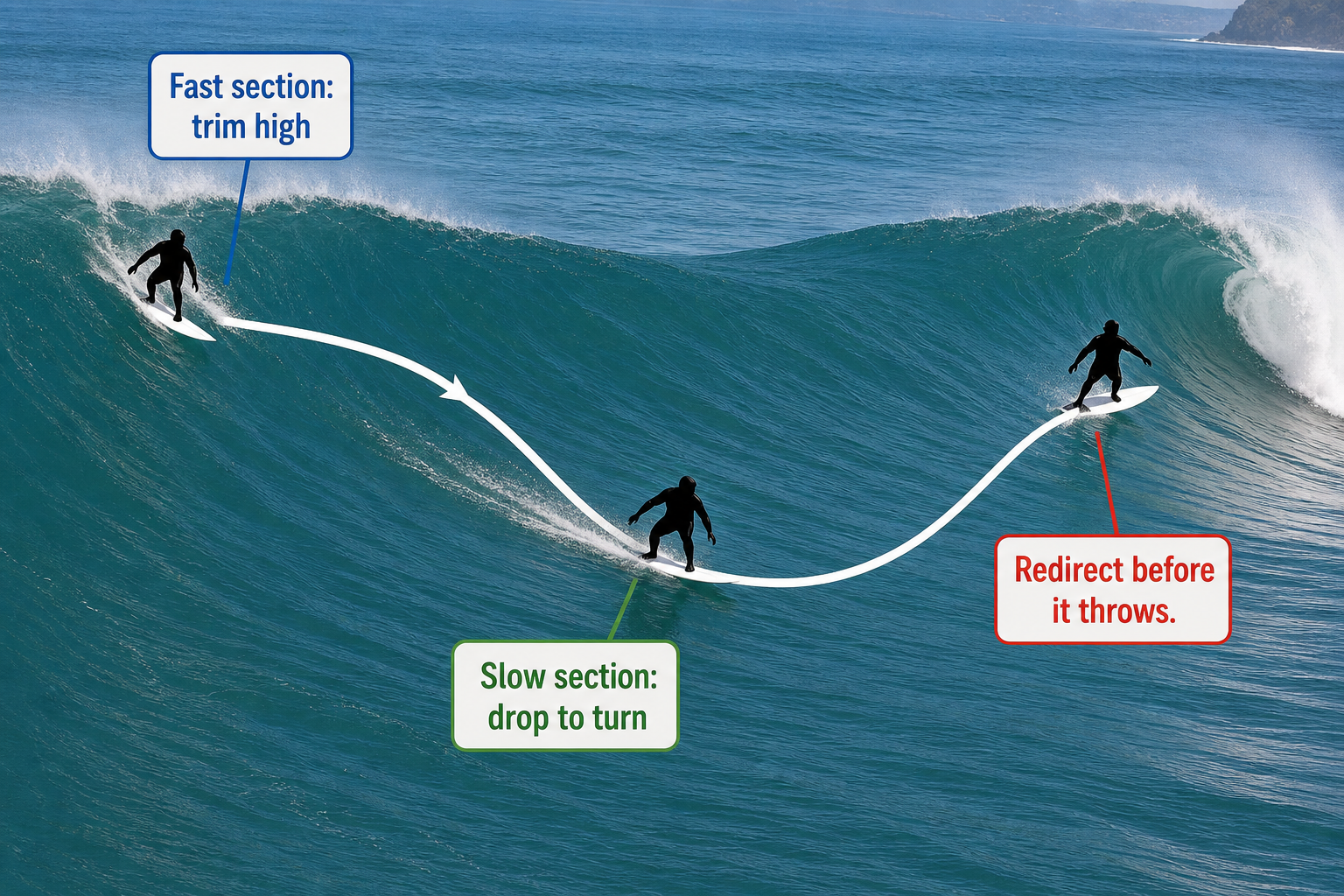
Wrapping waves often have alternating fast and slow sections. The best surfers use the entire face, trimming high when the wave speeds up, dropping lower to set a turn when it slows, and redirecting before the next section throws.
- High-line trimming: stay near the upper third of the face to carry momentum.
- Small pumps: generate speed without wasting space on the wall.
- Cutbacks: return to the power source when the shoulder softens ahead of you.
- Foam climbs: reconnect with the pocket after a section breaks in front of you.
A common mistake is outrunning the pocket on a long wrapping wave. If the shoulder slows, do not keep racing into flat water. Cut back toward the breaking part of the wave and use its energy to set up the next wall.
Surfing Hollow Wrapping Waves
On hollow wraps, the takeoff and the first line are everything. The wave may bend onto a shallow shelf and throw quickly, so the best line is often higher and faster than it first appears. Rather than dropping immediately to the bottom, set your rail and travel with the lip line.
If the barrel section is short, aim to drive through and exit onto the open face. If the tube runs for a longer distance, manage your speed so you do not arrive too early at the next pitching section. Hollow wrapping waves often reward patience, because the barrel may form after the first bend rather than right at the peak.
If you are surfing hollow or reef waves regularly, a surf helmet is worth considering, and an impact vest can add a layer of protection when you come off over a shallow bottom. For breaks with exposed reef or rock, a pair of reef booties will protect your feet on the walk-in and after a wipeout.
Choosing the Right Board for Wrapping Waves
Board choice depends on the speed and steepness of the wave. A soft wrapping point works well on a longboard, mid-length, or relaxed shortboard where extra glide helps you enter early and connect flatter sections.
A faster, hollower wrap usually suits a board with more hold and drive. A performance shortboard or step-up can stay in the curve of the wave and handle the speed through steeper sections. The main question is whether the wave calls for glide, tight control, or a bit of both.
Fins play a big role in how your board responds to a wrapping wave. For a high-performance shortboard, a set of FCS fins in a tri-fin setup gives you a good balance of speed and hold. If your board uses a different box system, a set of futures-compatible fins is another solid option that lets you experiment with different configurations. Adding a surf traction pad to your tail can also improve back-foot grip and response when the wave accelerates.
Cold-water wrapping pointbreaks require the right wetsuit to stay comfortable in the lineup. A well-fitting full wetsuit will keep you in the water longer on those longer session days at exposed reef or point setups. For warmer conditions, a long-sleeve rash guard offers sun protection during extended sessions at tropical pointbreaks.
Long wrapping pointbreaks are also ideal for filming. An action camera like this 4K waterproof action camera mounted on your helmet or board gives you a great angle on those longer rides, and pairing it with a high-capacity microSD card means you will not run out of storage mid-session. Rocky points and reef setups can also leave dings in your board, so keeping a surfboard ding repair kit in your bag is a smart habit.
Famous Surf Spots with Wrapping Waves
Many of the world’s best pointbreaks are renowned because they consistently transform angled groundswell into long, peeling wrap-around waves. Each spot has its own swell window and bottom shape, but the same basic mechanics are at work at all of them.
- Chicama, Peru: One of the longest lefts in the world. South and southwest groundswell wraps around desert headlands, creating multiple peeling sections that can run for over a kilometer.
- Pavones, Costa Rica: A long left point that comes alive on strong south and southwest swell. The wave bends into the gulf and runs over cobblestone and sand.
- Raglan, New Zealand: A series of left points where Tasman Sea swell refracts around boulder and rock contours. Manu Bay and Indicators are classic examples of organized, long-period wrap.
- Rincon, California: A famous right point where winter northwest swell bends along a cobblestone setup. Its sections can link into long, clean walls under the right conditions.
- Honolua Bay, Maui: A powerful right reef where north and northwest swell wraps into the bay. The wave can shift from open face to hollow sections in a single ride.
- Jeffreys Bay, South Africa: A fast right point where Southern Ocean swell lines up along the coast. Its speed and section variety are a prime example of how powerful a well-aligned wrapping point can be.
- Noosa Heads, Australia: A series of right points that can turn easterly swell into long, approachable wrap-around waves, with a relaxed vibe that suits everything from logs to shortboards.
- Scorpion Bay, Mexico: A chain of right points where northwest swell wraps into a protected bay. On the right swell, sections connect for extremely long rides.
- Malibu Surfrider, California: A right point famous for long, clean walls when south swell wraps into the cove and lines up over cobble and sand.
- Superbank, Australia: A sand-bottom right where swell wraps and runs along a sand system from Snapper Rocks through to Kirra, producing one of the longest and most crowded pointbreak rides in the world.
Wrapping waves are a reminder of how much the coastline and seabed can do to refine raw swell energy. The same storm that makes one beach a chaotic close-out can bend around a point and become a clean, peeling wall just around the corner. Learn to read swell angle, period, tide, and bottom shape, and wrapping waves become far easier to predict and find. Learn to surf their rhythm, and they can offer some of the longest and most memorable rides in the sport.