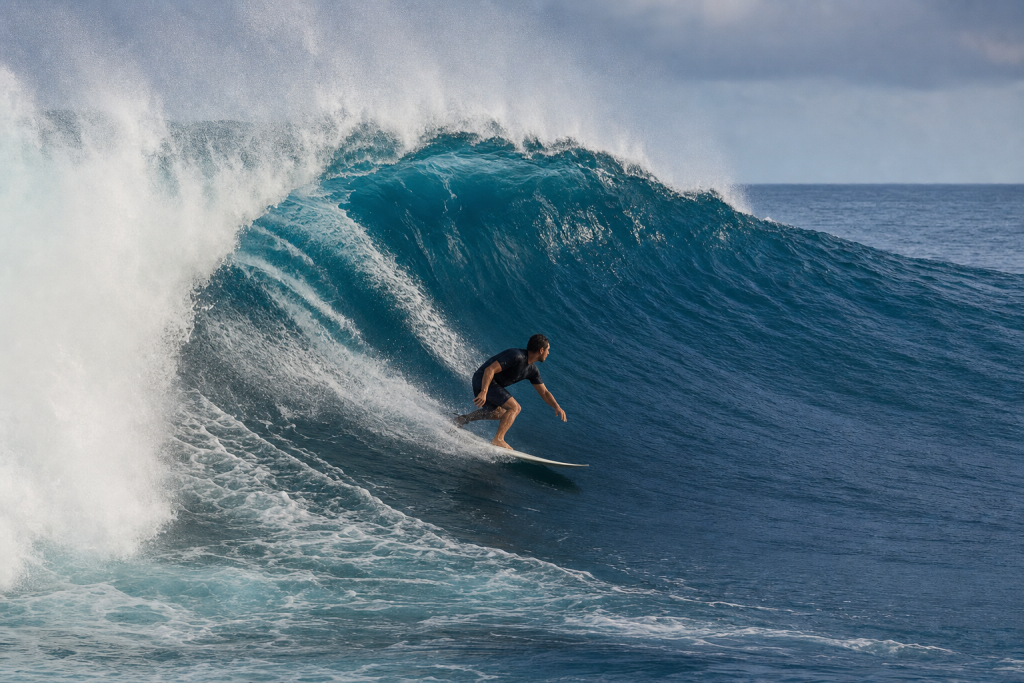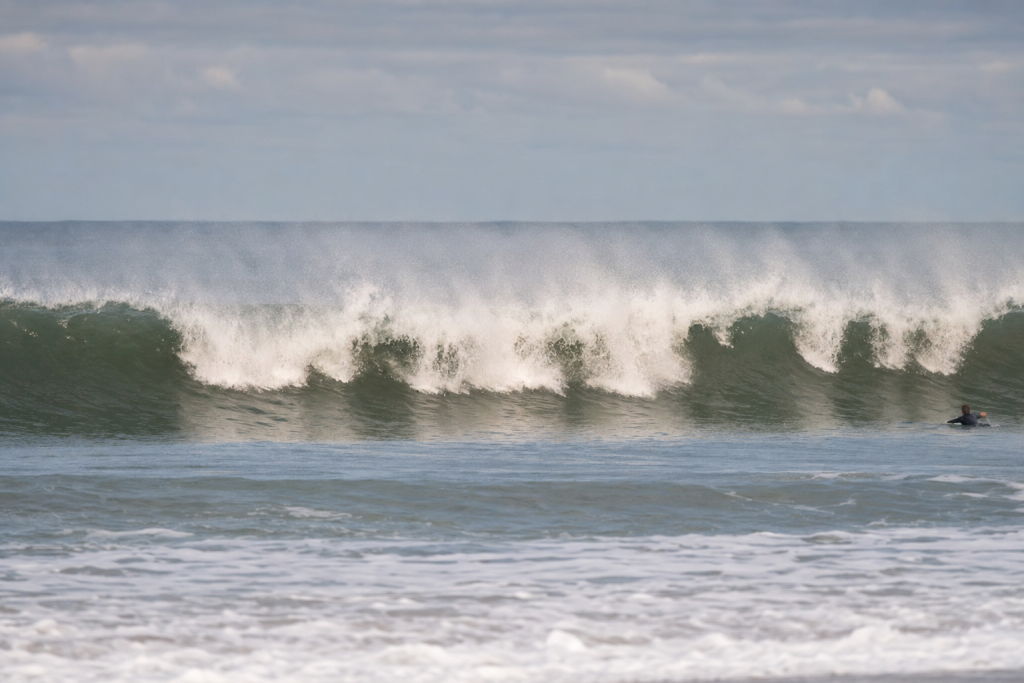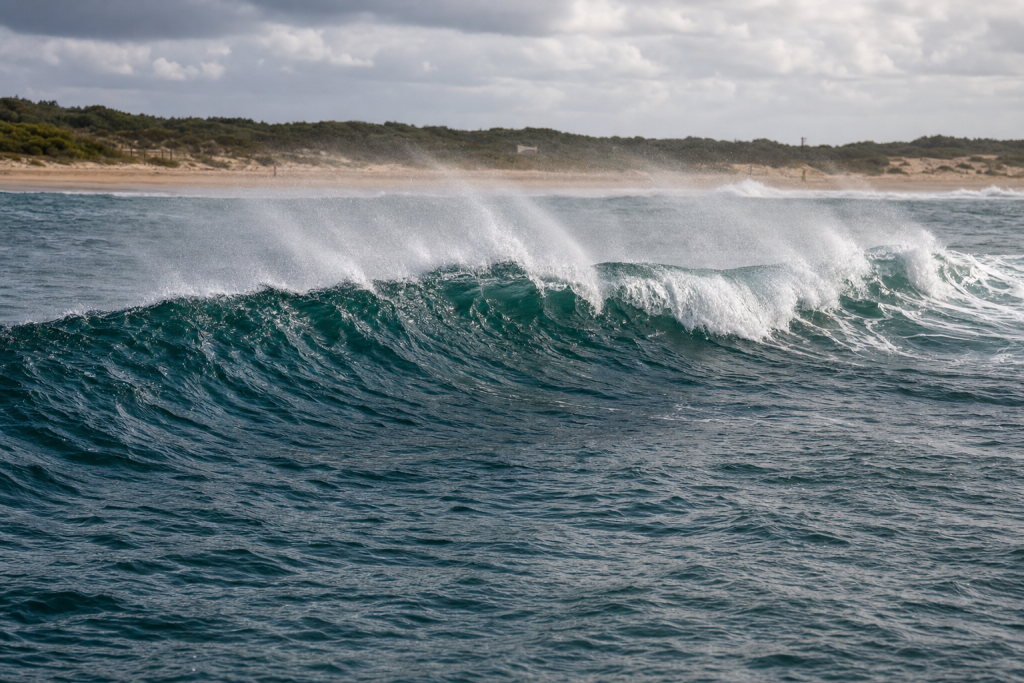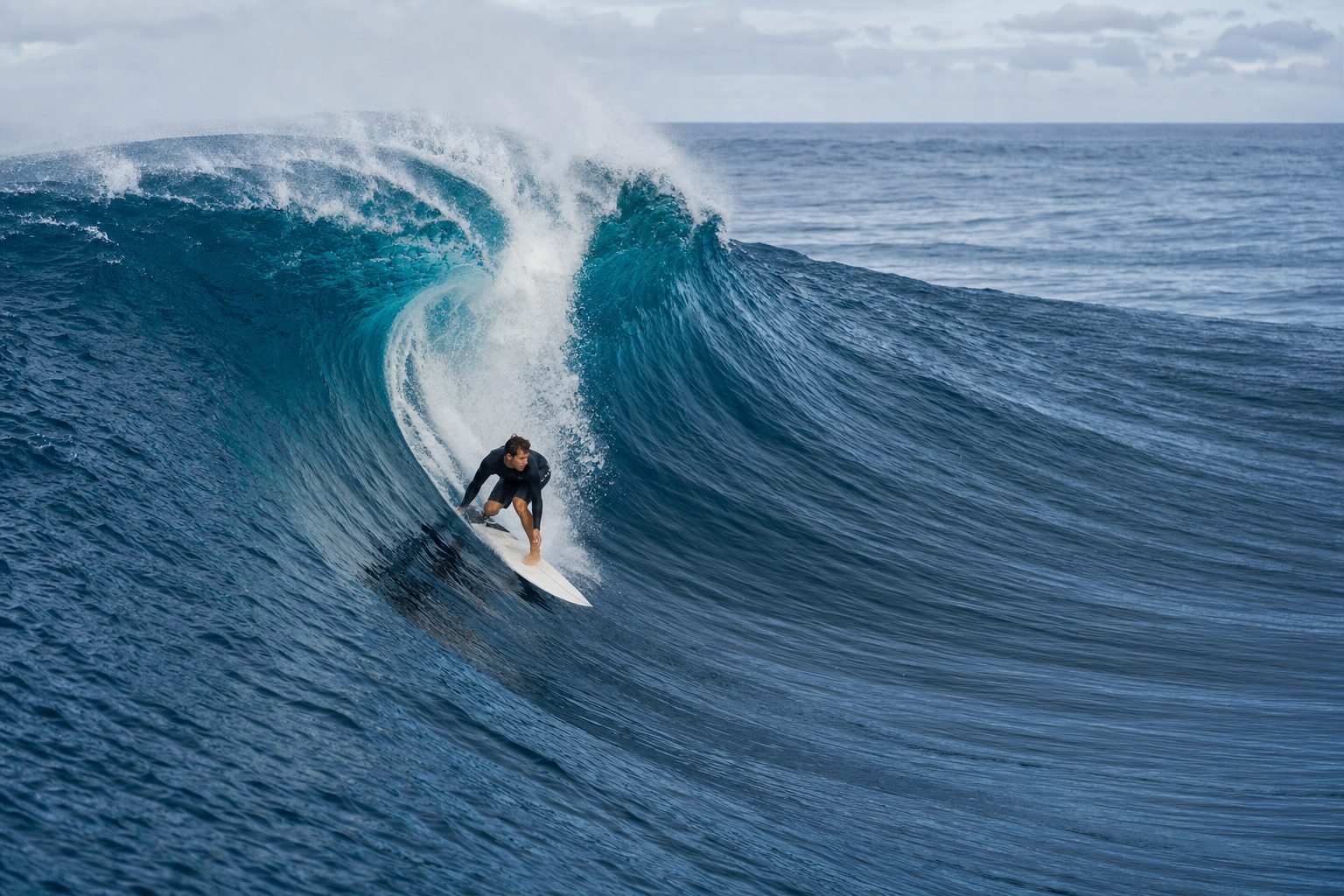
Heavy waves are the ones that make even experienced surfers stop and study the lineup before paddling out. They are not defined by size alone. A head-high slab can be heavier than a wave twice its size if it has a thick lip, a shallow bottom, and a sudden ledge that forces the ocean to unload all at once. Understanding what creates heavy waves helps you know where to find them, when they turn on, and how to manage the speed and intensity that make them so challenging. If you are going to surf powerful, thick waves, having the right gear matters from the start — a dependable surfboard leash is one piece of equipment you should never compromise on in heavy surf. When it comes to traction and hold on steep takeoffs, a quality surf traction pad can also make a noticeable difference.
What Makes Heavy Waves Heavy?
A heavy wave is powerful because a large volume of water is forced to break quickly over shallow ground. The key ingredients are swell energy, seabed shape, and how rapidly the wave transitions from deep water to shallow water.
In deep water, long-period swells travel fast and carry energy efficiently. When that energy reaches a reef, rock shelf, or steep sandbar, the lower part of the wave slows as it feels the bottom. The upper part keeps moving forward. If the transition is abrupt enough, the lip pitches out instead of spilling gently. That forward-throwing lip is what gives heavy waves their thick, detonating character.
Wave power increases dramatically with height, but period matters just as much. A long-period groundswell has more water moving beneath the surface than a short-period wind swell of the same height. This is why a 6-foot wave at 18 seconds can feel far heavier than a 6-foot wave at 9 seconds.
Heavy Waves vs. Hollow Waves vs. Slab Waves
These terms overlap, but they do not mean exactly the same thing.
- Heavy waves are powerful waves with a lot of water in the lip and strong impact when they break.
- Hollow waves throw out to form barrels. They can be heavy, but some hollow waves are relatively playful.
- Slab waves are an extreme form of heavy wave that breaks over a sudden ledge, often in very shallow water.
A classic slab looks almost unnatural. The wave may draw water off the reef, stand up steeply from below sea level, and throw a square barrel with a lip as thick as the face is tall. Not all heavy waves are slabs, though. Some break over sandbars, deep-water reefs, or bathymetry shaped by underwater canyons.
The Shape and Feel of Heavy Waves
Heavy waves are usually steep, fast, and hollow. The takeoff is often late because the wave does not gradually slope into a catchable face. It can go from a moving lump of swell to a near-vertical wall in a matter of seconds.
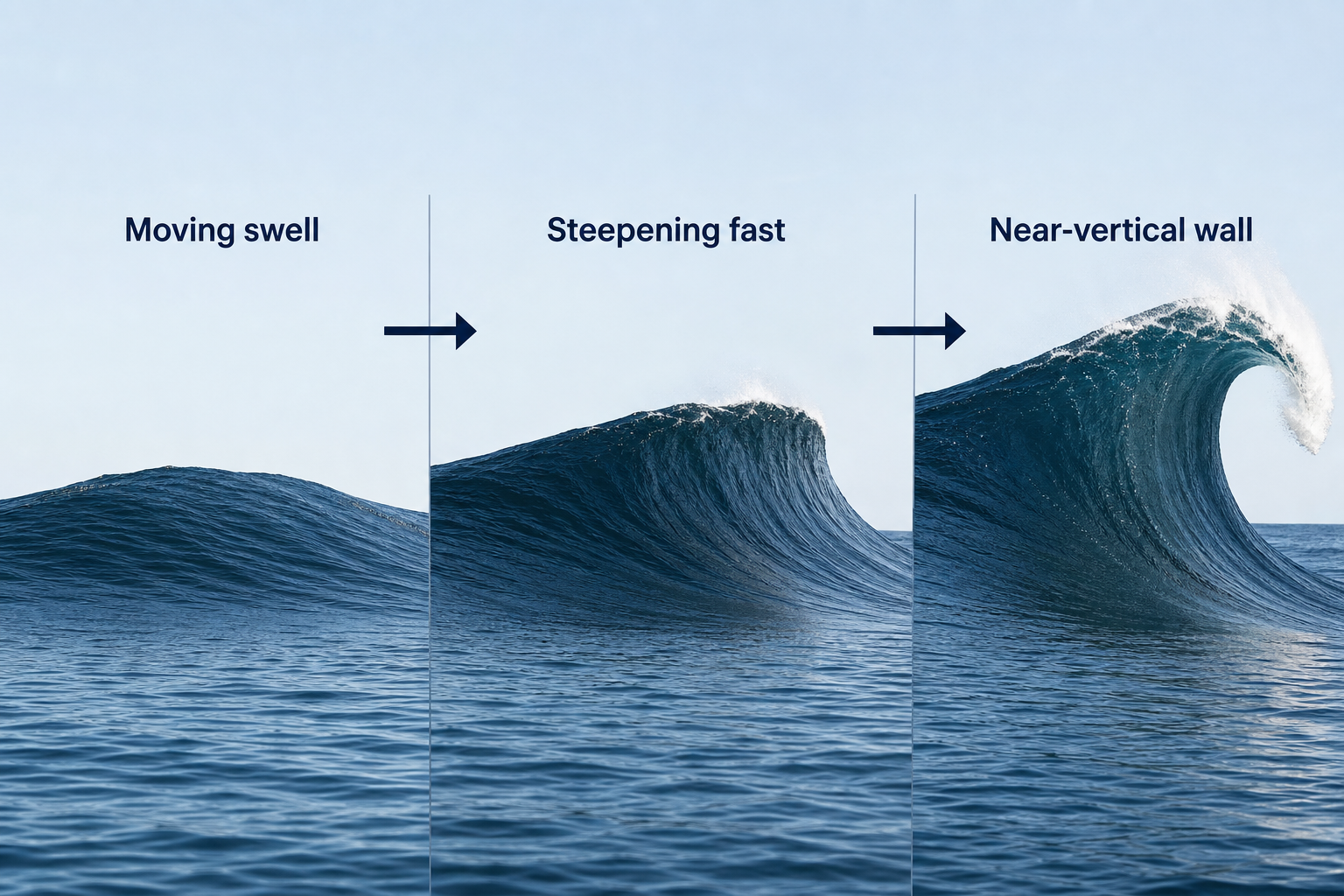
Shape of Heavy Waves
Common heavy-wave shapes include:
- Square barrels: The tube is almost as wide as it is tall, with a thick lip landing well out in front.
- Ledges: The wave hits a sudden shallow section and jumps up abruptly.
- Double-ups: Two lines of swell or a reflected wave combine to thicken the wall and fold it over all at once.
- Backless waves: The wave has little shoulder, so the surfer must commit under the lip rather than ease in from the open face.
The best heavy waves have a clear direction of peel. The worst ones throw perfectly but shut down across the entire reef or sandbar with nowhere to go.
Power, Speed, and Steepness
A heavy wave does not just move forward. It also draws water upward and backward as it prepares to break. This suction can make the trough look lower than the surrounding ocean. On shallow reefs, the face may appear to jump up from nowhere.
The speed comes from swell period and the angle of the break. Long-period waves move quickly through deep water. When they hit a reef at an angle, the breaking section may race down the line faster than expected. On some heavy waves, the first bottom turn is not a wide drawn-out arc at all. It is a quick adjustment to set the rail and hold speed.
Height and Hollowness
Heavy waves can be any size, but their character changes as they grow. At head-high, a slab may already be thick and dangerous because it breaks in very shallow water. At double overhead, the same wave may become faster and more open. At extreme size, some slabs become unrideable because the lip lands too far out or the reef closes out entirely.
Hollowness depends on how abruptly the wave breaks. A steep reef or sandbar creates a plunging breaker. A gentler slope creates a spilling breaker. Heavy waves almost always sit at the plunging end of that spectrum.
Why Heavy Waves Are Hard to Surf
Heavy waves are difficult because they compress every decision. You have less time to paddle, less margin on the drop, and less room to recover from a mistake. The wave may not offer a forgiving shoulder. It may demand a late takeoff under the lip, followed immediately by a barrel or a high-speed race down the line.
The challenge is not only physical. Heavy waves require precise reading. You need to understand which lump will turn into a makeable barrel, where the reef bends, and how the tide changes the takeoff zone. A surfer with strong basic skills can still struggle if they cannot read the ledge. Picking up a book like a surf technique guide can help you develop a deeper understanding of wave mechanics and body positioning before you commit to heavier surf.
In general, heavy waves are best suited to advanced surfers. Smaller versions can be useful training grounds, but full-size heavy surf demands confident paddling, fast pop-ups, solid rail control, and calm decision-making under pressure.
How to Surf Heavy Waves
Surfing heavy waves starts before you catch one. The most important work is observation. Watch several sets from land if you can. Notice where experienced surfers sit, which waves they pass on, and what the tide is doing to the shape.
Choose the Right Board for Heavy Waves
The best board depends on the wave. A heavy open-ocean reef may require a step-up or gun for paddling speed. A short, square slab may work better with a compact step-up that fits into a tight curl. In both cases, the board needs hold and control.
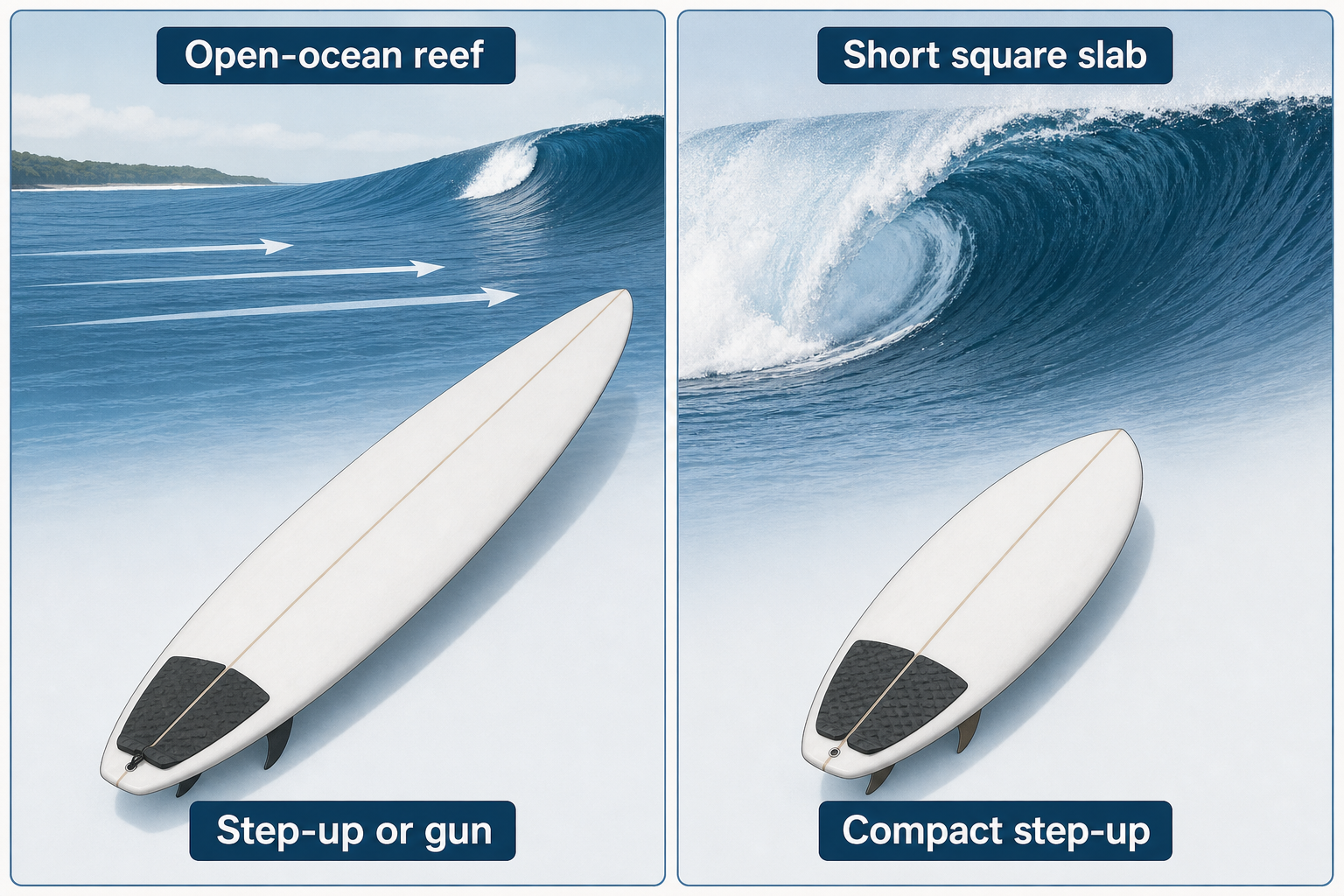
Useful features for heavy-wave boards often include:
- Extra volume: Helps with paddling and early entry.
- Rounded pin or pin tail: Adds hold on steep faces.
- Stronger glassing: Helps the board survive powerful lips.
- Reliable fins: Gives bite during high-speed lines.
Fins are especially critical in heavy surf. A set of stiffer, performance-oriented fins can dramatically improve how your board holds through a fast drop or a high-speed barrel. The FCS II neo glass tri fins are a solid option for surfers looking for a responsive setup across varied conditions. If you prefer a Futures-compatible setup, a reliable set of honeycomb fiberglass performance fins offers good control and drive in faster surf.
For paddle-in heavy waves, too little board can leave you stuck under the lip. Too much board can make it hard to fit into a tight barrel. The goal is not maximum length — it is the right balance between entry speed and control.
Positioning for Heavy Waves
Your position in the lineup is often deeper than it looks from the beach. On heavy waves, the shoulder may look safer but may sit too far out on the face to actually catch the wave. Many slabs require surfers to sit close to the ledge and paddle into the steepest part of the peak.
Use fixed markers where possible. Line up a rock, cliff, or channel marker to hold your spot. On reef waves, boils on the surface can show where the ledge is shallowest. Channels often mark deeper water beside the breaking zone.
Do not assume every set breaks in the same place. Long-period swells can produce wider sets that break farther out. Smaller waves may focus on the inside ledge. Good heavy-wave surfers constantly adjust their position.
The Takeoff on Heavy Waves
The takeoff is the defining moment. You usually need to paddle with full commitment and angle slightly down the line. A straight takeoff may send you to the flats with too much speed to redirect. Too much angle can cause the rail to skip or the board to outrun your feet.
As the wave lifts you, keep your chest low and your paddling strong. Pop up quickly but without jumping away from the board. Your weight should settle smoothly into the rail. On very steep waves, the first move is often to compress and hold rather than launch into a big bottom turn.
If the barrel is immediate, look through the section rather than staring at the lip. Your body follows your eyes. A clean, controlled line through the opening is better than a dramatic turn that burns speed at the wrong moment.
Riding the Barrel on Heavy Waves
Once inside the barrel, speed control becomes everything. Too low and the foam ball may swallow you. Too high and the lip may clip your rail. Most heavy barrels reward a high line with subtle, reactive adjustments.
Frontside, surfers often use a low stance with the leading arm extended to guide the line. Backside, the pig-dog stance helps hold the rail and keep the body compact. In both cases, the goal is to stay relaxed enough to respond to whatever the wave does next.
Heavy waves often produce foam balls that surge forward inside the tube. If you see one coming, hold your speed and stay just ahead of it. If the exit starts to pinch, aim for the highest clean opening rather than the flat water at the base of the wave.
How to Recognize Rideable Heavy Waves
The hardest part of surfing heavy waves is knowing which ones to catch. A wave can look perfect and still be unmakeable. The difference usually comes down to the angle of the peel, the direction the lip throws, and whether there is an actual exit.
Signs a Heavy Wave Is Rideable
- It has a corner: One part of the wave breaks first, while the rest feathers down the line.
- The shoulder stays open: The barrel has an exit rather than a flat wall of whitewater.
- The lip throws outward: A pitching lip creates space inside the tube.
- The wave peels with the reef: The breaking line follows the bottom contour rather than shutting down all at once.
- The takeoff zone repeats: Good heavy waves usually have a recognizable ledge or peak that fires consistently through a set.
Makeable heavy waves often look intimidating but organized. The peak stands up, the lip throws, and the line bends away into a shoulder. Even if the drop is late, there is a path.
Signs a Heavy Wave Is Unmakeable
- The whole line breaks at once: This usually means the swell angle is too straight for the setup.
- The lip lands on the flats: If there is no tube space, the wave is more explosion than ride.
- The exit pinches early: A perfect-looking takeoff can still shut down after one second.
- The wave doubles up too late: A sudden step can throw the surfer off balance before the drop is complete.
- The tide exposes too much reef: Some waves become too shallow to hold their shape at low water.
One useful habit is to watch the third or fourth wave of each set. The first wave may be the cleanest, but later waves reveal how much water is draining off the reef. If every wave after the first warps or closes out, the rideable window may be narrower than it looks.
The Best Bottom Structure for Heavy Waves
Heavy waves are shaped by bathymetry — the contour of the seafloor. The most powerful setups typically have deep water close to a shallow breaking platform.
Reef Ledges and Slabs
Slabs form where swell travels rapidly from deep water onto a shallow reef or rock shelf. The abrupt change causes the wave to jack up and pitch. If the ledge is angled correctly, the wave can peel. If it is too straight, it closes out.
The best slab reefs often include a channel beside the break. The channel gives the wave a direction, helps shape the shoulder, and keeps deep water next to the impact zone. Without a channel or bend in the reef, a slab may be spectacular but nearly impossible to ride consistently.
Heavy Beachbreak Sandbars
Heavy waves do not require reef. Some of the world’s most powerful barrels break over sand. These waves typically need steep sandbars, deep water close to shore, and strong long-period swell. Because sandbars shift, heavy beachbreaks can change from world-class to chaotic within days.
A heavy beachbreak is often less predictable than a reef. Peaks move, rips shift, and the best takeoff zone may change with each set. The reward is that sand-bottom waves can produce thick, hollow barrels without the fixed danger of a shallow ledge directly beneath you.
Deep-Water Reefs and Canyons
Some heavy waves are created by underwater reefs or submarine canyons that focus swell energy onto a specific stretch of coast. A canyon can bend and concentrate swell toward one area. A deep-water reef can trip giant swells into enormous breaking waves without the square shape of a shallow slab.
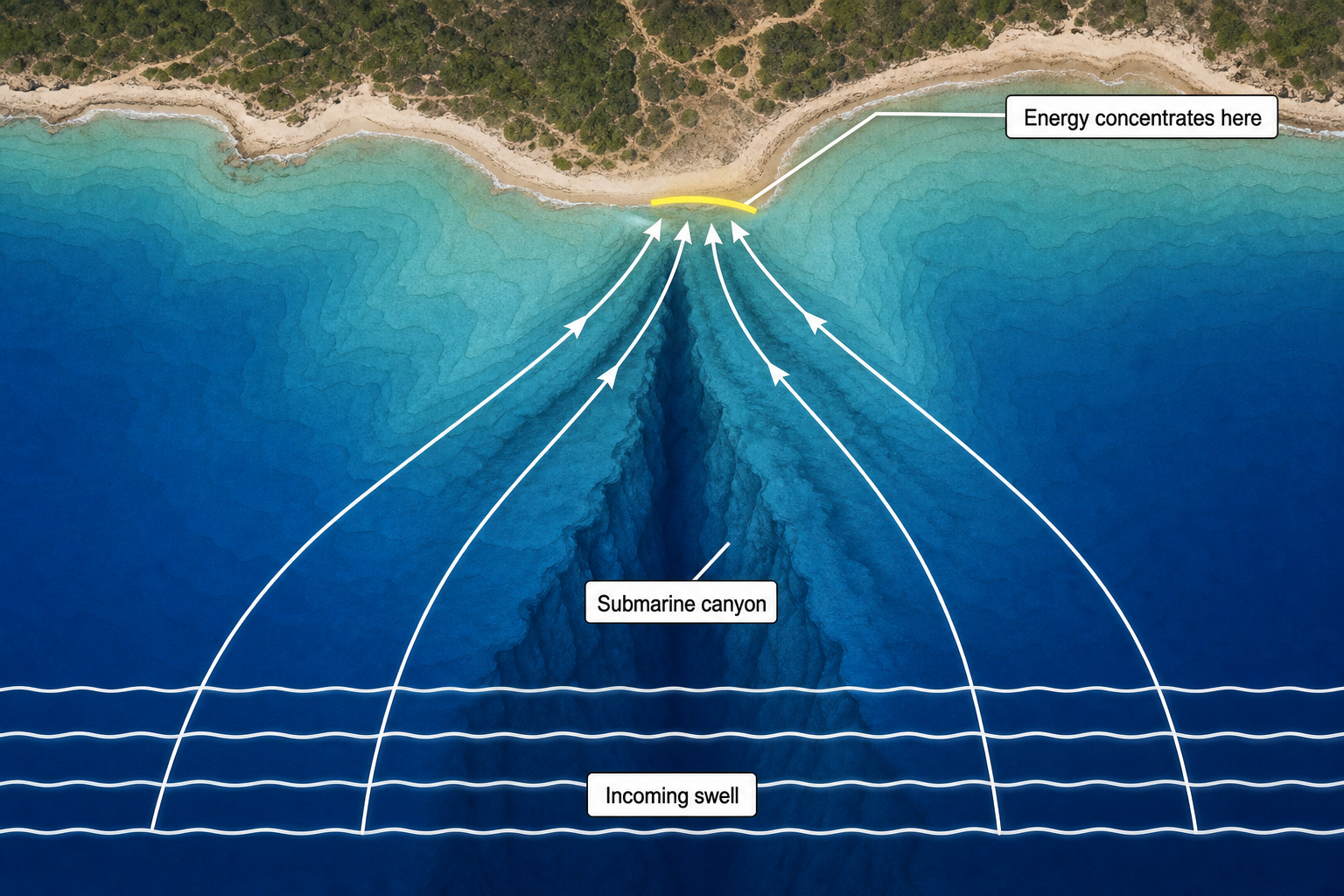
These waves may be less hollow than slabs, but they can generate far more raw power because of their size and the sheer volume of moving water. Mavericks and Nazaré are clear examples of how bathymetry can create extraordinary wave energy, even though the surfing experience there is very different from a short reef barrel.
Best Swell, Tide, and Wind for Heavy Waves
There is no universal perfect forecast for heavy waves. Every spot has its own swell window and bottom shape. Still, certain patterns appear consistently.
Best Swell Direction for Heavy Waves
Heavy waves need enough swell exposure to receive energy, but the angle must suit the reef or sandbar. A swell that approaches too directly can close out the entire lineup. A swell that is too angled may miss the reef or create a wave that races down the line too fast to catch.
For many hollow reefs, the best swell angle is slightly off-perpendicular to the ledge. This gives the wave enough energy to stand up while still allowing it to peel. A rough guideline is 10 to 30 degrees off straight, but the exact number is always spot-specific.
Best Swell Period for Heavy Waves
Longer-period swells generally create heavier waves because they carry more organized energy. For serious reef waves, 14 to 20 seconds is a common power range. Some slabs perform best at 12 to 16 seconds, because extremely long-period swell can make them too square or too fast to ride.
At big-wave reefs, periods above 16 seconds can be ideal. At shallow slabs, a 20-second swell may be too much unless the angle and tide are perfectly aligned. Short-period swell can still produce barrels, especially at beachbreaks, but it carries less deep-water energy.
Best Wave Height for Heavy Waves
The best size depends on the spot. A small slab may start working at head-high. A big-wave reef may not break properly until the faces are well overhead. Some heavy waves improve as they grow because the barrel opens up. Others become unmakeable when the lip starts landing too far out in front.
| Wave Type | Typical Heavy Range | What Changes With Size |
|---|---|---|
| Shallow slab | Head-high to triple overhead | Gets hollower, faster, and more critical |
| Heavy reef pass | Overhead to very large | Barrel length and water volume increase |
| Heavy beachbreak | Head-high to double overhead or larger | Peaks shift and closeouts become more common |
| Big-wave reef | Large to extreme | Power becomes the main challenge, not always hollowness |
Best Tide for Heavy Waves
Tide controls how much water sits over the bottom. Lower tides usually make waves hollower because the swell hits shallower ground. Higher tides generally soften the break, though they can improve some slabs by adding just enough water over the ledge to keep them from shutting down.
Many heavy reef waves are best on low to mid tide. Extreme low tide can make a wave too shallow or cause it to stop breaking properly. A rising tide can be helpful because it adds water gradually while still maintaining hollow shape. Heavy beachbreaks vary more because sandbar shape plays a bigger role in determining the best tide.
Best Wind for Heavy Waves
Light offshore wind is usually ideal. It holds the face open and keeps the surface clean. Too much offshore wind can make the drop harder by holding the surfer back as they try to get to their feet. Cross-offshore wind can also be excellent if it keeps the barrel open without adding chop to the surface.
Onshore wind quickly damages heavy waves. A little texture can make some waves slightly easier to enter, but strong onshore conditions turn steep barrels into unpredictable explosions.
Gear and Safety for Heavy Waves
The right gear does not make heavy waves easier to surf, but it can reduce the consequences when things go wrong. Protection is worth thinking about carefully before paddling out to a serious break.
A well-fitting wetsuit keeps you warm and provides a small amount of padding. A full wetsuit is worth considering if you are surfing cold water or a reef break where skin contact with the bottom is a real possibility. In warmer water, a long sleeve rash guard offers UV protection and some barrier against reef rash.
For reef breaks specifically, a pair of reef booties protects your feet during wipeouts in shallow water. An impact vest can absorb some of the blow from a heavy lip landing on your back or chest. At heavier breaks, a surf helmet is worth wearing, especially at shallow reef spots where head contact with the bottom is a genuine risk.
Heavy surf is also hard on your board. Thick lips, powerful wipeouts, and shallow reef can cause dings quickly. Keeping a surfboard ding repair kit in your car means you can seal damage before water gets into the foam. And if you want to review your sessions or capture the experience, mounting an action camera — paired with a reliable high-capacity microSD card — lets you analyze your surfing afterward, which is genuinely useful for learning heavy waves. Before paddling out, a fresh coat of surf wax suited to the water temperature will keep your feet from slipping at the worst possible moment.
Where to Find Heavy Waves
To find heavy waves, look for exposed coastlines with deep water near shore, consistent groundswell, and abrupt seabed changes. Islands in the path of Southern Ocean or North Pacific swells are prime candidates. So are coastlines with submarine canyons, lava shelves, or powerful winter storm tracks.
Famous Heavy Waves Around the World
- Teahupo’o, Tahiti: One of the world’s most recognized heavy lefts. Long-period south and southwest swells hit a shallow coral reef beside a deep channel, creating a thick, square barrel that is as wide as it is hollow.
- Pipeline, Hawaii: A legendary North Shore reef with multiple takeoff zones. Northwest winter swells create hollow lefts at Pipeline and rights at Backdoor, both known for their speed and consequence.
- Shipstern Bluff, Tasmania: A right-hand slab known for strange steps in the face caused by reef terracing. Southern Ocean swells meet a rugged ledge to create a heavy, unpredictable barrel.
- The Right, Western Australia: A powerful right-hand slab that breaks over very shallow reef. It is known for enormous barrels and extreme water movement during wipeouts.
- Cape Solander, Australia: Also known as Ours, this Sydney slab breaks close to rock on solid south swells and is one of Australia’s most serious urban surf spots.
- Puerto Escondido, Mexico: A sand-bottom beachbreak on the Oaxacan coast. South and southwest groundswell produces thick, fast barrels at Playa Zicatela that are often compared to Pipeline in character.
- Cloudbreak, Fiji: A long, powerful left reef that becomes extremely heavy on large southwest swells. It offers extended barrel sections rather than the quick, punishing drops of a shallow slab.
- Mavericks, California: A cold-water big-wave reef north of Half Moon Bay where northwest swell refracts over deep and shallow reef zones. It is heavy because of size, speed, and the sheer volume of water moving through the break.
- Nazaré, Portugal: A canyon-amplified big-wave location where an underwater canyon focuses swell energy directly onto the beach. It is not a classic slab, but it is one of the most dramatic examples of bathymetry creating extreme wave power.
How Forecasts Translate Into Heavy Waves
A surf forecast only tells part of the story. To predict whether a heavy wave will turn on, you need to read the forecast alongside an understanding of local bathymetry and any spot-specific knowledge you can gather.
Start with swell direction. Ask whether the swell will hit the reef directly, glance across it, or miss the main ledge. Then check the period. A longer period may wrap into sheltered spots, break farther out, and concentrate more strongly on shallow sections. Finally, compare the tide and wind forecast to the wave’s known behavior at that stage of the tide.
A forecast that looks perfect on paper can fail if the sandbar has shifted or the swell angle is slightly too straight. The opposite is also true. A modest swell with the exact right angle and period can turn a quiet ledge into a clean, heavy barrel that almost nobody expected.
The best heavy-wave surfers are not just bold. They are patient observers who understand how a spot behaves across the tide, how sets focus on the reef, and which waves have a real exit. Heavy waves reward that knowledge and punish guessing.
Heavy waves are among the most impressive forms of surf because they show how much energy the ocean can concentrate into a single breaking lip. They are created by the combination of powerful swell and precise bathymetry, then shaped further by tide, wind, and swell angle. Learning how they work makes them easier to read — whether you are watching Teahupo’o from the channel boat or studying a local ledge on a building south swell. The more you understand the shape beneath the water, the more clearly you can see the wave forming above it.