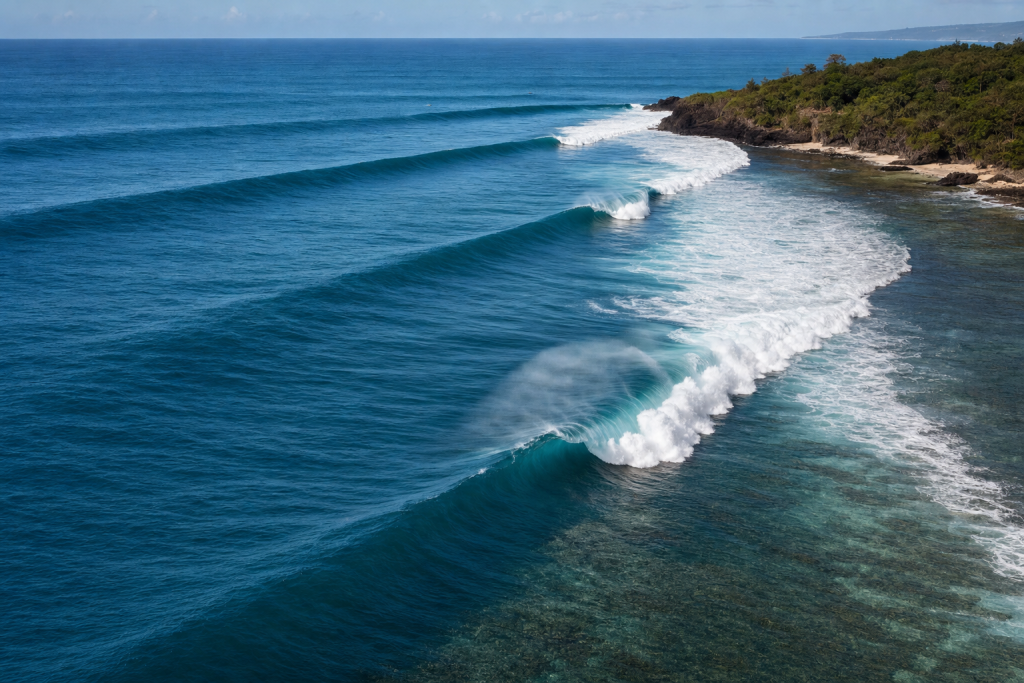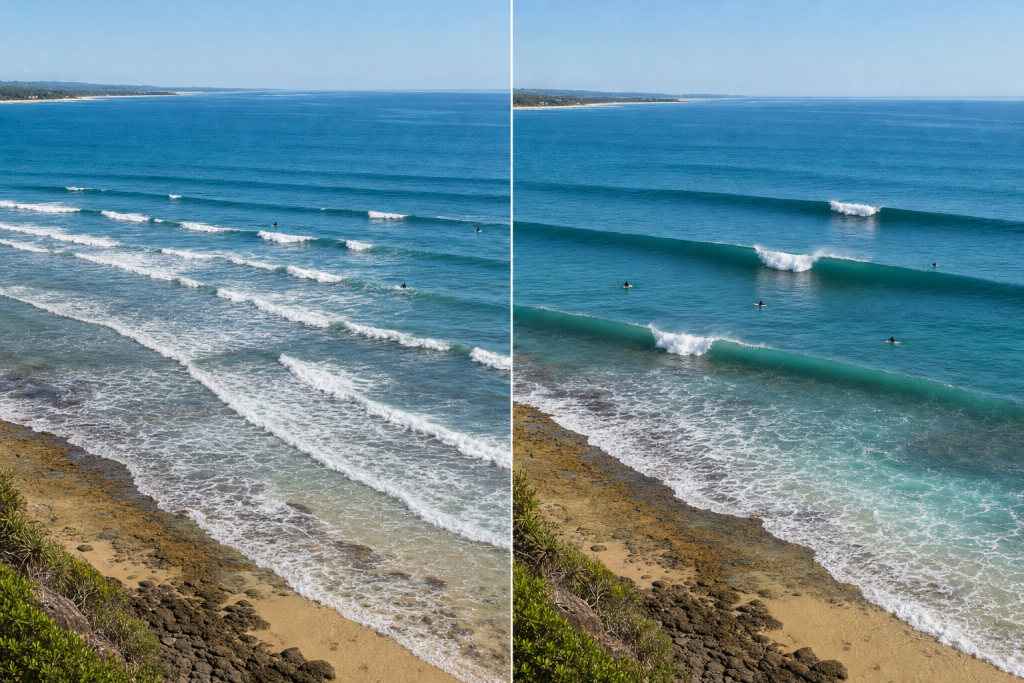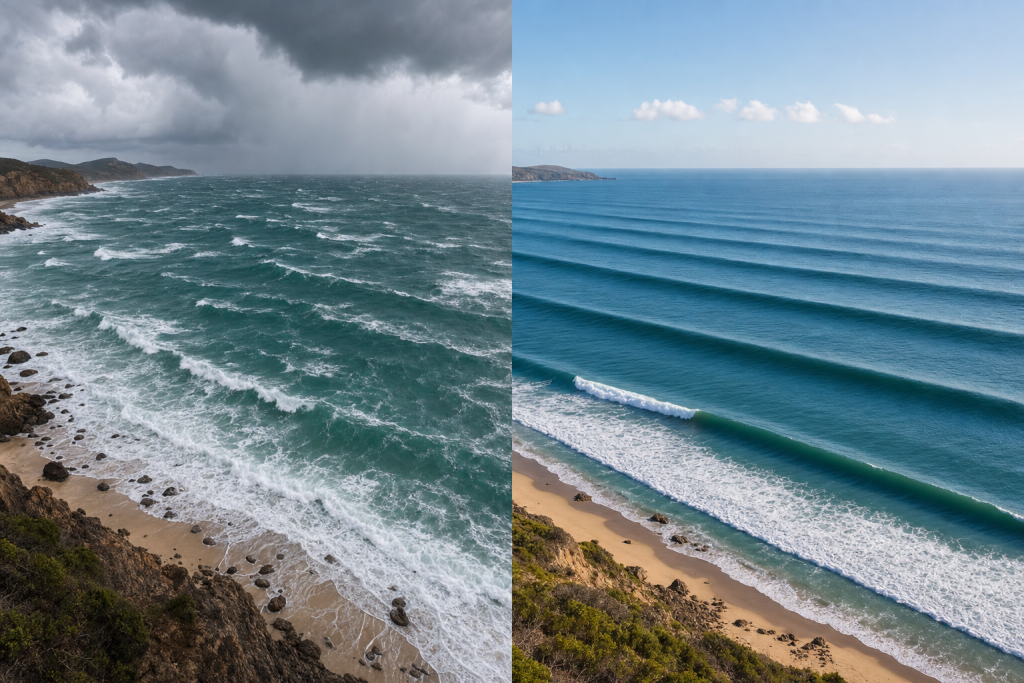
Swell direction is one of the most important factors in surf forecasting. It decides which beaches wake up, which points peel, and which reefs stay inexplicably flat while nearby spots pump. Two swells with the same height and period can produce completely different surf if they arrive from different angles. Understanding swell direction helps you read forecasts more accurately, choose the right spot on any given day, and make sense of why a shift of just a few degrees can transform a perfect wall into a closeout. If you want to go deeper on the subject, this surf forecasting guide covers the full picture in an accessible way. You might also find it useful to keep a surf journal to track how different swell directions affect your local breaks over time.
What Swell Direction Means in Surf Forecasting
Swell direction describes the angle from which wave energy is arriving. In surf forecasts, direction is typically expressed as a compass bearing in degrees. A west swell comes from the west and travels toward the east. A south swell comes from the south and travels northward.
This “from” convention matters. If a forecast says 270 degrees, the swell is coming from due west. If it says 180 degrees, it is coming from due south. The number tells you where the energy originated, not where it is headed.
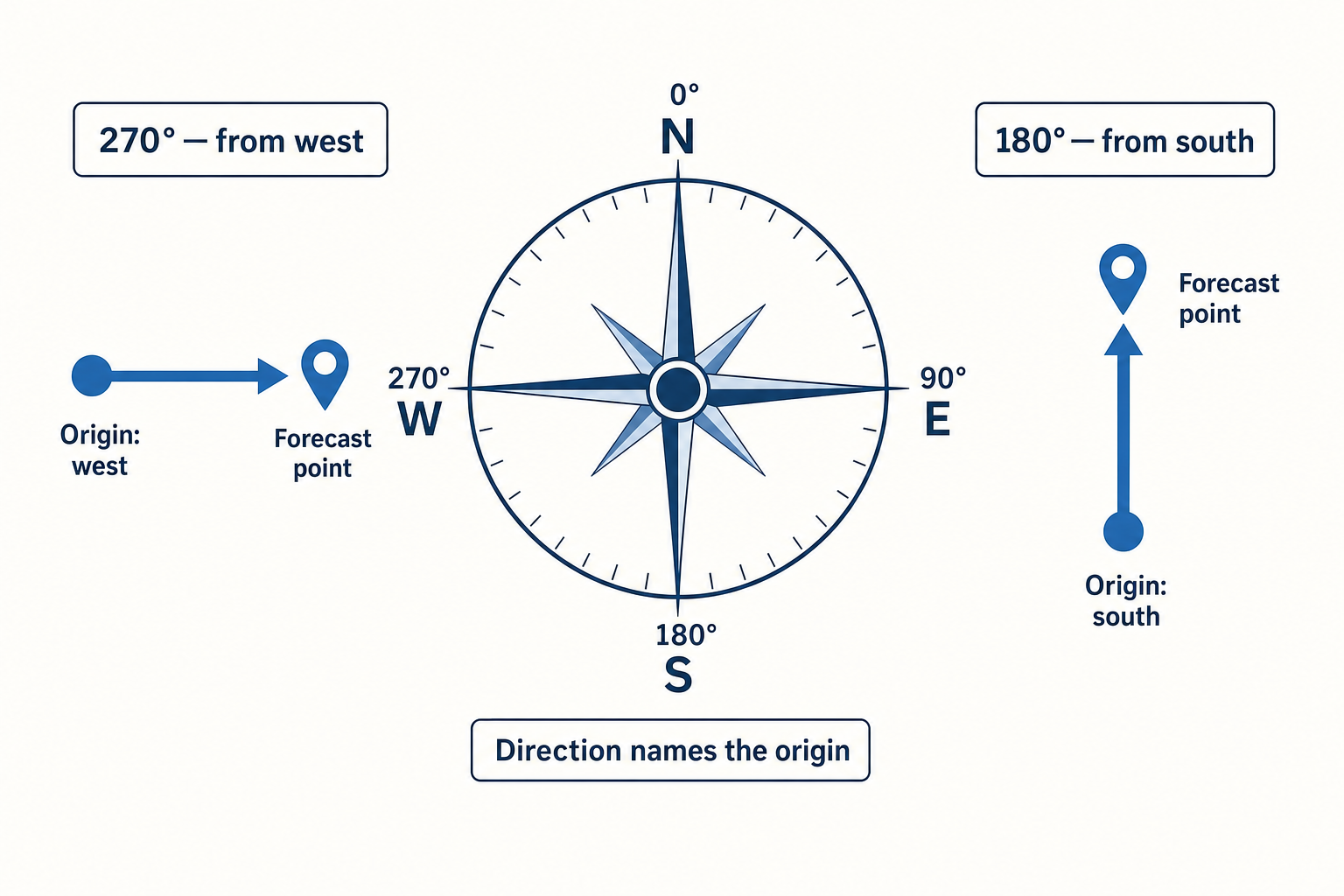
In deep water, swell direction is mostly determined by the storm that generated the waves. Closer to shore, however, waves can bend, lose energy, or change shape because of the seafloor and coastline. That is why the direction shown on an offshore buoy may not exactly match the angle at which waves finally break on the beach.
Swell Angle Versus Beach Angle
The most useful way to think about swell direction is to compare it with the orientation of the surf spot. A coastline that faces west is usually most exposed to west swell. A beach that faces south is most exposed to south swell.
But exposure is rarely that simple. A beach may face southwest but have an offshore island blocking part of its swell window. A reef may need a west-southwest swell because a due-west swell closes out while a southwest swell runs perfectly along the ledge. Swell direction only becomes meaningful when you match it to the coastline, underwater contours, and any obstacles sitting between the storm and the surf spot.
How Swell Direction Is Measured
Swell direction is measured in degrees on a 360-degree compass. North is 0 or 360 degrees, east is 90 degrees, south is 180 degrees, and west is 270 degrees. Intermediate directions are described with compass terms such as southwest, northwest, or east-southeast.
Surf forecasting models estimate swell direction from wind fields, storm position, and wave propagation across the ocean. Directional buoys measure the motion of the sea surface and calculate where the dominant wave energy is coming from. Satellites and coastal observations can also help refine the picture. If you enjoy studying the ocean science behind all of this, this book on ocean tides and wave science is a solid read.
Dominant Swell Direction and Secondary Swells
A forecast may show a dominant swell direction, but the ocean usually carries more than one swell at a time. A beach might have a long-period southwest groundswell underneath a shorter-period northwest wind swell. The dominant direction carries the most significant wave energy, but secondary swells can still affect wave shape and texture.
Mixed swell can create peaks, crossed-up conditions, or unpredictable sections. A small secondary swell from a different direction may not add much size, but it can break up long lines and introduce better-shaped waves on an otherwise straight beach.
Directional Spread in a Swell
A swell is not a perfectly narrow beam of energy. It has directional spread, meaning the wave energy arrives over a range of angles. A highly organized groundswell has a narrower spread, while local wind swell tends to be more scattered.
Directional spread matters because a spot that is slightly shadowed from the main swell direction may still receive some energy from the outer edges of the swell. It also explains why two forecasts with similar peak directions can behave differently if one swell is tightly focused and the other is broad.
Weather and Storm Conditions That Affect Swell Direction
Swell angle begins with the weather system generating the waves. The direction of the wind blowing over the ocean, the storm’s position, and the storm’s movement all help determine what kind of swell eventually reaches the coast. A portable weather station can help you monitor local conditions while you track offshore storms.
Storm Position and Fetch Direction
Fetch is the area of ocean where sustained wind generates wave energy. The longer and more directly the fetch is aimed at a coastline, the better the chance that coastline has of receiving strong swell.
If a storm’s winds are directed straight at a coast across open water, the resulting swell will typically be more powerful and well-organized. If the wind field is aimed away from the coast, only weaker sideband energy may arrive. This is why a massive storm in the open ocean does not always mean large surf at every beach.
Storm Track and Changing Swell Angle
Storms move, and as they track across the ocean, the angle of the swell they produce can shift. A swell event may start from one direction and gradually rotate as the storm changes position.
For example, a storm tracking east across the North Pacific might first send a west-northwest swell, then shift to northwest as it moves. A Southern Ocean storm may generate a swell that begins southwest and slowly trends south-southwest. These direction changes can make one spot improve while a nearby break fades, even if overall swell height stays similar.
Wind Strength, Duration, and Swell Organization
Stronger winds create larger waves, but direction depends on how consistently those winds blow across the fetch. A compact storm with shifting winds may produce a less organized swell with wider directional spread. A broad storm blowing steadily in one direction over a long fetch can generate a cleaner, more consistent swell angle.
Storm movement can also amplify swell when a storm tracks in the same direction as the waves it is creating. This allows wind energy to keep building the same wave field, often producing a stronger and more focused groundswell.
How Swell Direction Affects Surf Size
Swell direction strongly influences surf size because it controls how much wave energy actually reaches a break. A spot that is directly in line with the incoming swell may be much bigger than a nearby beach that is partially blocked or poorly aligned.
A directly exposed break receives more of the swell’s energy. A beach facing away from the swell may only receive refracted or diffracted energy, which is typically weaker. This is why a solid west swell can be overhead at a west-facing beach while remaining nearly flat around a corner at a south-facing cove.
Direct Swell Versus Oblique Swell
When swell approaches head-on, more energy arrives at once across the sandbar or reef. This can produce powerful waves, but it can also generate long closeout lines if the bathymetry is too uniform and straight.
When swell approaches at an angle, the energy reaches different parts of the break at slightly different times. This staggering effect can create peeling waves, especially at points and reefs. However, a very oblique angle can reduce size because some of the energy runs past the spot or is spread over a longer stretch of coastline.
Long-Period Swell and Directional Sensitivity
Long-period swell is more influenced by deep-water bathymetry than short-period swell. Because the wave energy extends deeper into the water column, it begins bending around underwater features well offshore. This can help long-period swell wrap into protected areas, but it can also cause energy to concentrate unevenly.
Long-period swell also makes direction more critical. A reef that handles medium-period swell from a wide window may become much more sensitive when a powerful long-period swell arrives. A difference of just a few degrees can determine whether the wave hits the reef correctly or detonates on the wrong part of the ledge.
Swell Direction and Shoreline Orientation
Shoreline orientation is the angle at which the coast faces the ocean. It controls the swell window of a surf spot, meaning the range of directions from which wave energy can arrive.
A west-facing beach generally has a swell window centered on west. A south-facing beach has a window centered on south. But the actual window may be narrower due to headlands, islands, or the shape of the continental shelf blocking portions of that range.
Open Beaches and Swell Direction
Open beaches often respond to a broader range of swell directions. If a beach has shifting sandbars, different angles may activate different peaks along its length. A more direct swell tends to add size, while a slight angle can add shape by staggering the wave lines.
On a straight beach with straight sandbars, a perfectly direct swell can produce ruler-edged closeouts. A slightly angled swell often improves the shape by making one section break before another. If the swell angle is too steep, waves may become smaller or race too quickly down the beach.
Points, Bays, and Swell Direction
Point breaks are especially sensitive to swell direction. The swell must wrap or approach at an angle that allows the wave to peel along the point. If the swell is too direct, the wave may section or close out. If it approaches too far behind the point, little energy may reach the takeoff zone at all.
Bays filter swell direction even further. A bay entrance may only allow certain angles to pass through, which can make bay waves cleaner and more organized while also leaving the spot flat during swells that arrive too far north, too far south, or blocked by the surrounding headlands.
Bathymetry and Swell Direction: How the Seafloor Shapes Waves
Bathymetry is the shape of the seafloor. It includes reefs, sandbars, submarine canyons, shelves, and underwater ledges. As swell moves from deep water into the shallows, bathymetry changes the speed, direction, and concentration of wave energy. Understanding how to read a nautical chart can help you visualize these underwater features. A good reference like this guide to reading nautical charts makes it much easier to interpret what is happening offshore, and a training nautical chart is useful for practicing chart reading skills.
Refraction and Swell Direction
Refraction is the bending of waves as they slow down in shallower water. The part of the wave that reaches shallow water first slows down, while the part still in deeper water keeps moving faster. This causes the wave crest to gradually turn toward the shallower area.
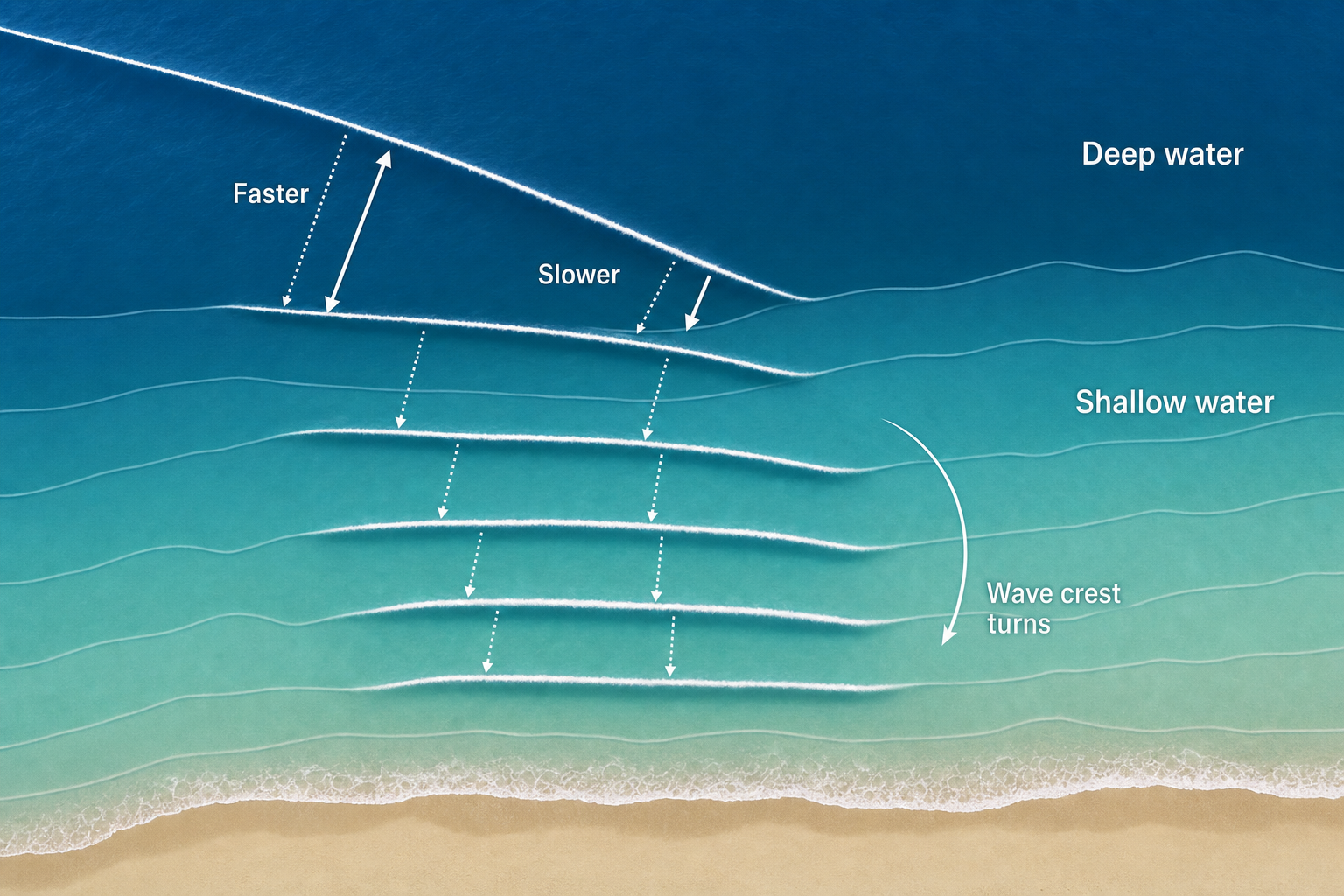
Refraction can make swell wrap into a bay, bend around a point, or focus onto a reef. It can also make swell appear to arrive from a different direction near shore than it did offshore. Long-period swell refracts more strongly because it interacts with the bottom in much deeper water.
Focusing and Defocusing by Bathymetry
Some underwater features focus swell energy. A submarine canyon, curved reef, or abrupt shelf can bend wave energy together, making one spot noticeably larger than nearby breaks. Other features defocus energy by spreading it out, which reduces wave size.
This is why surf can vary dramatically over short distances. Two beaches may face the same direction, but one may sit in the path of concentrated swell energy while the other lies in a zone where that energy has dispersed.
Reefs, Sandbars, and Swell Direction
Reefs and sandbars shape the final breaking wave. The swell direction determines where the wave first touches the bottom and how the breaking section travels across the shallow feature.
A swell that hits a reef at the right angle can produce a long, tapered wall. A swell that hits too square may break all at once. A swell approaching from the wrong side can miss the best part of the reef or create a fat, weak shoulder with little power.
How Swell Direction Affects Lefts, Rights, Peaks, Wedges, Closeouts, and Barrels
Swell direction does more than influence wave size. It changes the actual shape of the surf. The same break may produce long rights on one swell angle, short lefts on another, and heavy closeouts on a third.
Swell Direction and Lefts
A left is a wave that breaks to the surfer’s left while riding. Swell direction affects lefts by controlling how the wave line meets the reef, sandbar, or point. At some breaks, a more southerly swell approaches at the perfect angle to peel left along a reef. At others, a westerly swell wraps around a headland and creates a better left than a direct swell ever would. The ideal angle depends on the specific layout of the underwater feature and the coastline.
Swell Direction and Rights
A right breaks to the surfer’s right while riding. Rights often need the opposite angle from a nearby left, especially at reefs and points. A swell approaching from one side of the break may run down the line as a right, while a swell from the other side favors the left.
For point breaks, direction is often the key factor in whether the wave lines up at all. A right point may need the swell to wrap into it at just enough of an angle to create a peeling wall. Too much direct energy can make it sectiony, while too little angle leaves it weak.
Swell Direction and Peaks
Peaks form when a wave breaks both left and right from a central takeoff zone. They can be created by A-frame sandbars, reef shapes, or intersecting swell lines. Swell direction can shift the peak up or down the beach. A slightly different angle may turn an A-frame into a right-dominated or left-dominated peak. Mixed swell from two directions can also help generate peaks by breaking up long, uninterrupted lines.
Swell Direction and Wedges
A wedge forms when incoming swell combines with reflected or refracted energy. This often happens near jetties, harbor walls, or angled reefs. The swell strikes a feature, rebounds or bends, then intersects with the next incoming wave to create a steeper, amplified peak.
Wedges are highly angle-dependent. If the swell direction is too straight, the reflected energy may not meet the incoming wave properly. If it is too angled, the energy may miss the reflecting feature entirely. When the angle is right, the combined energy can produce an unusually steep and powerful takeoff.
Swell Direction and Closeouts
Closeouts happen when a wave breaks across too much of its length at once, leaving no open shoulder. Swell direction is one of the main causes. A direct swell hitting a straight beach can produce long, uniform lines that shut down completely. A slight angle can improve the shape by causing one section to break slightly before another. Too much angle, however, can make the wave race too quickly along the sandbar.
Swell Direction and Barrels
Barrels form when the lip throws out over a hollow section of the wave face. Direction matters because it controls how the swell meets the shallowest and most critical part of the reef or sandbar. At a reef pass or ledge, the right swell angle makes the wave stand up sharply and peel across the shallow section. A swell that is too square can produce heavy, unmakeable closeouts. A swell that is too angled may run too fast or bypass the steepest part of the reef altogether. Choosing the right surfboard fin set for the conditions can also make a real difference when navigating fast, hollow waves like these.
Why Some Surf Spots Need Very Specific Swell Direction
Some breaks work across a broad range of swell directions. Others need a narrow window. A spot may only produce quality waves on a swell from 205 to 215 degrees, with anything outside that range delivering completely different and often inferior surf.
This sensitivity usually comes from a combination of exposure, bathymetry, and coastal shape. A reef may only break properly when the swell hits one ledge before another. A point may need just enough wrap to line up without losing too much energy. A beachbreak may need a slight angle to prevent closeouts but not so much that the waves become small and weak.
Narrow Swell Windows
A narrow swell window occurs when a spot is blocked on either side by land or underwater features, forcing the swell to thread through a specific opening to reach the break. This is common in island chains, bays, and coastlines with prominent headlands. It can also result from offshore reefs or shallow shelves filtering out certain directions. When the correct angle arrives, the spot can look dramatically better than everything nearby. A pair of compact binoculars is handy for reading wave quality from a distance when you are trying to decide whether the angle has lined up before paddling out.
Direction Changes During a Swell Event
Because swell direction shifts throughout an event, some spots only come alive during a specific window. A reef might be too westerly in the morning, perfect when the swell trends west-southwest, then too southerly by evening.
This is why experienced forecasters track not just swell height and period but the directional trend as well. A modest swing in angle can be the difference between average surf and a rare window of genuinely excellent waves.
What Is a Swell Magnet?
A swell magnet is a surf spot that consistently picks up more swell than nearby breaks. It may be bigger, more consistent, or simply exposed to a wider range of swell directions than surrounding beaches. Swell magnets are especially valuable in weak swell conditions because they can turn a small forecast into something rideable. Being a swell magnet does not guarantee good waves, though. Some magnets catch plenty of swell but struggle with shape, particularly when the energy is too direct or the sandbars are uneven.
What Makes a Surf Spot a Swell Magnet?
The most obvious factor is exposure. A beach facing directly into the dominant swell direction will catch more energy than beaches tucked around a corner. Bathymetry can also create a swell magnet effect. Submarine canyons, offshore reefs, and deep-water channels can funnel wave energy toward one area, concentrating it at a single break.
Deep water close to shore also helps. Swell arriving over a deep nearshore bottom loses less energy than swell forced to cross a wide, shallow shelf. This is one reason why certain island breaks and steep coastal cliffs can be so consistent even when the overall swell forecast appears modest.
A spot may also be a directional swell magnet, meaning it excels at catching swells from one direction while being average on others. The better question is not simply whether a spot is a swell magnet, but which swell directions it attracts most effectively.
Swell Shadowing: Why Some Spots Are Smaller Than the Forecast
Swell shadowing happens when an obstacle blocks or weakens incoming wave energy before it reaches a surf spot. The forecast may show plenty of swell offshore, but the beach sits in the shadow of an island, cape, underwater reef, or shallow shelf.
Island Shadowing and Swell Direction
Islands can block swell much like a wall blocks wind. If a surf spot lies directly behind an island relative to the incoming swell, the island can reduce wave size dramatically. The extent of the shadow depends on the island’s size, the swell angle, and the swell period. Long-period swell can sometimes bend around island edges through refraction, while shorter-period swell tends to remain blocked. A small shift in swell direction may move a beach from deep shadow into partial or full exposure.
Capes, Headlands, and Coastal Shadowing
Capes and headlands act as directional filters. A beach tucked behind a point may be sheltered from north swell but fully open to west swell, while a beach around the corner has the opposite exposure. This is why coastline maps are so useful for surf forecasting. By tracing a line from your surf spot out to sea in the direction of the incoming swell, you can often see whether any land mass is intercepting part of the swell window. A reliable orienteering compass is a practical tool for doing this kind of directional analysis in the field.
Reef and Bathymetric Shadowing
Offshore reefs and shallow banks can remove energy from a swell before it reaches the inside break. Waves may break on the outside feature, refract away, or lose organization crossing shallow water. Bathymetric shadowing can be subtle because the obstacle is underwater and invisible from the beach. A spot may look perfectly exposed on a surface map but still be smaller than expected because an offshore shelf has redirected or absorbed part of the swell. This is another reason that knowing how to read a nautical chart pays off for serious surf forecasters.
Continental Shelves and Swell Direction
Wide continental shelves can alter swell direction and reduce energy before waves reach the shore. As swell travels over gradually shallowing water, it refracts, slows, and loses some of its organization. The effect is strongest when the swell crosses the shelf at an oblique angle, or when the period is long enough for the wave to feel the bottom far offshore. Coastlines with deep water close to shore receive swell with much less energy loss, which is one reason certain island spots and steep coastlines can be so consistent even when offshore swell readings appear modest.
How to Use Swell Direction in a Surf Forecast
To use swell direction effectively, start by learning the swell window of each spot you surf regularly. Note which directions produce size, which angles create good shape, and which directions are blocked by land or bathymetry. Over time, these patterns become more useful than the raw numbers in any forecast.
Compare Swell Direction With the Coastline
Look at the beach or reef on a map and identify which direction it faces. Then compare that orientation with the incoming swell. If the swell is aimed squarely into the spot’s window, expect more size. If the angle is marginal, expect smaller or less consistent waves. Keeping a waterproof notebook in your gear bag lets you jot down observations at the beach without worrying about moisture or spray.
Check for Shadowing
Look offshore for islands, headlands, and shallow banks. A swell may be strong in deep water but partially blocked before reaching the beach. Pay particular attention to swells arriving from near the edge of a spot’s window, as those angles are most vulnerable to shadowing. A handheld anemometer can also help you assess wind direction on the spot, since offshore winds can significantly affect wave quality once the swell arrives.
Watch the Directional Trend
Do not treat swell direction as a fixed number. Most swell events rotate through an angle range over their duration. If a spot needs a specific direction, the best surf may only occur during a short window when the angle lines up with the reef, point, or sandbar. Being aware of that trend lets you time your session rather than showing up randomly.
Match Swell Direction With Period and Size
Swell direction never works in isolation. Period affects how strongly the swell refracts, and size affects which features start breaking and at what intensity. A direction that is ideal at four feet may become too heavy or too uniform at double that size. The best forecasts combine swell direction with period, height, local wind, and tide. Direction tells you where the energy is coming from, but the final wave is the result of how all those variables interact with the coast.
If you like filming sessions to review how swell direction affected the waves, a waterproof action camera paired with a high-capacity microSD card lets you capture full sessions without running out of storage. And if you are checking forecasts from the beach on your phone, a waterproof phone pouch will protect your device from spray while you scout the lineup.
Swell direction is the link between distant storms and the waves that break at your local spot. It explains why one beach is flat while another is overhead, why a point suddenly switches on, and why a reef may need a precise angle to produce its best barrels. Once you understand how swell angle works together with shoreline orientation, bathymetry, and shadowing, surf forecasts become far more actionable. Instead of simply asking how big the swell is, you can ask the more useful question: is it coming from the right direction for the wave you actually want to surf?